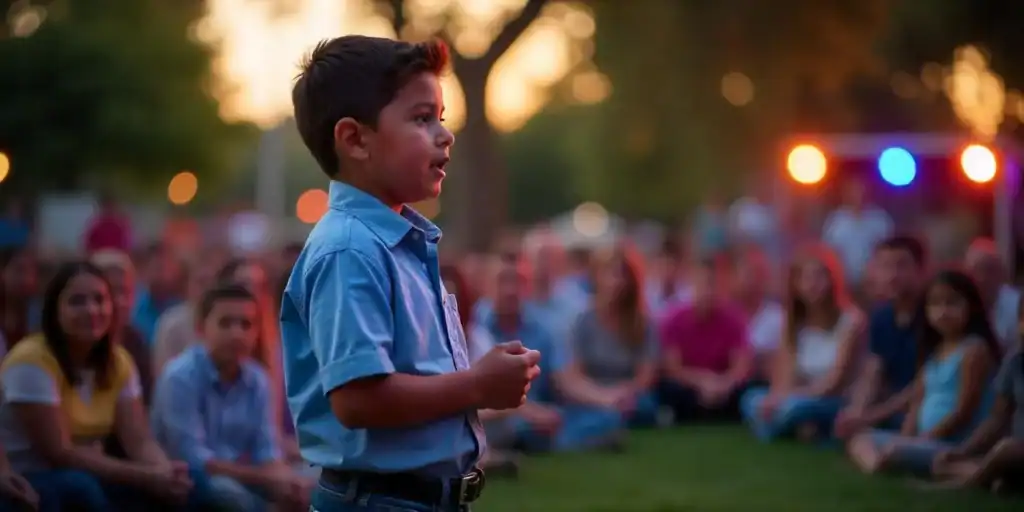

At home, eight-year-old Leo is an absolute force of nature. He routinely narrates elaborate space battles across the living room rug, performs spot-on impressions of the family dog, and speaks with an infectious, booming enthusiasm that fills every corner of the house. But last week, when his teacher asked him to stand in front of his third-grade class and share a simple weekend recap, something shifted dramatically. Leo froze. His hands shook visibly, his face flushed a deep crimson, his eyes darted to the floor, and his voice dropped to an inaudible whisper. For parents, watching a vibrant, expressive, and passionate child instantly retreat into a shell when facing an audience can be incredibly baffling, frustrating, and painful. This sudden, paralyzing transformation is a classic manifestation of stage fear in kids, a common yet deeply misunderstood developmental hurdle that affects millions of children globally.
Many parents naturally assume that a child who is articulate and talkative within the comfort of the family home will seamlessly translate that comfort into public settings. However, speaking in front of others requires an entirely different set of emotional, psychological, and physiological tools. When a child transitions from the safe, predictable, and non-judgmental environment of the living room to the formal, structured scrutiny of a classroom, school assembly, or social gathering, their internal security system can register the change as an immediate threat. To help children overcome this challenge, we must first deeply understand the root causes.
Understanding why this transformation occurs is the first crucial step in helping your child build lasting social confidence, emotional resilience, and communication confidence for kids.
What Is Stage Fear in Kids?
Stage fear, professionally recognized within educational psychology as a localized form of performance anxiety or public speaking anxiety, is far more than just a fleeting case of “butterflies” before a performance. It is an intense, inhibitory emotional and physical response triggered by the prospect of performing, speaking, or being evaluated before a group of people. While almost every child experiences a healthy, temporary surge of nervousness before a major school play or sports competition, true stage fear is persistent, deeply distressing, and actively disruptive to a child’s normal academic and personal routine.
From an educational psychology researcher’s perspective, the primary difference lies in how the child processes the experience internally. Normal developmental nervousness is adaptive; it sharpens the senses, floods the body with a manageable amount of adrenaline, and typically fades within the first few moments of speaking or performing. Conversely, deep-seated anxiety triggers a profound “fight-or-flight” response in the child’s autonomic nervous system.
The brain’s amygdala perceives the eyes of peers and adults not as a friendly audience, but as a collective biological threat. This psychological hijack makes rational thought difficult, blocks verbal memory access, causes throat muscles to constrict, and creates an overwhelming, primitive urge to flee the situation entirely. Recognizing this distinction helps parents move away from feelings of impatience and instead move toward empathetic, highly structured support systems.
Signs Your Child May Be Struggling With Public Speaking Anxiety
Identifying public speaking anxiety isn’t always straightforward or apparent. Children do not always possess the emotional vocabulary or self-awareness to tell an adult, “I feel completely overwhelmed by the fear of judgement right now.” Instead, their underlying performance anxiety manifests through subtle or overt behavioral changes, physical ailments, and chronic emotional avoidance patterns. As a parent or educator, recognizing these signs early prevents the anxiety from becoming a deeply ingrained facet of their identity.
To help clarify how stage fear presents itself compared to typical childhood shyness or minor pre-performance jitters, consider the structured behavioral indicators outlined below:
| Category | Typical Developmental Nervousness | Persistent Stage Fear / Anxiety |
|---|---|---|
| Behavioral Responses | Fidgeting slightly with clothing before starting, shifting weight, but visibly warming up and engaging within a minute or two. | Actively avoiding participation entirely; consistently refusing presentations, volunteering to go last, or feigning severe illness to stay home from school on presentation days. |
| Vocal Characteristics | Speaking a bit fast initially due to excitement, stumbling over a word, then stabilizing into a natural, audible conversational rhythm. | Speaking very softly, mumbling into the chest, utilizing a completely flat, monotone delivery, or losing their voice entirely due to acute psychological throat constriction. |
| Physical Symptoms | A brief, manageable feeling of butterflies in the stomach or cold hands that disappears once the task begins. | Severe stomach aches, nausea or vomiting, trembling hands and knees, visible sweating, dizziness, hyperventilating, or experiencing a racing heart hours or days before speaking. |
| Emotional Signs | Expressing mild concern about doing a good job, wanting to make parents or teachers proud, but remaining optimistic. | Crying intensely or having full panic attacks before performances, prolonged sleep disturbances days prior, and deep expressions of inadequacy or worthlessness. |
If these symptoms frequently or predictably occur before your child is expected to share, speak, or perform in front of others, they are likely navigating severe performance anxiety rather than simple shyness. Expecting them to just “get over it” without help can cause them to build complex, lifelong avoidance mechanisms that severely limit their educational and personal potential throughout their formative child development years.
Why Some Kids Fear Speaking in Public
Stage fear does not emerge overnight or in a vacuum. It is almost always a complex, multi-layered weave of cognitive development, environmental influences, past socialization, and a child’s unique biological and neurological wiring. To truly support your child, we must look past the superficial, unhelpful label of a “shy child” and deeply dissect the underlying psychological roots of their intense fear of speaking in front of others.
Fear of Being Judged
As children grow, particularly during the transition from early childhood to middle childhood (between the ages of 7 and 11), they undergo a massive cognitive shift. They develop the capacity for advanced metacognition—the ability to think about what other people are thinking. While this milestone is essential for empathy, it introduces a painful vulnerability: a hyper-awareness of peer evaluation.
A child standing at the front of a classroom suddenly realizes that dozens of pairs of eyes are analyzing their appearance, their words, their accent, and their ideas. This acute fear of judgement can completely freeze their expressive capabilities, as they assume their peers are actively looking for reasons to reject, criticize, or ridicule them. They lack the adult context to realize that most of their peers are actually preoccupied with their own anxieties.
Negative Past Experiences
The human brain is fundamentally an efficient pattern-recognition engine, evolutionary designed to protect us from physical and emotional discomfort. If a child experienced even a single public speaking stumble in the past—such as forgetting a line during a kindergarten recital, dropping a prop, mispronouncing a word, or being chuckled at by a single classmate—their brain flags the front of the room as unsafe.
Consider the case of Sarah, a bright ten-year-old who mispronounced the word “island” during a reading circle in second grade. The brief, harmless laughter from her classmates was processed by her sensitive emotional core as a massive social trauma. Years later, her subconscious mind still actively sabotages her presentation skills tasks because it directly links the front of the classroom with acute public humiliation and emotional pain.
Perfectionism and High Expectations
We live in a hyper-competitive culture that frequently rewards flawless outcomes while ignoring the messy process of learning. Highly intelligent, conscientious, and empathetic children are particularly susceptible to an internal drive for perfectionism. When a child believes that their performance must be absolutely flawless to be valuable or acceptable, the emotional stakes of public speaking become impossibly high. They fall prey to cognitive distortions like all-or-nothing thinking: “If I stammer, mispronounce a word, or lose my place, I am an absolute failure.” This rigid mindset turns a simple school presentation into an existential emotional gamble, forcing the child to choose retreat and silence rather than risk an imperfect attempt.
Limited Speaking Opportunities
Public speaking is not an innate talent that children are magically born with; it is a highly complex motor, cognitive, and social skill. In an era heavily dominated by text-based communication, digital devices, and passive streaming entertainment, many modern children suffer from a chronic lack of structured communication development opportunities.
When a child rarely practices articulating their thoughts, adjusting their volume, or maintaining eye contact in a safe, dynamic, and encouraging group setting, the mechanics of public speaking feel completely alien. Standing before a crowd without having developed basic public speaking skills for children is the psychological equivalent of being asked to play a complex piano concerto without ever being taught how to practice basic musical scales.
Comparison With Other Children
Children are highly astute observers of their immediate social ecosystems, particularly within the family structure. They constantly measure their own worth and capabilities against siblings or prominent classmates. Imagine a household where an older sibling is a natural, effortless orator—routinely winning school debates, landing lead roles in theater productions, and effortlessly charming family guests at holiday gatherings.
This dynamic can provide an environment where the younger or more reserved child develops a deep, unspoken sense of inadequacy. They convince themselves that they can never match that impossible standard. This toxic internal comparison breeds an attitude of learned helplessness—”why should I even try?”—which significantly reinforces their public speaking anxiety and makes them retreat from the spotlight.
Naturally Reserved Temperament
Every single child enters the world with a distinct biological temperament and nervous system configuration. Shy children or introverted youngsters naturally possess a more reactive nervous system that registers environmental and social inputs—such as bright stage lights, crowded rooms, loud background noise, and direct social scrutiny—with much greater intensity than their extroverted peers. For a highly sensitive or naturally reserved child, the sheer volume of sensory and emotional stimuli involved in a public performance can induce immediate sensory overload. Their anxiety isn’t necessarily driven by a lack of desire to connect or share, but is rather a primitive, biological defense mechanism against overwhelming environmental input that their brain struggles to filter out.
Fear of Making Mistakes
In many traditional academic environments, mistakes are strictly penalized with lower grades, red ink, or public correction. This systematic conditioning over years causes children to view errors as catastrophic structural failures rather than natural, healthy components of the learning curve. When facing an audience, the cognitive load on a child increases exponentially, and the statistical likelihood of making a minor slip-up rises. The paralyzing fear of making mistakes causes children to over-monitor their own speech in real-time. This hyper-vigilance leads to unnatural pauses, physical stammering, sudden loss of breath, and eventually, the complete cognitive freezing associated with severe stage fear.
Pressure From Adults
Well-meaning parents, teachers, and coaches often inadvertently amplify a child’s performance anxiety through their own enthusiasm and high stakes. Phrases intended to motivate, such as, “Make sure you speak up clearly so everyone can hear you, we have incredibly high hopes for you today!” or “Don’t forget your lines, everyone is coming to watch you!” are frequently interpreted by a child as a conditional contract for parental affection and adult approval. The child internalizes the heavy idea that their standing, worth, and love within the family or classroom hinges entirely on a flawless public performance, raising their internal baseline stress levels to an unsustainable peak before they even step onto the stage.
How Stage Fear Affects Children Beyond Public Speaking
It is tempting for busy parents to view stage fear as an isolated, minor issue—something that only really matters on the rare occasions a child has to stand at a podium or deliver a formal school report. However, extensive child development research and educational observations reveal that unaddressed communication anxieties rapidly spill over into almost every single dimension of a child’s academic, social, and emotional life, leaving long-lasting scars if left untended.
When a child struggles with a fundamental lack of speaking confidence, their daily classroom participation drops significantly. They will purposefully and consistently avoid raising their hand to answer questions, ask for clarity, or join debates, even when they completely know the correct answers, out of an intense fear that the teacher’s follow-up attention will put them under an unwanted spotlight. Over time, this chronic lack of engagement severely hampers their academic confidence and performance, as educators may easily mistake their prolonged silence or reluctance for a lack of basic comprehension, preparation, or intellectual effort.
Socially and emotionally, the long-term ramifications are equally profound. A child who fears authentic self-expression often struggles to navigate complex playground dynamics, step into vital leadership opportunities during collaborative school projects, or robustly advocate for themselves when faced with peer pressure or bullying. This systemic, defensive retreat from social interactions lowers their overall self-esteem and drastically limits their capacity to form deep, resilient, and supportive friendships, as they constantly filter and suppress their authentic self out of a chronic, exhausting fear of negative evaluation from those around them.
What Parents Should Avoid Doing
When trying to guide a loved child through the painful throes of performance anxiety, our protective or ambitious parental instincts can sometimes lead us down deeply counterproductive paths. Knowing what to actively avoid doing is just as critical as mastering the strategies to help them heal and grow.
- Forcing Children Onto a Stage: The old-school, aggressive philosophy of “throwing them into the deep end to teach them how to swim” rarely, if ever, works for psychological anxiety. Forcing an intensely terrified child onto a stage or into a public spotlight without proper coping mechanisms often results in severe emotional sensitization. This process actively deepens the fear, traumatizes the nervous system, and permanently links public communication with intense panic.
- Comparing Siblings or Outgoing Peers: Saying seemingly innocent things like, “Look how effortlessly your younger sister handles the crowd, why can’t you just stand up and do that?” is deeply damaging. It immediately breeds intense sibling resentment, erodes foundational self-esteem, and reinforces the toxic idea that they are fundamentally broken or disappointing to the family.
- Criticizing Mistakes Post-Performance: Nitpicking a child’s physical posture, speaking volume, eye contact, or nervous pacing immediately after they have braved an audience completely invalidates their immense courage. They will remember the sharp sting of parental criticism far longer than any generic, half-hearted praise you offer afterward.
- Expecting Instant, Overnight Confidence: Sustainable confidence building is an inherently non-linear, slow developmental process. Expecting a child to attend a single weekend workshop or read an educational book and instantly transform into a charismatic, fearless public speaker sets an unrealistic, toxic standard that inevitably leads to profound mutual frustration and shame.
Practical Ways to Help a Child Overcome Stage Fear
Fortunately, stage fear is entirely treatable and reversible. Overcoming public speaking anxiety requires a consistent, gentle, and highly structured intervention approach. By thoughtfully integrating small, intentional confidence-building routines into your family’s daily life, you can systematically rewire your child’s physiological response to public speaking and cultivate a genuine love for authentic self-expression.
1. Implement Incremental Micro-Challenges: Avoid jumping straight from complete isolation to large, intimidating public audiences. Start by deliberately creating ultra-safe, low-stakes micro-speaking opportunities directly at home. Ask your child to stand up at the dinner table and enthusiastically tell a two-minute story about their favorite cartoon character, or have them read a single exciting paragraph of a storybook aloud to a couple of trusted family members. This proven psychological process of systematic desensitization builds neurological comfort step by step, showing the brain that speaking while standing is safe.
2. Transform Daily Family Conversations into Active Skills Practice: Encourage intentional communication development during standard, ordinary daily routines. Ask open-ended, engaging questions like, “What were the three most surprising or funny things that occurred at school today?” rather than close-ended questions that yield flat, one-word answers. This simple habit consistently trains their developing brain to quickly organize thoughts sequentially, select descriptive vocabulary, and speak with real vocal intent and emotional clarity.
3. Shift the Family Focus to Positive Reinforcement of Effort: Praise their underlying effort, emotional courage, and specific behavioral actions rather than focusing entirely on flawless outcomes. Instead of offering hollow praise like, “You were absolutely perfect up there,” try utilizing specific validation: “I love how bravely you stepped up to the microphone today, and your voice was incredibly clear and strong during the first three sentences.” This reinforces the exact actions within their direct control and dramatically lowers the paralyzing weight of perfectionism.
4. Engage in Playful, Creative Storytelling Activities: Make verbal communication highly entertaining through low-stakes, interactive family games. Play games like “Pass the Story,” where one family member begins an imaginative tale with a single sentence, and the child must immediately invent the next sentence on the spot. This practice rapidly develops spontaneous thinking, sparks joyful creativity, and systematically diminishes the paralyzing fear of making mistakes in front of others by framing verbal stumbles as hilarious plot twists.
When Professional Guidance Can Help
While home-based support and parental empathy provide a truly wonderful and essential foundation, some children require a more specialized, peer-driven environment to completely break through deeply entrenched performance anxiety patterns. If your child’s intense fear is causing them to actively withdraw from standard school events, experience a noticeable drop in academic grades, avoid social interactions, or experience persistent physical symptoms like stomach aches and sleeplessness before routine tasks, it is an ideal time to seek specialized, professional support.
Professional communication coaching designed specifically for youth provides a unique, highly encouraging community of peers who are navigating similar hurdles. In a structured, non-judgmental laboratory setting, children learn the hard, physical mechanics of public speaking—including vocal projection, expansive body language, conscious audience engagement, breath control, and internal anxiety-management techniques—through playful, evidence-based methodologies. This guided, positive exposure helps them replace their old, painful fear patterns with fresh, empowering memories of social confidence, personal agency, and clear communicative achievement.
Conclusion
Navigating the complex realities of stage fear in kids can frequently feel like an exhausting, uphill battle for any dedicated parent, but it is deeply important to remember that confidence is absolutely not a fixed, genetic trait that children are either permanently born with or without. Rather, public speaking confidence is a dynamic, highly trainable muscle—one that can be systematically nurtured, strengthened, and mastered over time with the right combination of parental patience, deep psychological understanding, and structured professional guidance.
By uncovering the precise, underlying reasons behind your unique child’s anxiety, establishing a supportive domestic environment completely free of toxic comparison, and consistently celebrating their small, courageous victories, you can effectively help them step out of the shadows of fear. Every single child inherently deserves to experience the profound, transformative joy of authentic self-expression and know with absolute certainty that their unique voice has the incredible power to inspire, connect, and shine bright in front of the world.