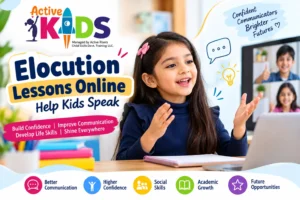

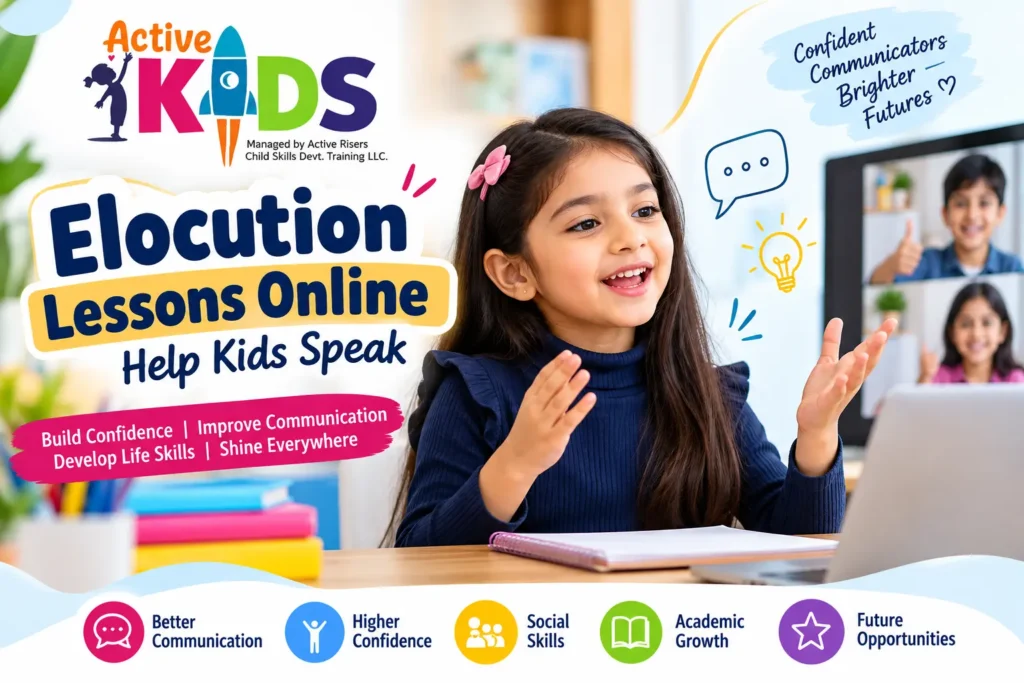
A child can know exactly what they want to say and still struggle to get the words out clearly. Maybe they speak too softly, rush through sentences, avoid eye contact, or freeze when a teacher asks them to present in front of the class. That is where structured elocution lessons online can make a practical difference.
Elocution is not about making every child sound the same. For children, it is about helping them speak clearly, use their voice with purpose, organise their thoughts, and become more comfortable expressing themselves. With the right format, online learning can give children regular speaking practice without making communication feel like another school subject.
What Are Elocution Lessons Online?
Elocution focuses on the way a person communicates through speech: pronunciation, articulation, pace, tone, pauses, expression, and overall delivery. For children, those skills connect naturally with classroom presentations, reading aloud, storytelling, conversations, competitions, and everyday confidence.
The online format simply changes where the learning happens. Instead of travelling to a centre, a child can join a live session from home, participate in guided activities, practise speaking, and receive feedback from an educator.
A useful elocution class should therefore be more than a video lesson. The best elocution lessons online give children a reason to speak, respond, perform, and improve during every session. Children need opportunities to speak, listen, respond, perform, and try again. That active practice is what turns a communication concept into a usable skill.
Why Elocution Lessons Online Can Work Well for Children
The online format is most useful when children are actively involved. In well-designed elocution lessons online, the screen is not the lesson; it is the space where the child speaks, listens, performs, receives feedback, and practises again.
For parents, this distinction matters. A library of recorded videos may teach information, but communication is a performance skill. Children need repeated opportunities to use it. A live online speech lessons format can provide that interaction when the teacher keeps the session participatory and age-appropriate.
The same principle applies to speech and drama for kids: children learn through doing. Reading a script, changing expression, responding to a prompt, presenting a short idea, or taking part in a role-play gives the child a concrete speaking task.
7 Powerful Ways Elocution Lessons Online Help Kids Speak
1. Clearer pronunciation and articulation
When children practise pronunciation and articulation deliberately, they become more aware of how they form sounds and words. That can make their speech easier for teachers, classmates, family members, and other listeners to follow.
Good practice is not about correcting every accent or making a child sound “perfect.” The goal is clarity. A child should be able to pronounce words comfortably and make their message understandable.
Activities such as reading aloud, sound drills, poetry recitation, and guided speaking tasks can give children repeated opportunities to work on clarity.
2. Better voice control and expression
A child who speaks every sentence at the same volume and pace can sound flat even when the idea is interesting. Elocution introduces children to voice modulation: changing pitch, pace, volume, tone, and pauses to match the meaning of what they are saying.
This becomes particularly useful in storytelling, presentations, drama, and poetry. A pause can create emphasis. A change in tone can show emotion. A slower pace can make an important point easier to understand.
These are practical speaking choices, not just performance tricks.
3. More confidence when speaking in front of others
Confidence usually grows through experience. Telling a child to “just be confident” does not give them that experience.
A structured programme can create small, repeatable speaking opportunities. A child might answer a question, read a short passage, perform a poem, explain an idea, participate in a discussion, or present to a small group.
Over time, these manageable experiences can make speaking feel less unfamiliar. Active Kids’ Speak & Shine programme, for example, combines elocution with speech, drama, and debate activities and includes virtual showcases as part of the learning journey. urlSpeak & Shine programmehttps://activekidsonline.com/speak-and-shine/
4. Stronger expressive speaking and storytelling
Speaking is not only about saying words correctly. Children also need to communicate meaning.
Storytelling activities encourage children to use expression, sequence ideas, describe situations, and keep a listener interested. They also give children a natural reason to practise vocabulary, pauses, tone, and body language.
This is one reason online speech lessons can be useful beyond formal speeches. A child who learns to tell a story clearly is also practising how to structure and communicate an idea.
For a broader look at the skills children can develop through elocution, see 7 powerful skills kids build through elocution lessons.
5. Better reading fluency
Reading aloud is closely connected with spoken communication. Children have to recognise words, pronounce them, maintain an appropriate pace, and use expression that matches the text.
Elocution practice can support these habits through guided reading, poetry, scripts, and performance activities. It can also help children become more comfortable hearing their own voice and adjusting their delivery.
For younger learners, these skills can sit alongside foundational language development. Active Kids also offers a Phonics Club designed around pronunciation, reading fluency, vocabulary recognition, and related language skills. urlPhonics Clubhttps://activekidsonline.com/phonics-club/
6. More organised and persuasive communication
As children get older, speaking tasks become more demanding. They may need to explain a viewpoint, answer an unexpected question, participate in a discussion, or defend an idea.
This is where elocution can overlap with debate and persuasive communication. Strong debate skills help children practise clear reasoning, structured answers, and confident delivery. Children learn that a strong answer is not simply a collection of words; it needs a clear thought, logical structure, and confident delivery.
Active Kids’ Speak & Shine programme includes debate activities where children practise structured discussions, arguments, rebuttals, and persuasive communication. urlSpeak & Shine: debate modulehttps://activekidsonline.com/speak-and-shine/
7. A safer way to practise before bigger speaking moments
Many children do not struggle because they lack ideas. They struggle because the first time they are asked to speak publicly is also the first time they have seriously practised.
Regular elocution training creates a rehearsal environment. Children can make mistakes, receive feedback, repeat an activity, and gradually improve.
That matters before a school presentation, speech competition, assembly, storytelling activity, debate, or stage performance. The objective is not to remove nervousness completely. It is to give the child enough practice that nervousness does not control the entire performance.
What Should a Good Online Elocution Programme Include?
Not every course labelled “elocution” will provide the same learning experience. Parents should look beyond the course title and check what children actually do during the sessions.
Look for:
· Live speaking practice: children should have regular opportunities to speak rather than only watch videos.
· Feedback: an educator should be able to identify issues with pronunciation, pace, expression, or delivery.
· Age-appropriate activities: a five-year-old and a fourteen-year-old should not be taught in exactly the same way.
· Progressive difficulty: activities should become more challenging as the child develops.
· Real speaking situations: presentations, storytelling, recitation, discussion, drama, or debate make skills easier to transfer outside class.
· Small-group interaction: children need opportunities to listen and respond to other speakers.
· Evidence of progress: showcases, assessments, feedback, or performance milestones can help parents understand development.
Active Kids describes its communication and elocution approach around live online sessions, age-appropriate teaching, guided participation, and skill-focused learning. Its Speak & Shine programme also lists small class sizes, two weekly classes, and virtual showcases. citeturn1view3turn1view4
If the programme also includes speech and drama for kids, check whether those activities are connected to communication goals rather than added simply for entertainment. Drama can be useful when it gives children practice with expression, listening, response, and audience awareness.
Elocution Lessons Online vs. Practising Alone at Home
Home practice still matters. In fact, children can improve faster when they practise between classes.
The difference is that independent practice does not always provide an outside perspective. A child may not notice that they rush through sentences, swallow certain sounds, speak too quietly, or use the same tone throughout a presentation.
A good combination is simple:
Learn → practise → receive feedback → repeat → use the skill in a real speaking situation.
Parents can support this by asking a child to read aloud for five minutes, record a short presentation, retell a story, or explain something they learned at school. The aim is consistency, not turning every evening into a lesson.
For additional ideas, you can also read 7 skills kids can learn from online courses and Mastering Elocution: A Comprehensive Guide to Effective Speaking for Kids.
How Parents Can Tell Whether Their Child Is Improving
Progress in speaking is not always visible through a test score. Parents can watch for small behavioural changes.
For example, your child may:
· answer questions with less hesitation;
· speak at a steadier pace;
· pronounce unfamiliar words more clearly;
· use pauses instead of rushing;
· look more comfortable during a presentation;
· explain an idea in a clearer sequence;
· use more expression while reading or telling a story;
· volunteer to speak more often.
These signs should be considered alongside the child’s age, personality, starting point, and learning environment. The purpose of an elocution class is not to create a single “ideal” speaking style. It is to help the child communicate more clearly and confidently in their own developing voice.
For parents specifically evaluating public speaking for kids, the strongest sign of progress is not whether the child sounds like an adult. It is whether the child communicates an idea more clearly, with less hesitation and more control than before.
Are Online Elocution Lessons Suitable for Children?
They can be, provided the programme is genuinely interactive and designed for the child’s age.
Online learning can work particularly well when the child has a quiet place to participate, a reliable internet connection, and an educator who actively involves learners rather than relying on passive video content.
Parents should also check the course structure. Good elocution lessons online should make the learning experience interactive rather than turning screen time into passive watching. For younger children, shorter activities and frequent interaction can help maintain attention. Older children may benefit from more complex presentations, debate, speech writing, and performance work.
Active Kids currently positions its online programmes for children aged 4–14, while Speak & Shine lists different course durations for younger and older age groups and uses small-group live classes. citeturn1view3turn1view4
How to Choose the Right Elocution Programme for Your Child
Start with the outcome you want. If your child mainly needs clearer pronunciation, look for a programme with strong articulation and reading practice. If the bigger challenge is stage confidence, look for presentations, drama, recitation, and performance opportunities. If your child enjoys arguing a point or explaining ideas, debate and structured discussion can add another useful layer. This is where debate skills become a practical extension of elocution.
Then check the practical details:
1. What age group is the programme designed for?
2. Are classes live and interactive?
3. How many children are in a class?
4. How often does the child speak during a session?
5. Does the educator provide individual feedback?
6. Are there showcases, presentations, or other performance opportunities?
7. Is the curriculum progressive rather than a collection of disconnected activities?
8. Can parents understand what their child is learning and how they are progressing?
Active Kids’ Elocution page explains its broader communication focus, while Speak & Shine gives more detail about its elocution, speech and drama, and debate modules. Parents can review both before deciding whether the programme matches their child’s needs. urlExplore Active Kids Elocutionhttps://activekidsonline.com/elocution/
If you are specifically looking for a programme that combines elocution with speech, drama, and debate, you can also explore Speak & Shine.
The Bottom Line
Good speaking is built through practice, feedback, and repeated opportunities to express an idea.
The value of elocution lessons online is not simply that a child learns to pronounce words more clearly. A well-structured programme can help children practise voice control, expression, reading fluency, storytelling, presentation, and confident communication in a consistent environment.
For parents, the key question is not “Will online lessons make my child a perfect speaker?” A better question is: Will this programme give my child meaningful opportunities to speak, receive feedback, and use those skills in real situations?
If the answer is yes, elocution can become a useful part of a child’s wider communication development.
At Active Kids, communication-focused programmes include Elocution, Speech & Drama, Debate, and related learning experiences for children. Parents interested in seeing how the approach works can start with the Speak & Shine programme or explore the broader Elocution for Children page.
Frequently Asked Questions About Elocution Lessons Online
What do children learn in elocution lessons?
Children can work on pronunciation, articulation, fluency, voice modulation, expression, pacing, reading aloud, presentation, and confident communication. The exact curriculum depends on the programme.
At what age can a child start elocution?
There is no single correct starting age. Younger children can begin with simple pronunciation, reading, expression, and speaking activities, while older children can handle presentations, debate, speech, and more advanced performance tasks.
Are online elocution lessons effective for shy children?
They can provide repeated, structured speaking opportunities in a familiar environment. Progress still depends on the child, teaching approach, consistency, and amount of active participation.
What is the difference between elocution and public speaking?
Elocution focuses heavily on how speech is delivered—clarity, pronunciation, articulation, pace, tone, and expression. Public speaking is broader and can include audience awareness, structure, persuasion, presentation skills, and handling questions. Good programmes may combine both.
Can elocution help with school presentations?
Yes, the underlying skills are directly relevant: clear speech, organised ideas, appropriate pace, expression, voice control, and confidence while addressing an audience.
How often should children practise?
Short, regular practice is generally more practical than occasional long sessions. A few focused minutes of reading aloud, storytelling, or speaking practice can reinforce what a child learns in class.