Menu
Being able to speak confidently can change how a child participates in class, presents an idea, joins a discussion, or simply talks to others. Our Public Speaking Classes for Kids are designed to help children develop clear speech, confidence, expressive communication, and the ability to share their thoughts without hesitation.
Through engaging online learning, children get opportunities to speak, listen, present, perform, and participate rather than simply watch a lesson.
Help your child take the first step towards becoming a more confident communicator.

Public speaking is more than standing on a stage and giving a speech.
For children, it is about learning how to organise their thoughts, choose the right words, speak clearly, use their voice effectively, and communicate an idea with confidence.
Good Public Speaking Classes for Kids should therefore go beyond memorising speeches. Children need regular opportunities to practise speaking in different situations — from presentations and storytelling to discussions, debates, and expressive performance.
At Active Kids, communication development is approached as a practical skill. Children learn through participation and guided activities that encourage them to express themselves, develop speaking confidence, and become more comfortable communicating their ideas.
The goal isn’t to make every child sound the same. It is to help each child find their voice and use it with greater clarity and confidence.
Some children have plenty to say but hesitate when it is their turn to speak.
Others may know the answer in their head but struggle to explain it clearly. Some become nervous during presentations, while others speak very quickly, quietly, or without enough expression.
These challenges can improve with consistent practice.
Developing public speaking skills can help children:
These skills are useful beyond the classroom too. A child who becomes comfortable expressing an opinion today is developing a foundation for communication, leadership, presentations, and everyday interactions in the future.
Children learn to express their thoughts clearly and communicate with greater confidence. Guided speaking activities give them opportunities to practise rather than worry about getting every word perfect.
Clear communication depends on more than vocabulary. Pronunciation, articulation, pace, voice modulation, and expression all influence how effectively a child communicates.
Presenting in front of others can feel intimidating. Regular practice helps children become more comfortable speaking to an audience and handling the attention that comes with presenting.
Children also benefit from learning how to develop an argument, listen to another viewpoint, respond appropriately, and communicate an opinion respectfully.
Storytelling encourages children to combine imagination with communication. It gives them a natural way to work on vocabulary, expression, sequencing, voice, and audience engagement.
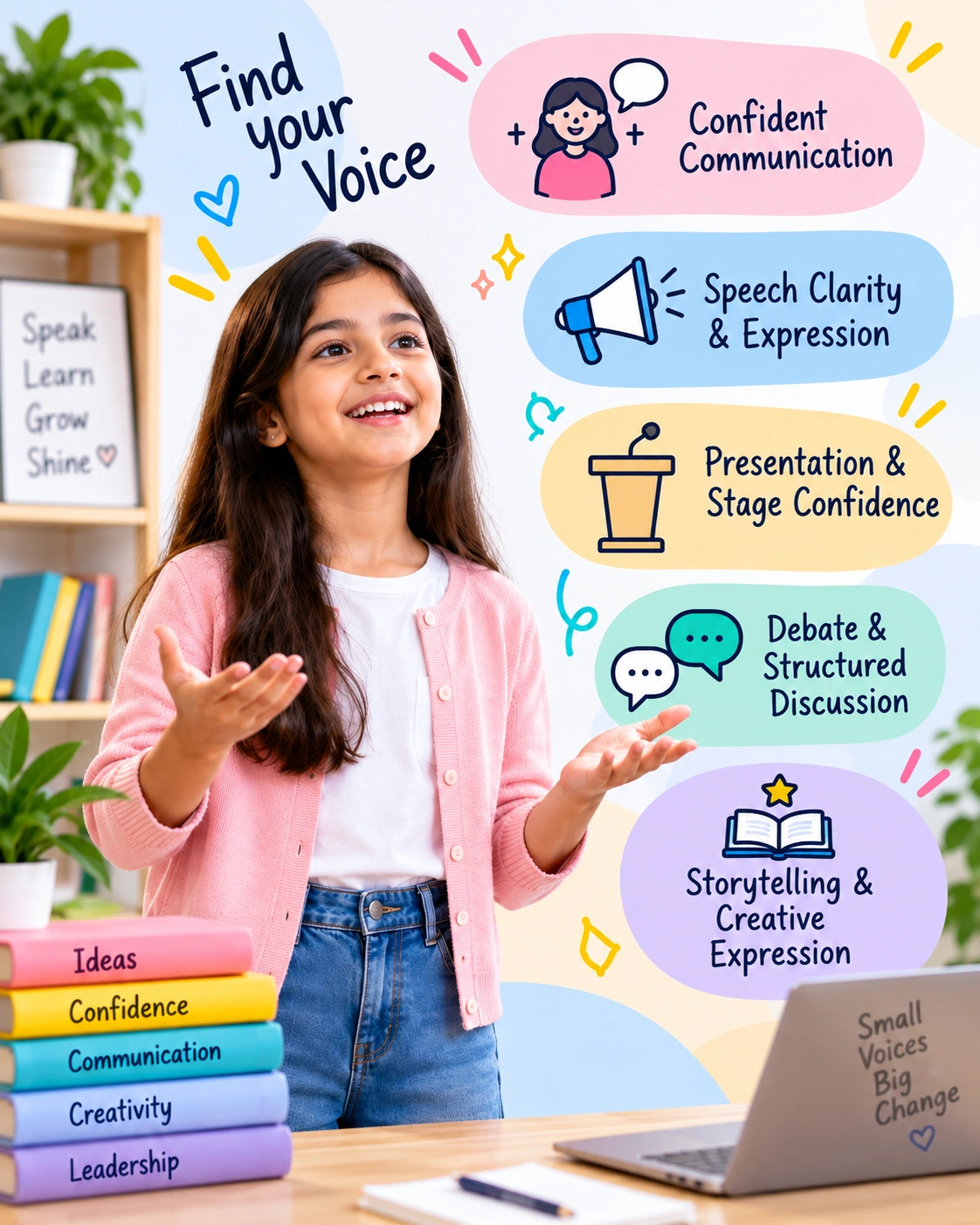
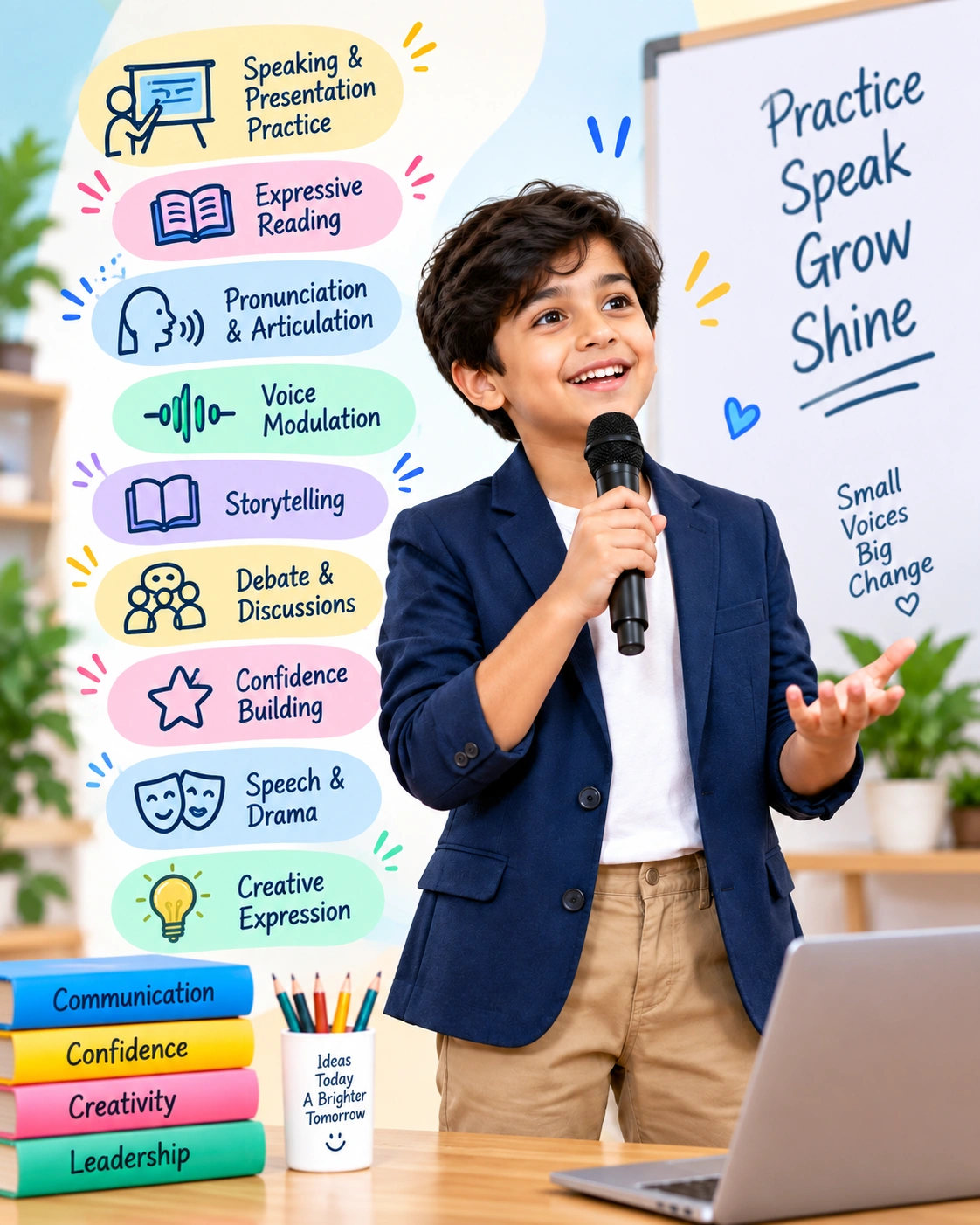
Children learn communication best when they are actively involved.
Our approach combines guided speaking activities with opportunities for children to practise communication in different forms. Instead of treating public speaking as a single skill, we work on the supporting abilities that help children become effective communicators.
This includes:
The focus is practical: helping children become more comfortable using their voice.

For parents looking for a structured Public Speaking Course for Kids, our Speak & Shine programme provides a natural pathway into communication development.
Speak & Shine brings together three important areas:
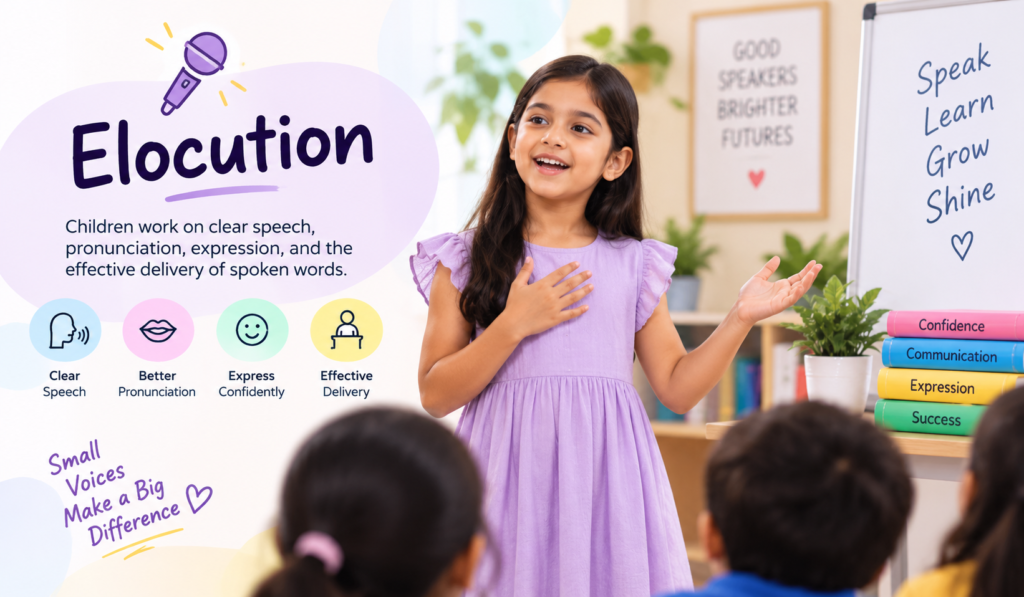
Children work on clear speech, pronunciation, expression, and the effective delivery of spoken words.
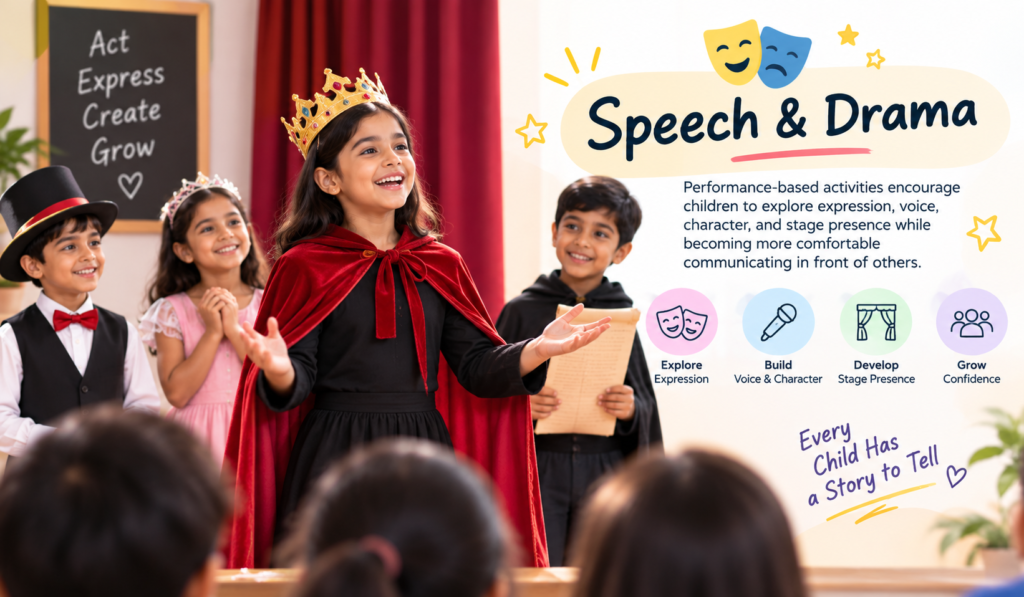
Performance-based activities encourage children to explore expression, voice, character, and stage presence while becoming more comfortable communicating in front of others.
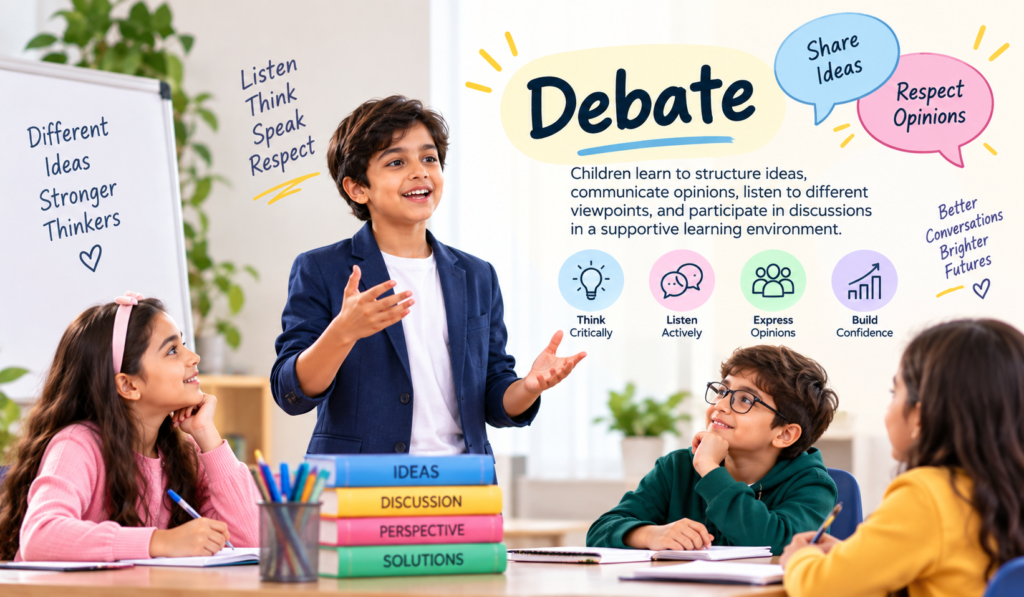
Children learn to structure ideas, communicate opinions, listen to different viewpoints, and participate in discussions in a supportive learning environment.
Together, these areas create a broader communication experience rather than focusing only on prepared speeches.
Parents don’t simply want their children to learn to speak.
They want to see a child who is more willing to raise their hand, explain an idea, participate in a discussion, present in front of classmates, or speak without immediately losing confidence.
That’s why our learning approach focuses on participation and skill development.
Children benefit from:
Our programmes are built around the core tenets of Trinity College London, aligning our practices and approach with international standards of speaking. Active Kids also provides opportunities such as online showcases to demonstrate learning and progress.
For interested students, communication development can also progress towards international certification in speech and drama through Trinity College London.
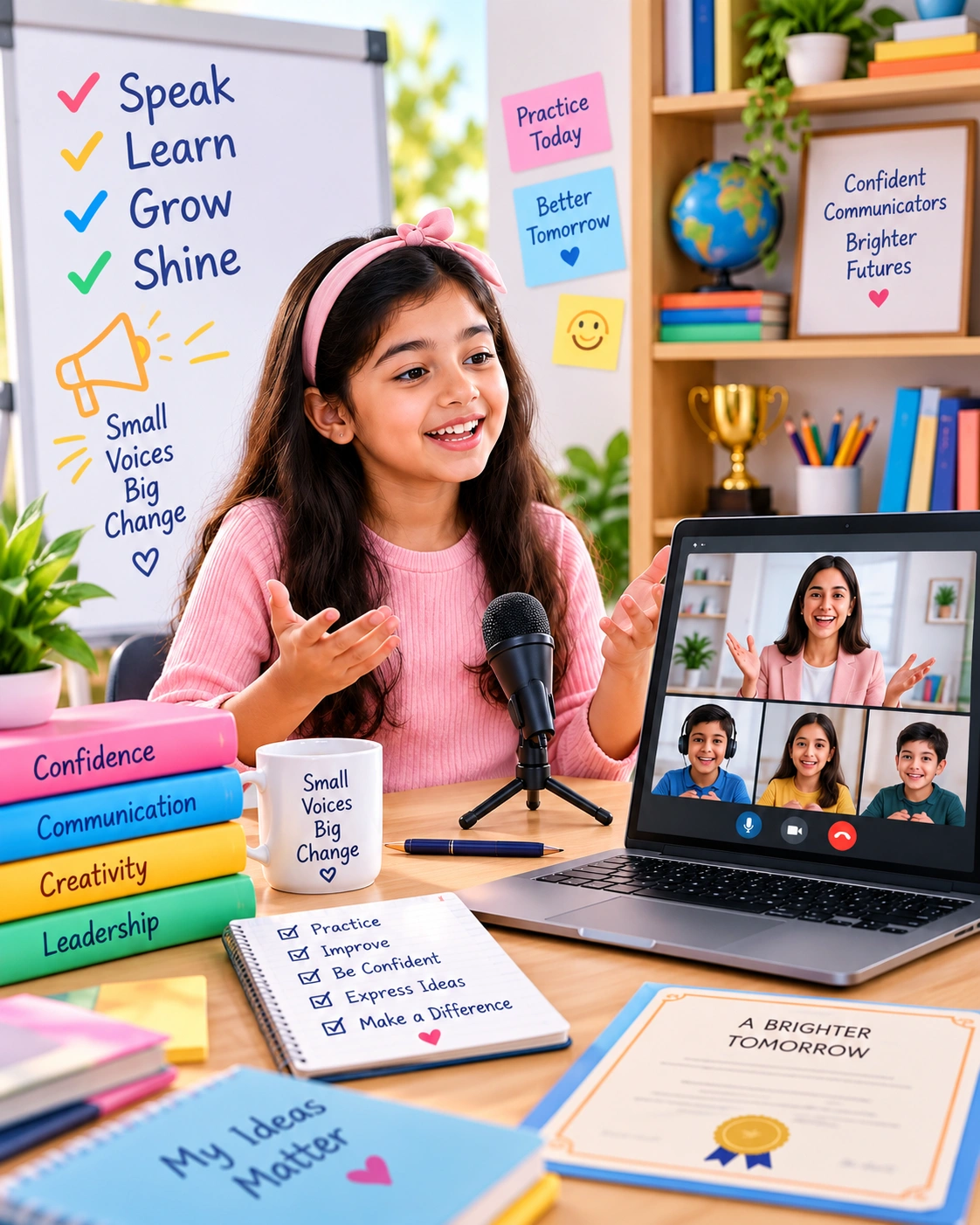
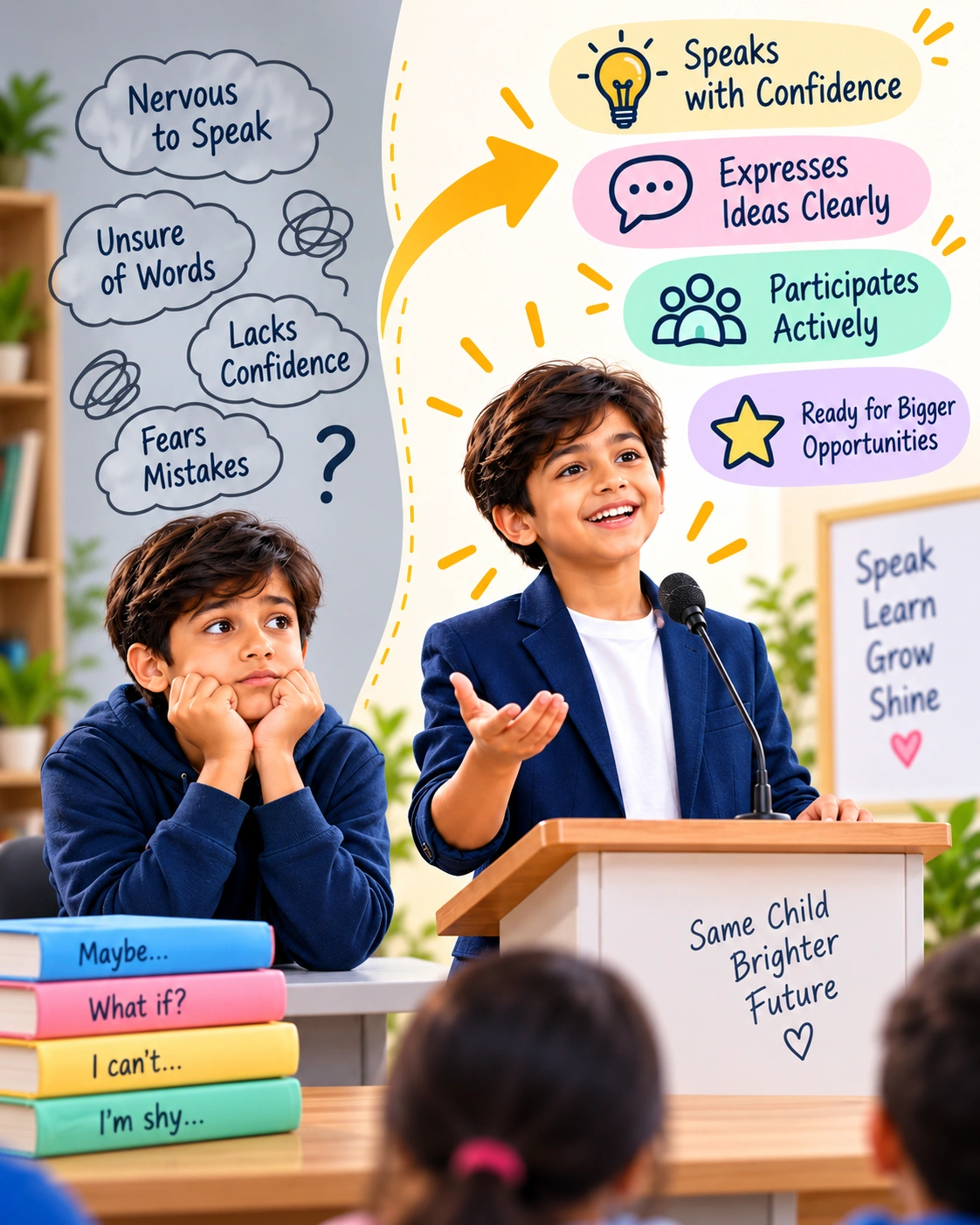
Public Speaking Classes for Kids can be valuable for children who:
A child does not need to already be confident to benefit from public speaking.
In many cases, the purpose of the programme is to help build that confidence gradually through practice.
Learning online does not have to mean sitting quietly in front of a screen.
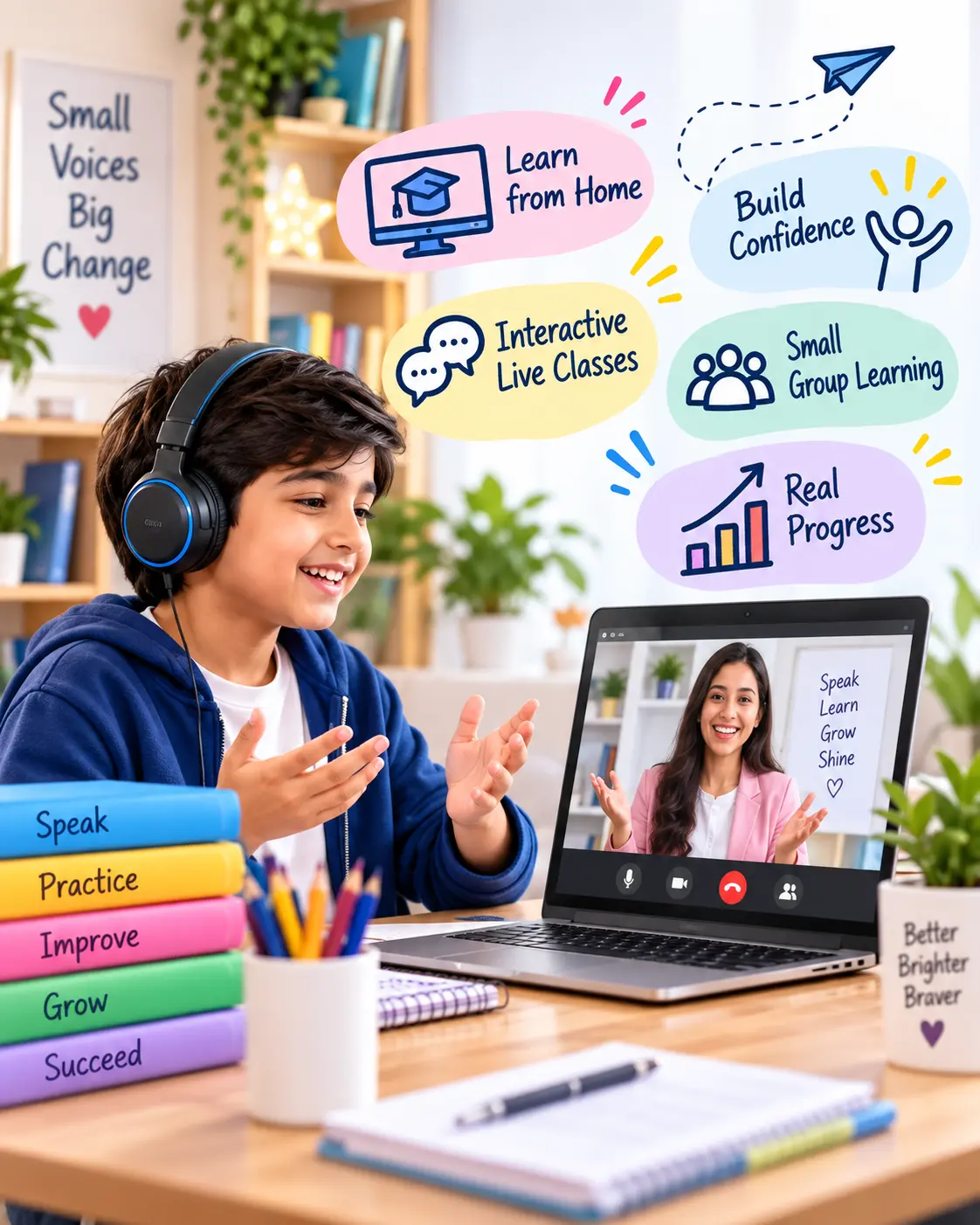
Well-designed online public speaking classes for kids can create a structured environment where children actively speak, participate, present ideas, respond to questions, and interact with their educators.
For families looking for flexible learning, online delivery can also make it easier to incorporate communication development into a child’s existing schedule.
At Active Kids, our online programmes are designed specifically for young learners and focus on interactive learning rather than passive screen time.
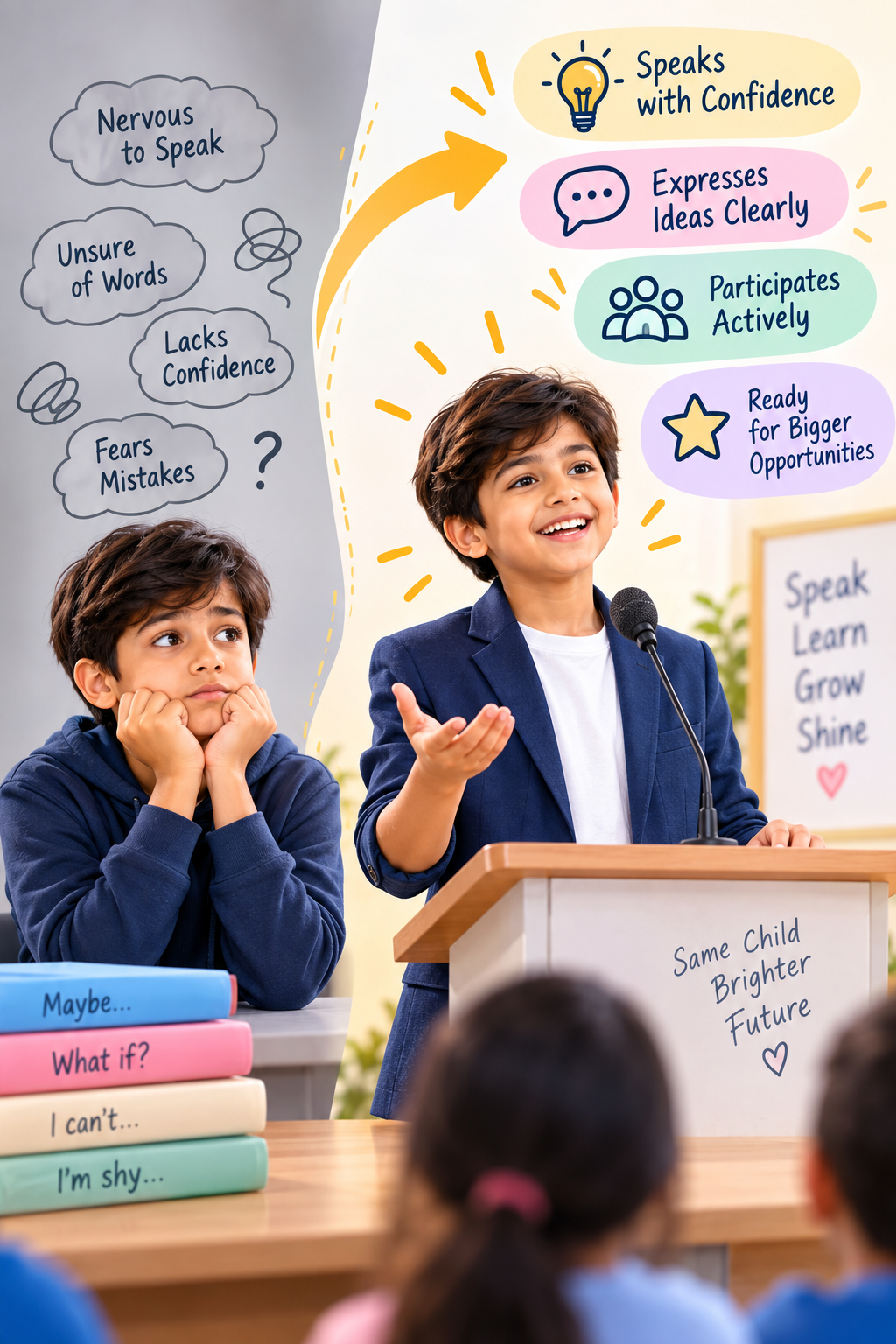
Confidence rarely appears overnight.
It develops when children get the opportunity to speak, make mistakes, try again, receive guidance, and gradually become more comfortable expressing themselves.
That is the purpose behind our approach to communication development.
Whether your child wants to become better at presentations, improve spoken English, explore debate and drama, or simply feel more confident when speaking, the right practice can make communication feel less intimidating and more natural.
Help your child develop stronger communication, clearer speech, expressive speaking, and greater confidence through engaging online learning.
Studies show that strong communication skills are directly linked to higher self-confidence, academic success, and leadership potential in children. At Speak & Shine, we nurture these essential skills through our core pillars—Elocution, Speech & Drama, and Debate—empowering every child to communicate with ease, clarity, and authentic connection in any setting.
In Module 1, your child will learn to this :
In Module 2, your child will learn to this :

In Module 3, your child will learn to this :

Tarannum Sheikh is a TED speaker, accomplished author, and educationist with nearly a decade of experience across India and the UAE. A seasoned communicator with over nine years in Toastmasters, Tarannum has delivered more than 100 impactful speeches, earning her a reputation as an inspiring and accomplished speaker
As the founder of Active Kids, a virtual academy with over 500 students, she has designed a transformative confidence-building program that empowers kids to speak with eloquence and impact. Tarannum’s mission is to help every child articulate their inner genius and thrive in an ever-evolving world.
Author, TEDx speaker, Trainer & Toastmaster
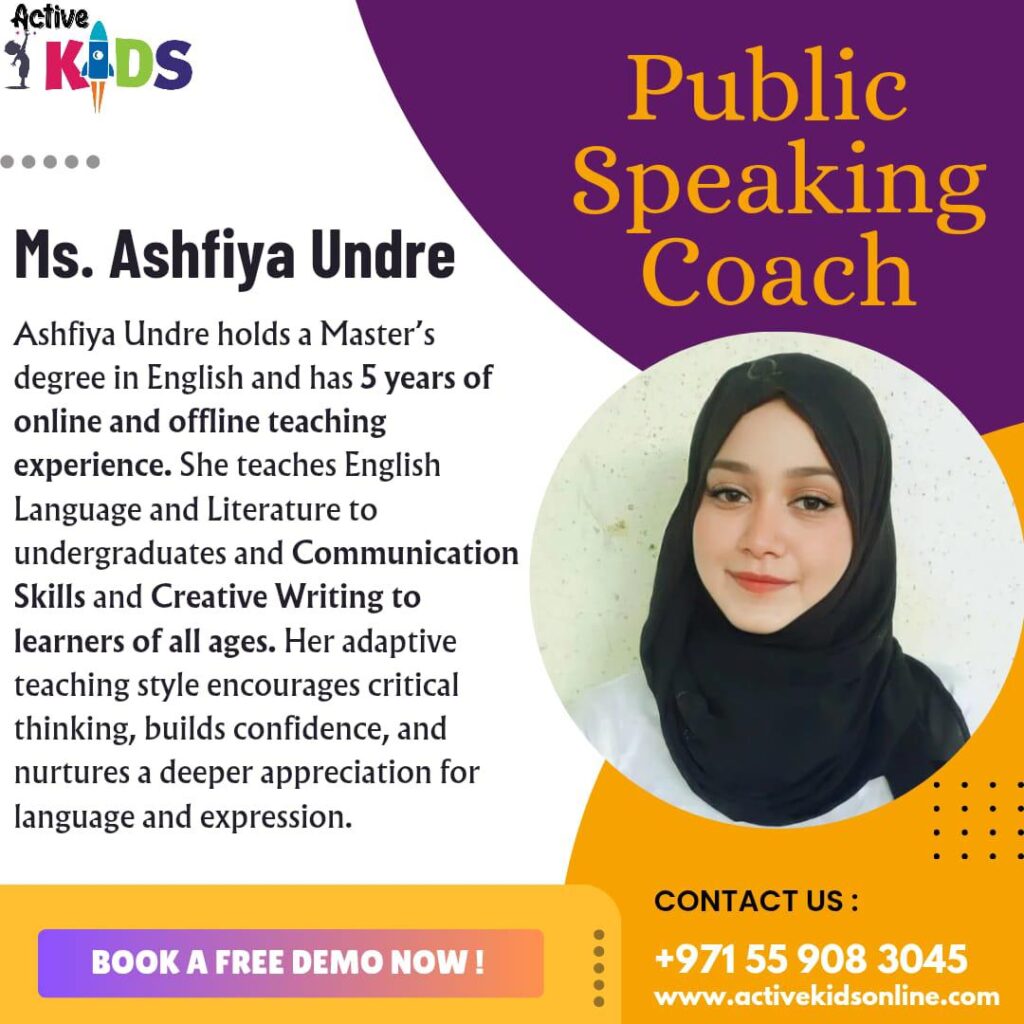
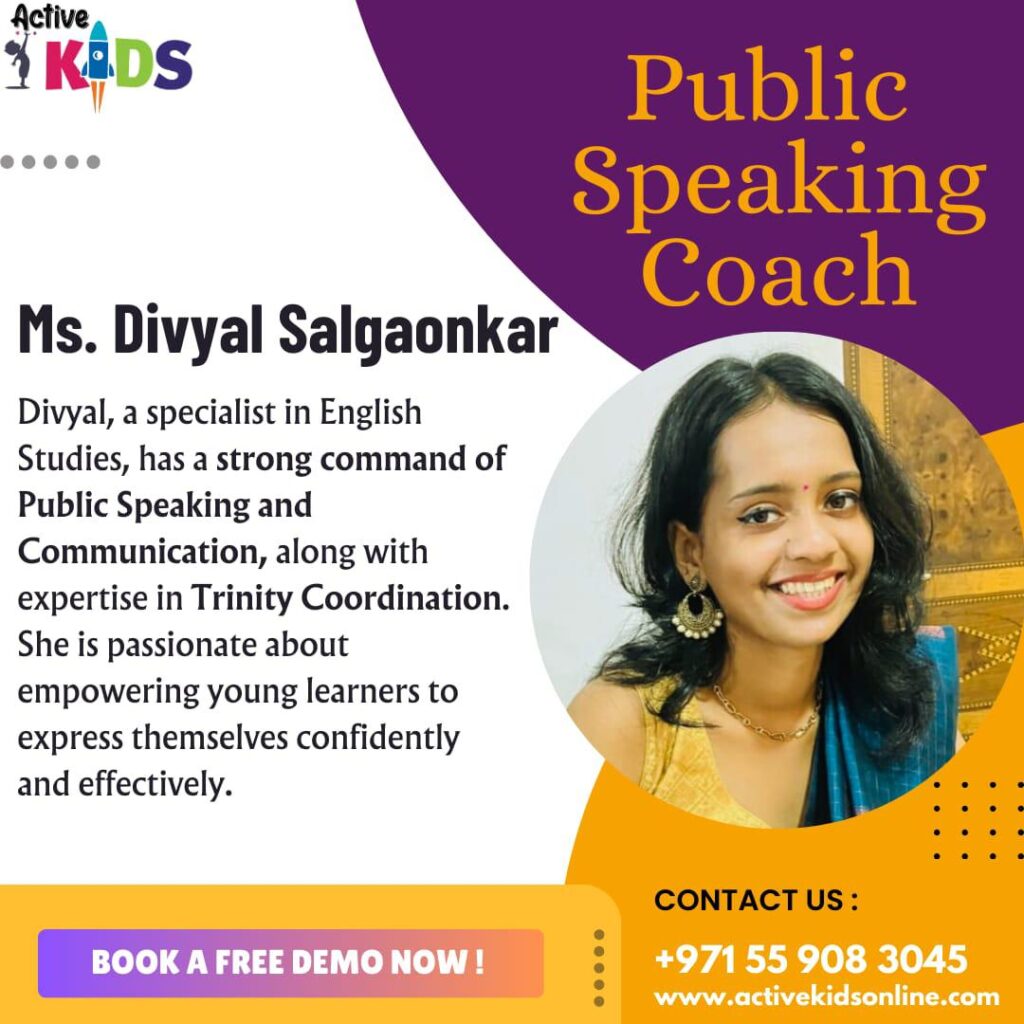
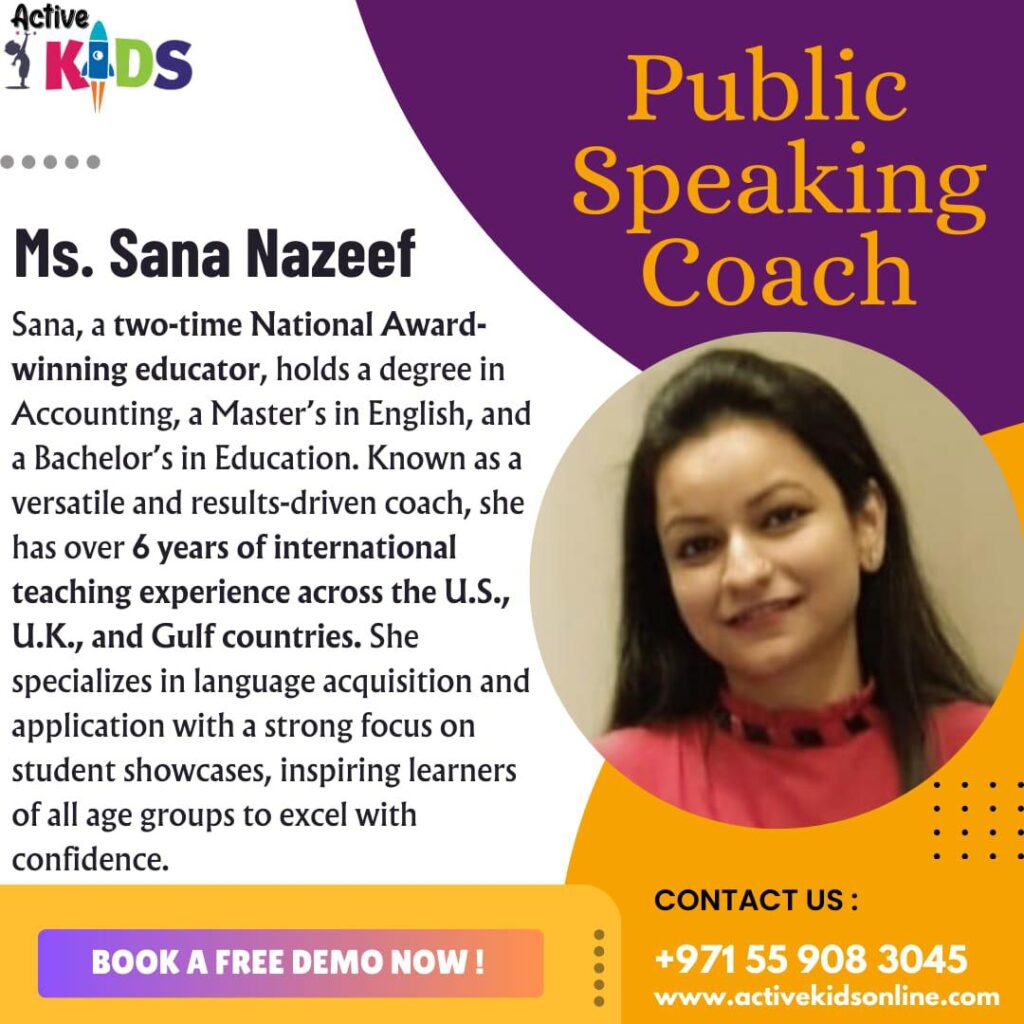
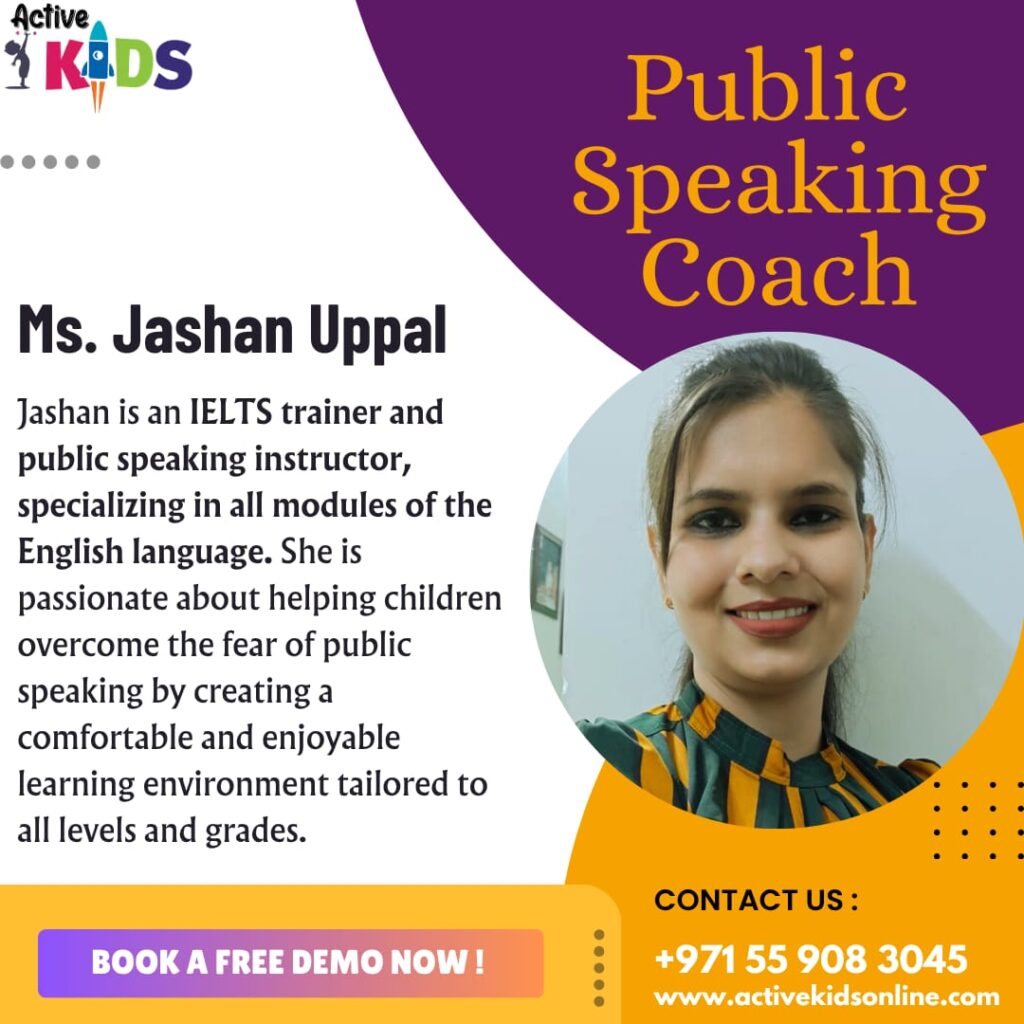
Children can develop public speaking skills through regular, age-appropriate practice. Start with short activities such as introducing themselves, describing a favourite topic, storytelling, reading aloud, and giving simple presentations. Gradually introduce audience interaction, debates, role-play, and structured speeches. The goal is not to eliminate every mistake, but to help children organise their thoughts, speak clearly, manage nervousness, and become comfortable expressing their ideas.
At Active Kids, children practise communication through interactive activities involving elocution, speech and drama, storytelling, debate, and presentations. Our Speak & Shine programme gives children a structured environment to build speaking confidence through guided practice.
There is no single “best” age to start learning public speaking. Children can begin developing communication and confidence through simple speaking activities from an early age, with the complexity of activities increasing as they grow.
For older children, structured public speaking can include presentations, storytelling, debates, expressive speaking, and speech and drama. The important factor is that activities are appropriate for the child's age and confidence level.
Active Kid’s Speak & Shine programme is designed for children aged 5–14, making it suitable for children at different stages of communication development.
Yes, when the programme provides consistent practice rather than simply teaching children to memorise speeches. Well-structured public speaking classes can help children develop speaking confidence, presentation skills, clearer communication, expressive speaking, and the ability to organise and communicate ideas.
These skills can support classroom participation, presentations, group discussions, storytelling, and other situations where children need to communicate confidently.
For children who regularly hesitate, become nervous when speaking, or find it difficult to express their thoughts, structured practice can be particularly useful.
Children can learn much more than how to deliver a speech. A well-rounded programme may cover speech structure, pronunciation, voice projection, voice modulation, body language, eye contact, storytelling, presentation skills, debate, and audience interaction.
At Active Kids, communication development is supported through Elocution, Speech & Drama, and Debate within the Speak & Shine programme. This gives children opportunities to work on both the technical and expressive sides of communication.
Public speaking classes can help children become more comfortable with speaking in front of others by giving them repeated, supportive opportunities to practise.
Rather than expecting a child to become confident immediately, effective training gradually increases the level of challenge. A child might begin with speaking for a few sentences and progress towards storytelling, presentations, drama activities, debates, and structured speeches.
With practice, children can learn strategies for managing nervousness while becoming more comfortable with audience attention and performance situations.
Yes. Online public speaking classes for kids can be effective when children actively participate rather than passively watch a teacher.
A well-designed online class can give children opportunities to speak, answer questions, present ideas, participate in discussions, practise storytelling, and receive guidance from an educator. Online learning can also provide families with greater flexibility while maintaining a structured learning environment.
Active Kids delivers its communication programmes through interactive live online sessions designed specifically for young learners, with guided participation and skill-focused activities.
The 3/2/1 rule is commonly used as a speaking practice technique in which a speaker explains or retells an idea repeatedly while reducing the available speaking time. For example, a child might speak about a topic for three minutes, then two minutes, and finally one minute.
The exercise encourages children to identify the most important points, organise their thoughts quickly, speak more concisely, and become more comfortable speaking without relying entirely on memorised wording.
It can be useful as one practice activity, but a child's public speaking development should include a wider range of skills such as speech structure, expression, listening, presentation, storytelling, and audience awareness.
The 5 Cs are commonly described as Clarity, Confidence, Content, Connection, and Control. Together, they provide a useful framework for thinking about effective speaking.
For children, this can mean communicating an idea clearly, speaking with growing confidence, having relevant content, connecting with the audience, and controlling elements such as voice, pace, and body language.
Public speaking classes can help children practise these areas through activities such as presentations, storytelling, debate, expressive reading, and speech and drama.
Active Kids is an online learning academy for children aged 4–14, offering programmes in spoken English, creative writing, reading, handwriting, and confident communication. Our school-based enrichment programmes are delivered onsite across Dubai schools through Active Risers, our KHDA-approved ECA division. We are dedicated to bridging the learning gap and empowering every child to become a confident, independent learner.
Take a quick quiz
1. How comfortable is your child when speaking in front of others?
2. How well does your child organize their thoughts while speaking?
3. Does your child use appropriate voice modulation and expressions?
4. How does your child handle unexpected questions or situations while speaking?
5. How often does your child participate in group discussions or presentations?