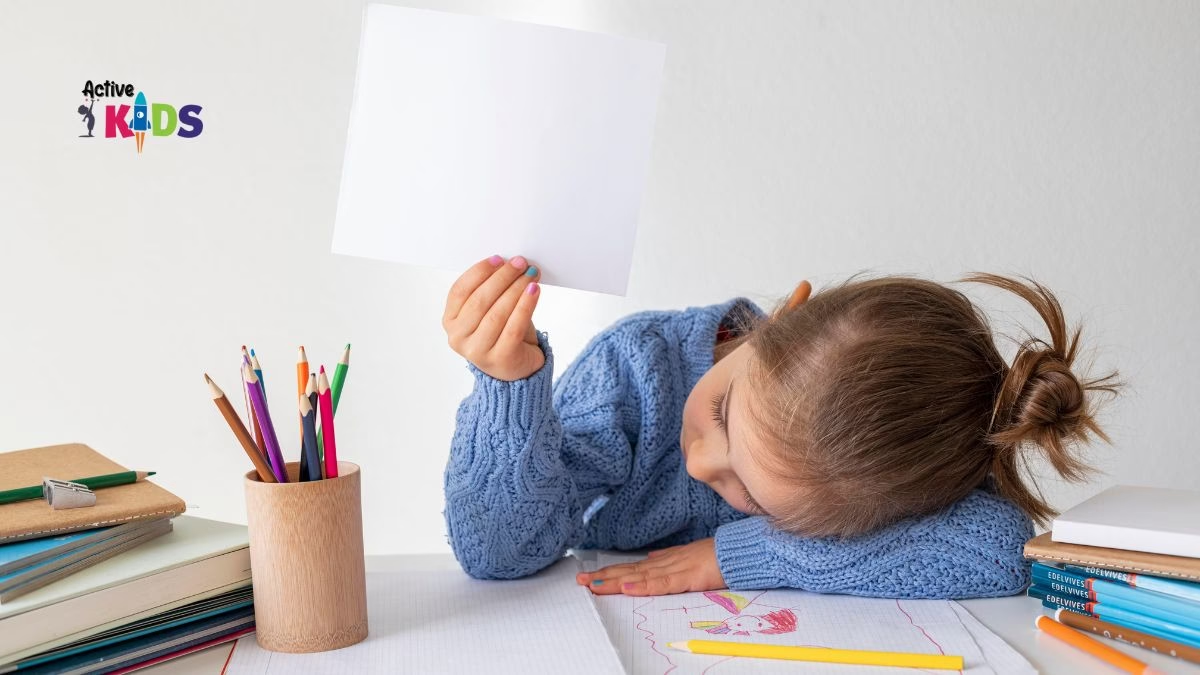


Imagine watching your child brainstorm an incredibly imaginative story or solve a complex analytical problem, only for their thoughts to stall when the pencil hits the page. It is deeply frustrating for parents when a child’s intellectual capacity is obscured by illegible script. In many cases, brilliant students lose essential academic marks simply because an examiner cannot decipher their work.
While the modern classroom embraces keyboards and tablets, the physical act of writing remains an indispensable foundation for cognitive mapping and academic success. Seeking effective handwriting improvement for kids isn’t about chasing rigid, old-fashioned calligraphy; it is about reducing physical fatigue, unlocking self-expression, and giving your child the tools to demonstrate their true potential. By understanding the biomechanics of child development, you can completely transform your child’s relationship with writing.
Why Some Kids Struggle With Handwriting
When a child produces inconsistent or erratic script, it is rarely due to a lack of effort or a refusal to cooperate. Handwriting is a complex neurological and physical milestone that requires multiple physiological systems to work in perfect harmony.
Fine Motor Skill Development
The hand contains dozens of intricate muscles, tendons, and nerve endings that must coordinate to execute minuscule, precise adjustments. If a child’s fine motor skill development experiences minor delays, manipulating a small writing utensil across a strict linear path feels incredibly taxing. The hand essentially struggles to execute what the brain is planning, leading to jagged lines and distorted shapes.
Pencil Grip Issues
A functional pencil grip acts as the steering wheel for writing. When a child adopts an inefficient grasp—such as wrapping their fingers into a tight fist or hyperextending their index finger—they inadvertently lock their wrist joints. This forces the larger muscle groups of the forearm and shoulder to take over a task meant for the fingers, resulting in rapid physical exhaustion and uneven letter sizes.
Excessive Screen Time
Modern childhood has fundamentally shifted away from tactile, manipulative play toward flat digital interfaces. When fingers spend hours tapping, swiping, or pinching smooth glass screens, they miss out on the resistance training provided by traditional toys. This lack of deep physical engagement leaves the hand muscles under-stimulated, making the transition to holding a solid pen or pencil significantly more challenging.
Poor Writing Posture
Legible script is a whole-body activity that relies entirely on a stable anatomical foundation. When a child slouches forward, wraps their feet around chair legs, or rests their head completely on the desk, their core stability collapses. This structural misalignment limits the natural range of motion of the dominant shoulder and elbow, forcing the wrist to work under awkward, unscientific angles.
| Biomechanical Barrier | Physiological Root Cause | Manifestation on Lined Paper |
|---|---|---|
| Interrupted Kinetic Chain | Weak core strength and slouched sitting posture | Descending baselines, floating letters, inconsistent margins. |
| Digital Muscle Underdevelopment | Lack of exposure to tactile resistance play | Drastic variations in letter sizes and shallow geometric control. |
| Locked Joint Compensations | Inefficient or tight finger-grasp patterns | Torn paper surfaces, hand cramps, slow copy speeds. |
Lack of Writing Practice
With educational curricula increasingly prioritizing digital submissions, the overall volume of long-form writing practice for kids has decreased globally. Muscle memory requires structured, rhythmic repetition to become second nature. Without frequent, low-stakes opportunities to write by hand, the neurological paths responsible for fluid letter generation simply do not crystallize.
Low Handwriting Confidence
When a student’s notebook is repeatedly returned covered in critical corrections regarding neatness, an emotional barrier forms. The child begins to associate the physical pencil with a deep sense of academic inadequacy. This psychological strain leads to severe writing avoidance, which directly stunts their progress and creates a stressful cycle of frustration for the entire family.
Signs Your Child Needs Handwriting Improvement Support
It is crucial to distinguish between normal, age-appropriate developmental variations and persistent challenges that require targeted intervention. Recognizing these behavioral and physical red flags early allows you to provide support before a child’s self-esteem suffers.
- Slow Handwriting Speed: Your child cannot keep pace with simple dictation or leaves timed school exams unfinished, despite knowing all the correct answers thoroughly.
- Erratic Spatial Mapping: Letters collide into a single continuous block without clear word boundaries, or words float unpredictably above and below the baseline.
- Persistent Mechanical Fatigue: The child frequently pauses to rub their palm, shake out their wrist, or massage their forearm after writing just a few sentences.
- Pronounced Writing Avoidance: Meltdowns, stalling tactics, or sudden somatic complaints (like headaches or stomach aches) manifest whenever homework involves written components.
- Asymmetrical Letter Formations: Letters are written from bottom-to-top or outside-in, showing that the child lacks an internal geometric blueprint for how characters are constructed.
Amazing Handwriting Improvement Tips for Kids
Remediating messy handwriting does not require hours of repetitive, uninspired copy work. Instead, real progress is achieved by applying targeted, evidence-based adjustments that make the writing process more efficient.
Improve Pencil Grip
Why it works: Transitioning toward a relaxed dynamic tripod grip allows the thumb, index finger, and middle finger to form a flexible tripod. This anatomical alignment gives the fingers maximum control to execute precise curves and slants, removing stress from the wrist.
Activity to try at home: The Pom-Pom Secret. Place a tiny pom-pom or a small crumpled piece of paper inside your child’s palm. Instruct them to hold it against their palm using only their ring finger and pinky finger while writing with the remaining three fingers. This naturally separates the hand into a stabilizing side and a dynamic working side.
Practice Short Daily Writing Exercises
Why it works: Exhausting, marathon writing sessions cause muscular fatigue, which actually reinforces bad motor habits. Short, hyper-focused writing exercises build high-quality muscle memory without triggering physical burnout or mental resentment.
Activity to try at home: The Two-Sentence Journal. Select a dedicated, visually appealing notebook. Every evening, have your child write exactly two sentences regarding their favorite part of the day. The catch? They must focus entirely on spatial control rather than content, turning it into a brief, low-stakes micro-habit.
Focus on Letter Formation
Why it works: Many children draw letters as random shapes, lifting their pencil inefficiently. Teaching standard top-down letter formation ensures the hand moves in a fluid, predictable rhythm, which naturally improves writing speed and consistency.
Activity to try at home: The Highlighting Pathway. Write a target lowercase letter in large format using a yellow highlighter. Have your child use a fine-tipped pen to track through the exact middle of the highlighted path, starting strictly from the top down while you call out rhythmic directional prompts like “down, bounce up, and around.”
Strategic Educator Note: When a child struggles to write cleanly on standard school paper, always scale up the medium before scaling it down. Practicing large movements on vertical surfaces like mirrors or windows using washable markers builds shoulder stability and arm coordination far more effectively than micro-movements on small paper.
Use Multi-Sensory Activities
Why it works: The brain retains motor patterns much faster when multiple sensory pathways are stimulated simultaneously. Incorporating touch and texture bypasses the stress of fine-line paper tracking, helping children internalize the shapes of letters.
Activity to try at home: The Sensory Tray. Fill a shallow baking sheet with raw cornmeal or fine sand. Have your child use their bare index finger to trace large geometric shapes and characters into the surface, feeling the physical resistance of the grains as they build spatial memory.
Build Hand Strength
Why it works: If the intrinsic muscles of the hand are under-conditioned, a child cannot sustain consistent pressure over a prolonged writing task. Building physical grip strength gives the hand the endurance it needs for long school days.
Activity to try at home: The Kitchen Tongs Challenge. Scatter small objects like dry beans, buttons, or cotton balls across a table. Give your child a pair of kitchen tongs or tweezers and challenge them to sort the items into cups using only their dominant hand, which builds the exact finger pinch muscles needed for a proper grip.
Encourage Cursive Writing Slowly
Why it works: For older children with deeply ingrained bad printing habits, introducing cursive writing can be incredibly transformative. Because cursive letters are linked by continuous lines, it naturally prevents letter reversals, eliminates irregular word spacing, and creates a highly efficient motor rhythm.
Activity to try at home: The Endless Wave. Before writing actual cursive letters, draw a long row of continuous wave patterns across an unlined sheet of paper. Have your child track over the waves slowly without lifting their pen, teaching the hand to maintain a smooth, connected kinetic flow.
Reduce Writing Pressure
Why it works: Children with low hand coordination often overcompensate by pressing into the page with excessive force. This creates severe physical strain, causes frequent pencil lead breakages, and slows down their writing pace dramatically.
Activity to try at home: The Carbon Paper Game. Place a sheet of carbon copy paper or a piece of soft cardboard directly underneath their writing page. Instruct your child to complete a short paragraph with just enough pressure to make their text clearly visible, but gently enough that they do not indent or tear the underlying surface.
Create Fun Writing Challenges
Why it works: Gamifying practice completely eliminates performance anxiety. When writing feels like play rather than an academic chore, children drop their defensive barriers and engage fully with the physical task.
Activity to try at home: The Upside-Down Mystery. Secure a piece of paper to the underside of a low coffee table or desk. Have your child lie flat on their back beneath the table and write out secret code words overhead. This unique angle naturally strengthens shoulder stability while making the practice session highly memorable.
How Handwriting Affects Academic Confidence
It is easy to assume that typing proficiency will eventually render penmanship obsolete, but cognitive science shows that the hand-brain connection is vital for long-term child development.
Classroom Confidence and Teacher Readability
Teachers have limited time to grade assignments. When a student’s work is neatly organized, the teacher can instantly recognize their subject comprehension. Conversely, messy handwriting creates unnecessary friction during grading. When neat handwriting tips are applied successfully, a child’s true knowledge shines through, leading to more accurate academic evaluations and positive feedback that boosts their classroom confidence.
Exam Performance and Test Speed
In timed examination settings, a slow handwriting speed becomes an invisible academic barrier. A student might possess an exceptional grasp of a topic, but if their physical writing habits cannot keep pace with their thoughts, they leave questions unanswered. Improving motor coordination directly increases writing speed, allowing students to navigate exams calmly and efficiently without running out of time.
Communication Skills and Child Self-Esteem
When a student is ashamed of how their notebook looks, they often withdraw from class participation and avoid written expression entirely. Resolving these mechanical struggles yields a massive surge in child self-esteem. When a child is proud of their clean, organized penmanship, they become far more eager to showcase their ideas, transform their communication skills, and view themselves as capable learners.
Can Online Handwriting Classes Help Kids?
Many parents wonder if an online format can effectively teach a physical, hands-on skill like penmanship. The truth is that virtual learning, when properly structured, offers incredible advantages for motor skill remediation.
Enrolling your student in specialized handwriting classes online provides a highly systematic learning environment. Rather than forcing a child to repeat mindless worksheets, a professional digital program focuses on live, real-time posture analysis and ergonomic guidance. This structured approach helps children break bad physical habits in a supportive, distraction-free environment.
The real key to long-term success in an online setting is the delivery of targeted, personalized feedback. Experienced instructors use high-definition camera angles to observe exactly how a student positions their fingers and directs their pencil strokes. This real-time guidance ensures that home-based handwriting practice sessions are highly efficient, preventing the accidental reinforcement of bad motor patterns.
Simple Daily Activities Parents Can Try at Home
You can effortlessly integrate writing improvement into your family’s daily routine through simple child development activities that require zero academic setup.
- Precision Tracing Exercises: Place transparent tracing sheets over detailed geometric patterns or illustrations, encouraging your child to track the fine lines accurately to build hand coordination.
- Whiteboard Writing Games: Use dry-erase boards for daily games like tic-tac-toe or hangman. The slick, low-friction surface allows markers to slide easily, making it perfect for children who get fatigued by paper.
- Air Writing Routines: Have your child stand up and use their entire arm to draw giant invisible letters in the air. This large-scale movement engages gross motor pathways and locks correct letter formation into memory.
- Clay Shaping Challenges: Roll modeling clay into long thin strands and have your child bend and pinch them into specific words, which strengthens the index and thumb muscle groups.
- Low-Stakes Family Journaling: Leave a shared notebook on the kitchen counter where family members can leave short, two-line illustrated notes or riddles for one another.
- Rhythmic Pattern Exercises: Fill unlined paper with continuous rows of connected loops, zigzags, and waves to build the muscle elasticity required for fluent writing habits.
When Parents Should Seek Extra Support
While many writing challenges can be successfully resolved with patience and consistent home practice, it is important to know when a child needs the structure of a formal program.
If your child shows persistent handwriting struggles that do not improve despite months of regular lifestyle adjustments, they likely require specialized support. Watch for extreme writing avoidance, such as emotional meltdowns or intense anxiety whenever a pencil is introduced. Furthermore, if your child faces broader coordination difficulties—such as struggling with clothing buttons, safety scissors, or opening basic containers—their writing challenges may be tied to deeper fine motor delays. Seeking professional support early prevents these addressable physical hurdles from turning into deep-seated academic anxiety.
Conclusion
Guiding your child toward clean, legible script is a journey that thrives on patience, consistency, and positive reinforcement. Focus your praise on small, incremental improvements—such as a beautifully spaced line or a perfectly formed character—rather than expecting flawless pages overnight. Prioritizing consistency over perfection is what truly builds lifelong writing confidence.
If you are ready to give your child structured, expert-backed support, we are here to help. Explore our specialized handwriting improvement for kids programs at Active Kids Online. We provide highly engaging, practice-based learning designed by child development experts who know exactly how to turn writing practice into a rewarding experience. For custom guidance tailored specifically to your child’s current age and developmental needs, reach out to our team directly through our WhatsApp support channel. Let’s work together to transform your child’s writing into a source of enduring pride and academic confidence.
FAQs About Amazing Handwriting Improvement Tips Kids
What is the best age to improve handwriting?
The optimal window for establishing foundational writing habits is between the ages of 4 and 9, as this is when a child’s fine motor skills and neurological motor maps are highly adaptable. However, handwriting improvement can be successfully achieved at any stage. Older children between 10 and 14 often make remarkably rapid progress because they possess better focus, stronger metacognitive skills, and a personal desire to improve their school performance.
How can I improve my child’s handwriting fast?
The fastest path to visible improvement is through short, daily targeted practice sessions of 5 to 10 minutes rather than long, draining weekend sessions. Prioritize correcting their writing posture and pencil grip first, as these physical adjustments immediately eliminate hand fatigue. Combining these adjustments with engaging, gamified writing exercises ensures your child remains motivated and accelerates their overall progress.
Are online handwriting classes effective?
Yes, high-quality online handwriting classes are highly effective when they pair structured lessons with real-time personalized feedback. A virtual setting allows specialized educators to observe a student’s hand positioning closely, analyze their letter formation strokes via video, and provide instant modifications that help correct deep-seated writing habits safely and efficiently.
Does cursive writing improve handwriting?
Yes, learning cursive writing frequently resolves persistent neatness and spacing issues. Because cursive script requires a continuous, fluid motion across the page, it naturally prevents word crowding and decreases letter reversals. It also eliminates the need to constantly lift and reposition the pencil, which directly boosts writing speed.