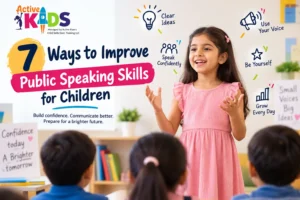

It’s a scene many UAE parents know well. At home, your child is a whirlwind of stories, jokes, and opinions. They can explain the entire plot of their favorite game or recount a school playground saga with cinematic detail. But the moment they stand up for a school assembly or a classroom presentation, something changes. The voice drops, the eyes hit the floor, and that natural spark seems to vanish.
If your child struggles with “freezing up,” you aren’t alone. In an increasingly competitive academic landscape—from Dubai to Abu Dhabi—the ability to articulate ideas clearly is no longer just a “nice-to-have” soft skill. It is the foundation of their academic success and social integration. Finding effective public speaking tips for kids isn’t about turning every child into a professional orator; it’s about giving them the tools to navigate a classroom, a group project, or a social circle with genuine confidence.
Developing communication skills for children is a marathon, not a sprint. It’s about moving from hesitation to participation, one small win at a time.
Why Public Speaking Skills Matter for Kids
In the modern classroom, the “quiet child” often gets overlooked, not because they lack brilliance, but because they lack the confidence to project it. Public speaking is rarely just about a podium and a microphone; it’s about daily interactions.
- Classroom Participation: A child who can express their thoughts clearly is more likely to ask questions when they are stuck and contribute when they have the answer.
- Social Confidence: Whether it’s joining a new sports club or attending a birthday party, speaking confidence for kids allows them to build friendships more easily.
- Critical Thinking: To speak well, you must think well. Organizing a speech helps children learn how to structure their thoughts logically.
- Future-Proofing: Beyond school, leadership and career progression depend heavily on how we communicate our value to others.
Public Speaking Tips for Kids That Actually Work
Many parents make the mistake of focusing on “The Big Speech.” Instead, the most effective way to build communication skills for children is to integrate small, manageable habits into their daily lives. Here is how to approach it practically.
Encourage Daily Conversations
Don’t wait for a school project to practice speaking. Use the drive home from school or dinner time to move beyond one-word answers. Instead of asking, “How was your day?” try open-ended prompts like, “Tell me about the most interesting thing that happened at break time today.” This encourages them to narrate events and express opinions naturally.
Focus on Confidence Before Perfection
If you jump in to correct a child’s grammar or pronunciation every time they speak, they will eventually stop trying. In the early stages, prioritize the act of speaking over the accuracy of the speech. When a child feels safe making mistakes, their stage fear begins to dissolve.
Start Small and Build Gradually
You wouldn’t ask a child to swim laps before they can doggy-paddle. Start with low-stakes environments:
- Reading aloud: Have them read a bedtime story to you or a younger sibling.
- The “Family Update”: Give them two minutes during dinner to tell the family about a topic they love (dinosaurs, space, football).
- Phone calls: Let them order the pizza or call a grandparent to say thank you.
Teach Eye Contact and Body Language
Body language speaks louder than words. Often, kids look at the floor because they feel exposed. Teach them the “triangle technique”: if looking directly into someone’s eyes feels too intense, they can look at the space between the person’s eyebrows or at their forehead. Remind them that standing tall—shoulders back, feet grounded—actually sends a signal to the brain that they are safe, which helps lower anxiety.
Use Storytelling to Improve Expression
Storytelling is the heart of great communication. Encourage your child to describe their day as a story with a beginning, a middle, and an end. This builds verbal communication flow and helps them move away from robotic, memorized scripts toward a more natural, engaging style.
Help Kids Slow Down While Speaking
Nervous speakers tend to rush. When the heart rate goes up, the words come out faster, leading to stumbles and “ums.” Teach your child the power of the “breath pause.” Taking a deep breath before starting a sentence gives the brain a second to catch up with the mouth.
Simple Activities to Improve Public Speaking Skills
You don’t need a formal stage to practice. These confidence building activities for kids can be done in your living room in ten minutes or less.
- The Mirror Game: Have your child practice a few sentences in front of a mirror. It helps them become aware of their facial expressions and hand gestures.
- Video Playback: Record a short 30-second clip of them talking about their favorite hobby. Watch it back together—not to criticize, but to point out what they did well (e.g., “I loved how clear your voice was there!”).
- The “What’s in the Bag?” Game: Place an everyday object in a bag. Have them pull it out and “sell” it to you for one minute. It builds spontaneity and quick thinking.
- Role-Play Scenarios: Practice how to introduce themselves to a new teacher or how to explain a project to a classmate.
How to Help Shy Kids Speak More Confidently
For a naturally shy child, “just be brave” is unhelpful advice. Shyness is often a form of perfectionism—the fear of saying the wrong thing.
To help a shy child, avoid pressure. Never force them to speak in front of a large group before they are ready. Instead, create a “safe speaking zone” at home where their ideas are always validated. Celebrate the “small-big” wins, like the first time they raise their hand in class or order their own meal at a restaurant in the mall. Avoid comparing them to a more “outgoing” sibling or friend; every child’s journey to confidence is unique.
Public Speaking Tips for Different Age Groups
Communication needs evolve as children grow. Here is a breakdown of what to focus on at each stage.
Ages 4–6: The Foundation
At this age, it’s all about vocabulary and play. Focus on storytelling and descriptive language. Use “Show and Tell” at home to get them used to holding an object and talking about it for sixty seconds.
Ages 7–10: The Social Shift
This is when classroom confidence becomes vital. Focus on reading aloud with expression and encouraging them to participate in group discussions. This is a great age to introduce the basics of presentation skills, like standing still and using a clear “big” voice.
Ages 11–14: The Analytical Phase
Pre-teens and young teens need to focus on structure and persuasion. This is the time to introduce debate skills and how to back up an opinion with a reason. Help them move away from reading off slides or notes and toward using bullet points to guide their thoughts.
Signs Your Child Is Improving in Public Speaking
Progress isn’t always a standing ovation; it’s usually found in the quiet shifts in behavior. You’ll know your child is gaining speaking confidence when you notice:
- They volunteer to answer a question in class, even if they aren’t 100% sure of the answer.
- They maintain better eye contact with adults during greetings.
- They stop fidgeting as much when explaining a concept.
- They start using pauses for effect rather than rushing to finish.
- They show less “physical” anxiety (like tummy aches) before a school presentation.
Helping Kids Become Confident Communicators
At the end of the day, public speaking is a muscle. Some children are born with a bit more natural “flex,” but every child can build strength with the right exercises and encouragement. It isn’t about eliminating butterflies in the stomach; it’s about teaching those butterflies to fly in formation.
When a child learns that their voice has value, their entire perspective on school and social life changes. They stop being a spectator in their own education and start becoming an active participant.
If you’ve noticed your child has brilliant ideas but struggles to share them, we can help bridge that gap. At Active Kids Online, our Speak & Shine programme is designed specifically to transform hesitation into articulation. We provide a supportive, high-energy environment where children can practice their presentation skills and build lasting confidence.
Ready to see your child shine? Book a free speaking assessment today and let’s help your child find their voice.