
It is a scene that plays out in thousands of households across Dubai, Abu Dhabi, and the wider Middle East every single morning. At the breakfast table, your child is a whirlwind of words. They tell elaborate stories, laugh loudly, negotiate for their favorite snacks, and express their thoughts with absolute clarity. They are expressive, dynamic, and unapologetically themselves.
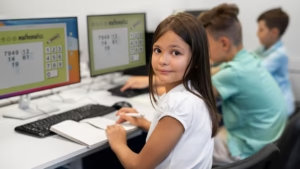
Then, the school gates arrive. As they step into the classroom, a visible shift occurs. Their shoulders drop, their eyes scan the floor, and their voice vanishes. When the teacher asks a direct question, your chatty child shrugs or stares silently. If a peer invites them to play, they might just nod or step away entirely.
For a parent, watching this transformation can be deeply confusing and anxiety-inducing. You know your child possesses excellent verbal skills. You know they are intelligent and curious. Naturally, you begin to wonder: Why does my child speak at home but not at school? Is it a lack of confidence, or is something deeper happening within their social world?
To solve this mystery, we must look beyond generic parenting advice that tells you to “just push them to be more outgoing.” Instead, we need to explore environmental communication psychology. By understanding how a child’s brain processes different spaces, we can help them navigate their classroom anxiety and build genuine, lasting communication confidence in children.
“Children rarely become confident communicators through pressure. They develop confidence when they repeatedly experience safe opportunities to express themselves.”
Why Children Behave Differently at Home and School
Adults often forget that school is a child’s professional workplace. It is an environment filled with complex social hierarchies, constant evaluation, and high sensory stimulation. When we examine why a child talks only at home, we are looking at the fundamental human need for safety, predictability, and emotional security.
Home represents a complete comfort zone. Within the walls of your house, the social rules are clear and unchanging. Your child knows exactly how you will react if they make a grammatical error, tell a silly joke, or throw a tantrum. This deep predictability creates an environment of total emotional security. They do not have to perform; they simply exist.
Furthermore, the home is populated entirely by known people who love them unconditionally. This eliminates the need for an internal filter. Your child can speak without analyzing the social risks of their words. Their brain is relaxed, which allows their natural language abilities to flow freely and spontaneously.
School, by contrast, operates on an entirely different behavioral script. A modern classroom in the UAE is highly dynamic, often multicultural, and intensely social. A child must constantly decode the intentions of twenty or more peers, interpret a teacher’s body language, and follow rigid academic routines. For many children, this shift requires massive cognitive and emotional energy, leaving very little bandwidth for vocal participation in class.
To illustrate these stark environmental differences, let us look at how various factors influence your child behavior across both spaces:
| Environmental Factor | The Home Environment | The School Environment |
|---|---|---|
| Social Audience | Unconditional, loving family members. No threat of rejection. | Peers and authority figures. High potential for judgment or comparison. |
| Predictability | High. Routines, responses, and spatial layouts are deeply familiar. | Variable. Unplanned interactions, shifting group work, and changing schedules. |
| Sensory Load | Low to moderate. Controllable noise levels and lighting. | Intense. Echoing corridors, bright lights, multiple overlapping conversations. |
| Performance Pressure | None. Communication is casual, relational, and self-paced. | High. Answers are evaluated for correctness, speed, and clarity. |
Confidence vs Comfort: The Crucial Distinction
When a child is quiet at school, well-meaning educators and relatives often label them as “lacking confidence.” They suggest that the child needs to work on their self-esteem. However, child communication psychology shows us that this diagnosis is frequently incorrect. The issue is rarely a lack of confidence; it is a lack of situational comfort.
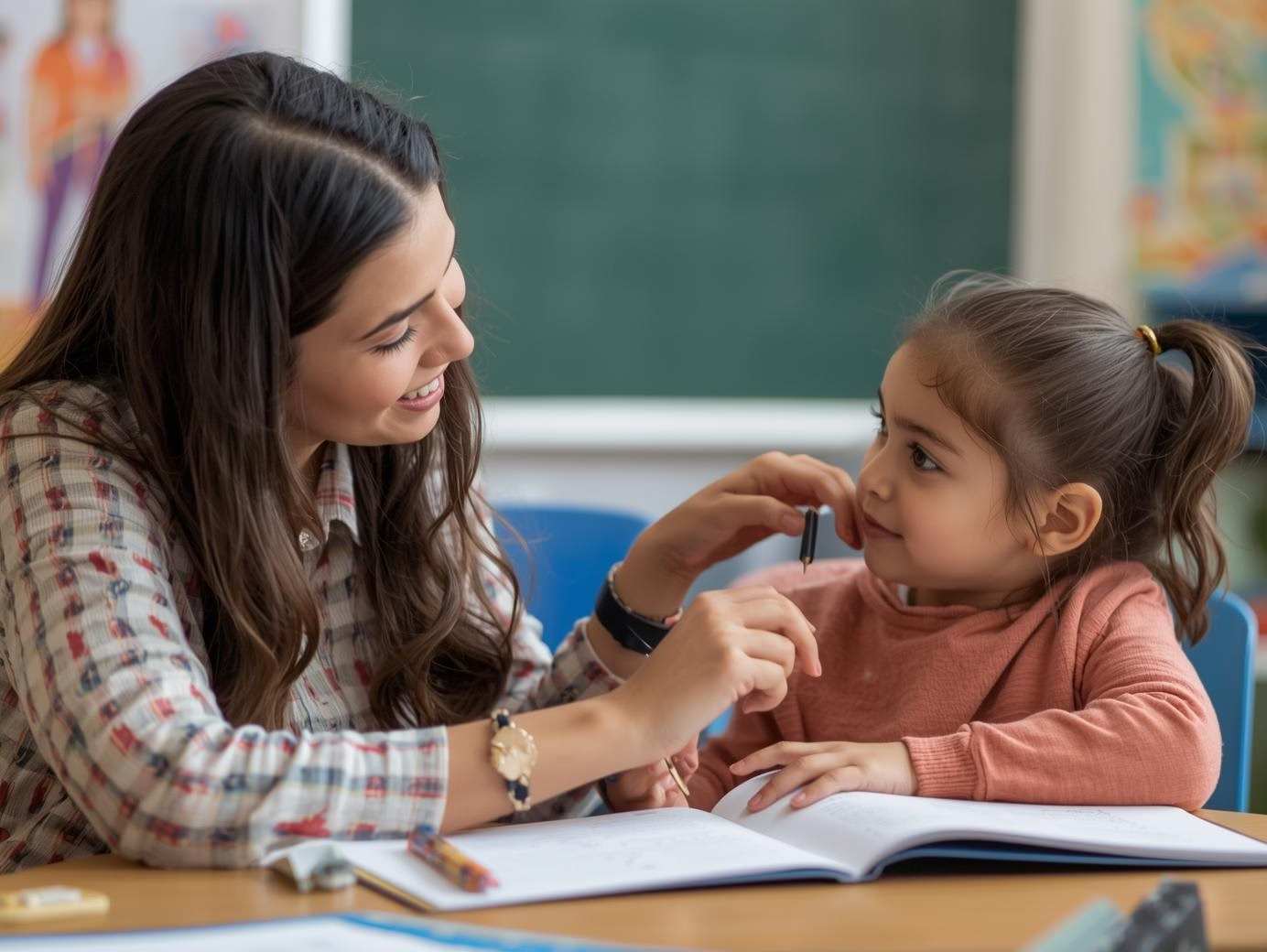
Consider the case of a six-year-old girl named Reem living in Dubai. At home, Reem builds complex Lego structures and narrates intricate stories about them to her mother. She speaks with clear syntax, uses advanced vocabulary, and displays high internal confidence. Yet, during circle time at school, Reem sits on the rug in total silence, pulling at the hem of her uniform.
Is Reem an unconfident child? Absolutely not. If she lacked fundamental confidence, she would struggle to voice her thoughts in all settings. Reem’s silence is an adaptive response to an environment where she does not yet feel comfortable. Confidence is an internal belief in one’s abilities, whereas comfort is an environmental reading that tells the brain it is safe to show those abilities.
When a child steps into a space where they feel socially exposed, their nervous system treats that exposure as a potential risk. Silence becomes a shield. By remaining quiet, the child avoids drawing attention to themselves, thereby minimizing the risk of making a mistake, being laughed at, or displeasing the teacher. It is a highly logical survival strategy executed by a young mind.
The Neurobiology of Communication: Psychological Safety
To truly understand why a child behaves this way, we must examine the concept of psychological safety. Coined by behavioral scientists, psychological safety refers to a shared belief that a well-defined space is secure for interpersonal risk-taking. For a child, speaking up in a classroom is an immense interpersonal risk.
When psychological safety is low, communication anxiety takes over. The human brain prioritizes survival over expression. If a child perceives their classroom as an unpredictable or highly critical space, their amygdala triggers a mild fight, flight, or freeze response. In many quiet children, this manifests as the ‘freeze’ response, which physically locks their vocal cords.
Let us break down the specific pressures that erode psychological safety in a school environment:
- The Fear of Judgement: Children are hyper-aware of how their words are received. They notice if a classmate smirks at their pronunciation or if a teacher looks disappointed by an incorrect response.
- The Weight of Teacher Expectations: Children often view teachers as powerful authority figures. The desire to please them can create a paralyzing fear of saying the wrong thing, causing the child to choose silence as the safest option.
- The Pressure of Peer Observation: Unlike at home, where conversations are usually one-on-one or in small groups, school conversations happen in front of a live audience. Knowing that twenty pairs of eyes are watching can turn a simple question into a terrifying performance.
- Mistake Anxiety: In a learning environment, answers are constantly categorized as ‘right’ or ‘wrong’. For a perfectionist or sensitive child, the public exposure of a ‘wrong’ answer feels like an emotional disaster.
Common School-Related Communication Barriers
Beyond psychological safety, several structural and dynamic elements inside the school building act as natural roadblocks to a child’s communication behaviour. Recognizing these specific school-related communication barriers helps parents move away from blame and toward constructive observation.
First, look at the sheer scale of group settings. At home, your child speaks within a familiar environment with minimal background noise. In contrast, modern classrooms require navigating intense peer interaction amid loud, chaotic group dynamics. For an introverted or sensory-sensitive child, this constant noise makes it incredibly difficult to find the right moment to speak.
Second, consider the specific nature of the teacher-child relationship. Some teachers employ highly structured, rapid-fire questioning styles designed to keep the class moving quickly. A child who needs extra time to process their thoughts and formulate sentences will easily get left behind at this fast pace. They choose not to participate because by the time they are ready to speak, the conversation has already moved forward.
Finally, we cannot ignore the child’s natural temperament. Every human being is born with a specific neurological blueprint. Some children possess a slow-to-warm temperament. They are naturally observant, analytical, and cautious. They prefer to thoroughly study a social environment, understanding every hidden rule and personality, before they feel safe enough to actively participate in class. This is not a flaw; it is an admirable, protective personality trait.
What Parents Should Observe Before Assuming a Communication Problem
Before rushing to assume that your child has a medical speech delay or a developmental issue, it is vital to collect objective data. Parents are the ultimate behavioral scientists for their children. By tracking patterns systematically, you can determine whether your child is simply navigating a temporary adjustment phase or if they need targeted communication support.
Use this structured observation guide over a two-week period to gather clear, actionable insights into your child’s communication habits:
| Observation Area | Specific Questions to Ask Yourself | What the Pattern Indicates |
|---|---|---|
| The “Who” Filter | Does your child speak easily to extended family, close family friends, or specific neighbors? | If they speak to selected familiar adults, the issue is environmental comfort, not a physical language deficit. |
| The “Where” Filter | Do they talk when playing at a public park in Dubai, or do they only speak inside your house? | Silence localized strictly to the school building suggests school-specific stressors or social pressure. |
| The “When” Filter | Are they more talkative right after school, or do they become silent and withdrawn due to exhaustion? | Post-school silence often indicates cognitive fatigue from masking their anxiety all day long. |
| Identifiable Triggers | Does the silence happen specifically when they are asked to read aloud, or does it happen during casual recess? | Academic-specific silence points to performance anxiety; social silence points to peer-related anxiety. |
| Non-Verbal Comfort | Do they use clear gestures, bright eye contact, and smiles at school, or is their entire body frozen? | Active non-verbal communication shows high social engagement; a frozen body indicates a nervous system in survival mode. |
When Extra Communication Support May Help
Many children naturally outgrow their classroom silence as they build strong friendships and grow accustomed to their teacher’s style. However, time alone is not always the answer. Waiting too long for a child to “snap out of it” can cause their silent habits to become deeply ingrained behavioral patterns, leading them to be permanently labeled as the “quiet child.”
As a parent, you do not need to wait for a crisis to offer your child valuable tools. Providing proactive, low-pressure communication development support can help them bridge the gap between their expressive home life and their quiet school life. This is about honoring their unique personality while expanding their social comfort zone.
To help you decide on the best path forward, review this practical decision framework to match your observations with the right level of support:
| Current Scenario | Likely Root Cause | Recommended Action Plan |
|---|---|---|
| The child is in a new school term or has a new teacher; silent for less than 4-6 weeks. | Natural adjustment period and situational transition. | Observe closely. Keep home routines predictable and give them time to settle. |
| The child communicates well with 1-2 close friends but remains totally silent during whole-class instruction. | Performance anxiety and fear of large-group judgment. | Collaborate with the teacher to allow small-group work. Consider a structured program like Speak & Shine to build presentation confidence. |
| The child has been silent at school for over 6 months, across multiple grades, and avoids eye contact entirely. | Deeply ingrained communication anxiety or situational avoidance. | Seek an integrated approach involving school counselors, teachers, and dedicated child communication experts. |
If you notice that your child’s silence is holding them back from sharing their brilliant ideas, it may be time to seek a supportive space designed specifically for them. This is exactly why specialized programs exist. For instance, the Speak & Shine program by Active Kids Online offers a gentle, engaging platform where children can practice speaking without the overwhelming pressure of a traditional classroom layout.
By utilizing evidence-based child communication methodology, such programs build a bridge between home and school. They provide small-group interactions and validate each child’s unique pace, transforming their internal confidence into visible, real-world communication skills.
Every child has something worth saying. Sometimes they simply need the right environment before they feel safe enough to say it.
Frequently Asked Questions
Why does my child only talk at home?
Your child talks only at home because it is their primary zone of emotional security. At home, the social stakes are non-existent, the routines are predictable, and there is zero fear of academic evaluation or peer rejection. Their nervous system is entirely relaxed, which lets their natural language skills emerge without a filter.
Why is my child quiet at school?
School introduces massive sensory and social demands, including loud group settings, peer observation, and teacher expectations. A child quiet at school is often using silence as a protective tool to manage communication anxiety and avoid the risk of making mistakes or facing social judgment.
Is it normal for a child to be shy only at school?
Yes, this is an incredibly common manifestation of situational behavior. Behavioral science shows us that children adapt their communication styles based on their perception of an environment’s safety. Being a child shy only at school proves that their core speech development is intact, but they require extra support to navigate the school environment.
Should I force my child to answer in class?
No, forcing or bribing a child to speak usually backfires. High-pressure tactics increase their internal anxiety, causing their brain to view the classroom as an even more dangerous space. Instead, focus on building their comfort slowly through small, low-stress social interactions.
Can anxiety affect speaking in a classroom?
Absolutely. When a child experiences communication anxiety, their body enters a mild survival mode. The brain redirects its energy away from higher-level language production and toward self-protection, which can cause a child’s vocal cords to tighten, rendering them physically unable to speak easily.
Will my child outgrow this quiet behavior?
While many children naturally warm up as they adapt to routines, others may find that their silent habits solidify into an ongoing behavioral pattern. Providing supportive, structured communication opportunities early ensures they build necessary classroom confidence before isolation impacts their academic journey.
Should I inform my child’s teacher about this behavior?
Yes, open communication with educators is vital. Share with the teacher that your child is highly talkative and expressive at home. This shift helps the teacher understand that the child isn’t defiant or disengaged, allowing you to partner together to build a welcoming, low-pressure environment in class.
When should parents seek extra communication support?
You should consider extra support if your child’s silence lasts for more than one academic term, begins to impact their ability to form friendships, or causes them evident distress. Proactive programs provide a safe, intermediary space to gently nurture their natural speaking confidence.