
Introduction
When parents search for how to choose a public speaking course for kids, they often find programmes promising confidence, communication skills, and better speaking. But those promises do not tell you what your child will actually learn, how much they will practise, or whether the programme provides meaningful feedback. The right choice depends on more than a catchy programme description.
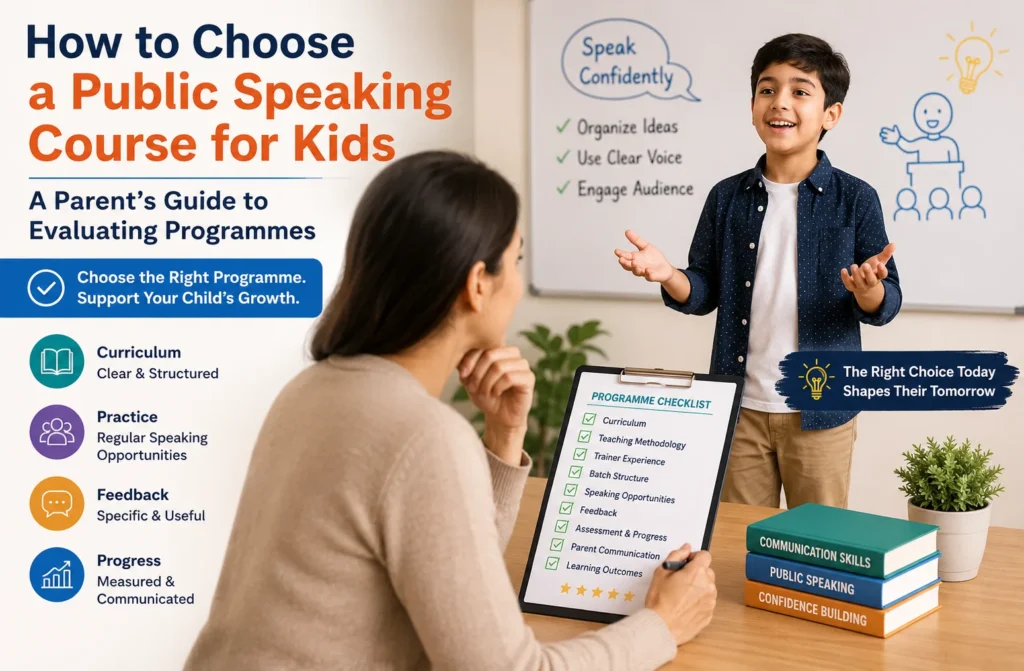
Before enrolling, parents should look at the speaking curriculum, teaching methodology, trainer experience, batch size, speaking opportunities, and learning outcomes. A good children’s communication programme should make these details clear and give parents a realistic way to compare different options.
This guide gives you a practical framework for evaluating a public speaking programme before making a decision. Instead of relying on marketing claims, you can use these seven criteria to compare what each programme actually offers.
1. Start With Your Child’s Communication Goals
Before comparing programmes, first identify what you want your child to develop. A child who needs help organising ideas may require a different learning focus from one preparing for presentations or group discussions.
Identify the Main Goal
Consider whether your priority is:
- expressing ideas clearly
- organising thoughts before speaking
- participating more comfortably in discussions
- presenting ideas to an audience
- improving overall verbal expression
Having a specific goal makes it easier to judge whether a programme’s learning outcomes actually match your child’s needs.
Consider Your Child’s Starting Point
Think about what your child can already do and where they need support. If they communicate comfortably at home but behave differently in unfamiliar settings, understanding why some children speak confidently at home but stay silent at school can help you interpret their starting point before choosing a programme.
2. Examine the Speaking Curriculum
A strong public speaking course for kids should have more than a collection of weekly speaking activities. Parents should be able to understand what children will learn, how those skills develop over time, and how much practical speaking is built into each session.
Look for a Clear Learning Progression
Ask the provider how the speaking curriculum is structured. Does it move from foundational communication skills towards more advanced speaking tasks, or does each class focus on an unrelated activity?
A clear progression makes it easier to understand what your child is expected to develop at each stage.
Check the Teaching Methodology
Public speaking is a practical skill, so children need opportunities to practise speaking, receive feedback, and try again. Ask how much of each session involves active participation rather than simply listening to the trainer.
Look for a balance of instruction, guided practice, speaking opportunities, and feedback.
Consider Age and Ability
A programme should account for differences in children’s ages, experience, and communication levels. Parents should ask whether activities can be adapted when a child is beginning, already confident, or needs additional support.
Parents can also review the Speak & Shine communication programme to understand how a dedicated children’s communication programme approaches structured speaking development.
3. Evaluate the Trainers and Feedback
The quality of a communication programme depends not only on its curriculum but also on how children are taught. A well-designed programme should give parents enough information to understand who teaches the sessions and how children are supported during practice.
Ask About Trainer Experience
Look for trainers who have relevant experience working with children, not simply experience in public speaking themselves. Teaching young learners requires an approach that is appropriate for their age, communication level, and learning needs.
Ask the provider about the trainers’ teaching background and experience with children’s communication development.
Find Out How Feedback Is Given
Feedback should help children understand what they did well and what they can improve next.
Instead of general comments such as “Good job,” useful feedback might address:
- clarity of ideas
- speech structure
- pace and pauses
- voice and delivery
- listening and responding
- audience awareness
Parents should also ask how frequently children receive individual feedback and whether progress is communicated to families.
Look for Individual Attention
A child can only benefit from feedback if the programme creates enough opportunities for the trainer to observe and guide them.
When comparing communication classes for kids, ask:
“How does each child receive individual attention during a typical session?”
The answer can tell you more about the programme’s teaching approach than its promotional claims.
4. Compare Batch Size and Speaking Opportunities
Batch size matters because public speaking develops through active participation. A programme may have a strong curriculum, but if children rarely get opportunities to speak or receive individual feedback, parents should ask how much practical learning is taking place.
Ask How Much Each Child Participates
Rather than looking for one “ideal” number of students, ask how the class is structured.
Find out:
- How many children are in a typical batch?
- How often does each child speak?
- Does every child receive individual feedback?
- Are there opportunities to practise in pairs or smaller groups?
- How does the trainer include quieter children?
This gives you a more useful basis for speaking class comparison than batch size alone.
Look Beyond the Student Count
A smaller group does not automatically mean a better programme. What matters is whether the teaching methodology makes good use of the available time.
When evaluating how to choose a public speaking course for kids, consider the relationship between batch size, speaking opportunities, practice time, and individual attention.
A provider should be able to explain clearly how children participate during a typical session.
5. Check How Your Child’s Progress Is Measured
Choosing a programme is easier when you know how you will recognise progress. Confidence alone can be difficult to measure, so ask how the programme evaluates the communication skills your child is developing.
Ask What Is Actually Assessed
A useful public speaking course checklist should include more than whether a child appears confident.
Ask whether the programme looks at areas such as:
- organising ideas clearly
- speaking with appropriate pace and volume
- responding to questions
- listening and responding appropriately
- structuring a presentation
- using voice and body language effectively
The exact assessment approach may vary between programmes, but parents should be able to understand what improvement looks like.
Find Out How Progress Is Tracked
Ask how often your child’s development is reviewed and how that information is shared with parents.
Useful approaches may include teacher observations, structured feedback, progress reviews, performance tasks, or other consistent methods. The important point is that parents should not have to rely solely on a vague statement such as “your child is becoming more confident.”
For a deeper framework on observing communication development without comparing children with one another, see our guide on measuring your child’s speaking progress.
Look for Clear Learning Outcomes
Before enrolling, ask:
“What should my child be able to do better by the end of the programme?”
Specific learning outcomes make it easier to judge whether the programme is addressing your original goals.
6. Ask These Questions Before Enrolment
Before choosing among the best public speaking classes for children, speak directly with the programme provider. A short conversation can reveal whether the programme has a clear structure or relies mainly on broad promises.
Questions About the Programme
Ask:
- What specific communication skills will my child develop?
- How is the speaking curriculum structured?
- How much speaking practice does each child receive during a typical session?
- How many children are in each batch?
- How do you adapt teaching for different ages and ability levels?
Questions About Trainers and Feedback
Also ask:
- What experience do your trainers have working with children?
- How is individual feedback given?
- How often do parents receive progress updates?
- How do you support a child who needs more guidance or practice?
Questions About Results
Finally, ask:
- What learning outcomes should I expect from the programme?
- How do you assess or track my child’s progress?
- How will I know what my child is improving and what still needs work?
A provider that can answer these questions clearly gives you more useful information for your speaking class comparison than a list of promotional claims or certificates.
7. Watch for Red Flags When Comparing Programmes
A programme does not need to make dramatic promises to be effective. When comparing options, pay attention to how clearly a provider explains its curriculum, teaching methodology, feedback, and learning outcomes.
Vague Curriculum
Be cautious if a provider talks extensively about confidence and communication but cannot clearly explain what children will learn.
Parents should be able to understand the main skills covered and how the programme develops them over time.
Big Promises Without Clear Evidence
Claims such as “instant confidence” or guaranteed results should prompt further questions.
Communication skills develop through practice, feedback, and continued participation. Look for a provider that explains how children learn rather than relying only on promised outcomes.
Limited Speaking or Feedback Opportunities
If children spend most of a session listening to a trainer, ask how they are expected to develop a practical speaking skill.
Similarly, find out whether feedback is specific to each child or limited to general comments.
No Clear Progress Communication
Parents should know how they will receive information about their child’s development. If a provider cannot explain how progress is observed, reviewed, or communicated, that is worth investigating before enrolment.
One Approach for Every Child
Children enter a programme with different ages, abilities, personalities, and communication goals. A strong programme should be able to explain how it accommodates those differences rather than assuming every child needs exactly the same approach.
8. Look Beyond “Confidence” When Judging Results
Confidence can be one reason parents choose a speaking programme, but it should not be the only measure of progress. When evaluating how to choose a public speaking course for kids, look for changes in observable communication skills.
Focus on Practical Communication Skills
Ask whether your child is gradually becoming better at:
- organising ideas before speaking
- explaining thoughts clearly
- responding to questions
- listening and responding appropriately
- using an appropriate pace, volume, and tone
- structuring a presentation
- communicating with greater independence
These indicators give parents something more meaningful to observe than simply asking whether a child “looks confident.”
Compare Your Child With Their Own Starting Point
Children develop communication skills at different rates. Instead of comparing your child with classmates, compare their current abilities with where they started.
For example, a child who previously needed extensive prompting may eventually organise and deliver a short presentation independently. That is meaningful progress, even if another child appears more advanced.
For a more detailed framework, parents can refer to our guide on measuring your child’s speaking progress.
Look for Progress Over Time
A single successful presentation does not necessarily demonstrate consistent development. Look for patterns across different speaking situations and over a reasonable period.
The aim is to identify gradual, observable communication development, supported by practice and useful feedback.
9. Use This Public Speaking Programme Evaluation Scorecard
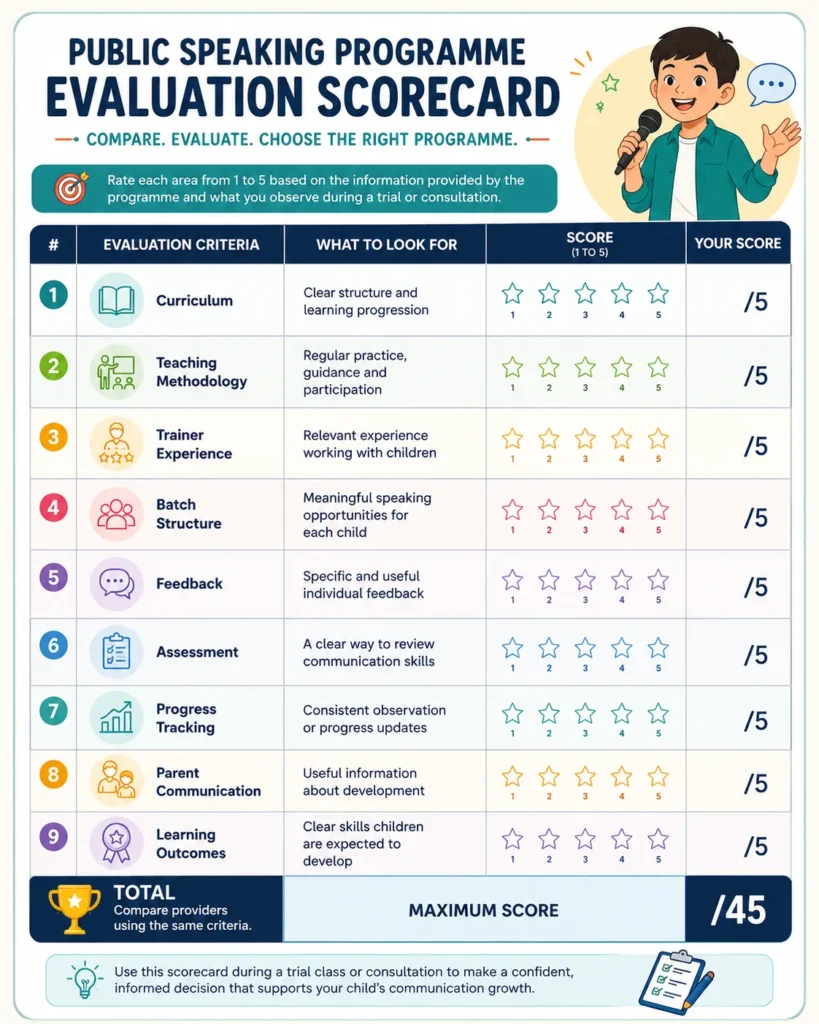
When comparing two or more programmes, a simple scorecard can help you look beyond marketing language. Rate each area from 1 to 5 based on the information provided by the programme and what you observe during a trial or consultation.
How to Use the Scorecard
Do not treat the total score as a universal pass-or-fail test. Its purpose is to make your speaking class comparison more structured.
Score each provider using the same criteria, then investigate any area that receives a particularly low score. A programme with strong marketing but unclear assessment or limited feedback should prompt more questions before you enrol.
You can use the scorecard during a trial class or consultation so your final decision is based on what the programme actually offers.
10. Use This Parent Evaluation Checklist
Before enrolling your child, use this public speaking course checklist to review the programme one final time.
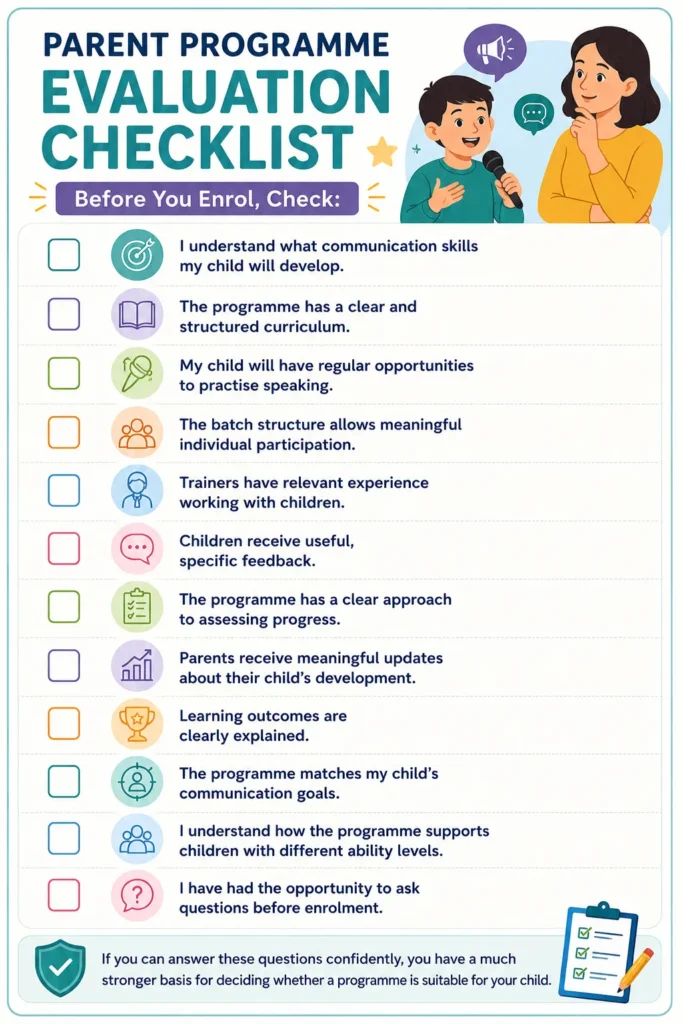
If you can answer these questions confidently, you have a much stronger basis for deciding whether a programme is suitable for your child.
How Speak & Shine Fits These Evaluation Criteria
Parents can use the same criteria to evaluate Speak & Shine rather than relying only on programme descriptions. Based on ActiveKidsOnline’s programme information, the programme focuses on structured communication development through practice, feedback, and real speaking opportunities.
Structured Communication Practice
Speak & Shine covers areas such as elocution, speech and drama, debate, voice, expression, and stage presence, giving children opportunities to practise different aspects of spoken communication.
Practice and Feedback
The programme information highlights regular speaking practice and feedback. This is important because parents should look for a programme where children can apply what they learn rather than only listen to instruction.
Opportunities to Apply Speaking Skills
Speak & Shine also incorporates opportunities such as showcases and regular speaking practice, allowing children to apply communication skills in practical settings.
When evaluating the programme, parents can use the same questions from this article:
- What will my child learn?
- How often will they practise?
- What feedback will they receive?
- How will I understand their progress?
This keeps the decision focused on the quality of the learning experience, rather than simply choosing a programme because it makes attractive promises.
Final Thoughts: Choose the Programme, Not the Promise
Knowing how to choose a public speaking course for kids makes it easier to look beyond attractive marketing claims. When comparing the best public speaking classes for children, focus on the curriculum, teaching methodology, trainer experience, batch structure, speaking opportunities, feedback, and learning outcomes.
The right children’s communication programme should match your child’s communication goals and provide regular opportunities to practise, receive meaningful feedback, and develop practical speaking skills over time.
Before making your decision, use the Parent Programme Evaluation Checklist to compare each option against the same quality benchmarks. This gives you a clearer basis for choosing a programme that genuinely fits your child’s needs.
Download our Parent Programme Evaluation Checklist and use these quality benchmarks when comparing programmes, including Speak & Shine.
FAQs : 7 Smart Ways to Choose a Public Speaking Course for Kids
What is the best public speaking course for kids?
There is no single “best” course for every child. The right programme depends on your child’s age, current skill level, and specific goals. Look for a programme that offers small batch sizes, qualified trainers experienced with children, a structured curriculum, and clear, objective progress tracking.
How do I compare communication programmes?
Compare programmes using measurable criteria rather than marketing claims. Evaluate batch sizes, active speaking time per child, trainer qualifications, teaching methodology (active practice vs. passive listening), and how individual progress is assessed and reported to parents.
What questions should parents ask before enrolling?
Ask about the maximum batch size, individual speaking time per student, trainer qualifications with children, how feedback is given, how progress is measured, and whether you will receive detailed performance updates.
How many students should be in one batch?
For effective skill development, small groups of 4 to 8 students are ideal. This cohort size provides enough diversity for peer learning and group activities while ensuring every child receives direct coaching and sufficient speaking time.
How long before children show improvement?
Initial changes—such as improved eye contact or willingness to participate—often appear within 4 to 6 weeks. However, core skills like organizing impromptu speeches, managing anxiety, and adopting natural vocal variety usually require sustained practice over 3 to 6 months.
Should classes include assessments?
Yes. Quality programmes use diagnostic baseline assessments and ongoing rubric evaluations to track growth. Assessments should be supportive and diagnostic, aimed at helping students and parents track progress rather than creating academic stress.
How can parents identify quality coaching?
Quality coaching is defined by specific, actionable feedback rather than generic praise. High-quality coaches guide students on pacing, structure, and body language while creating a safe, encouraging environment that builds long-term confidence.