
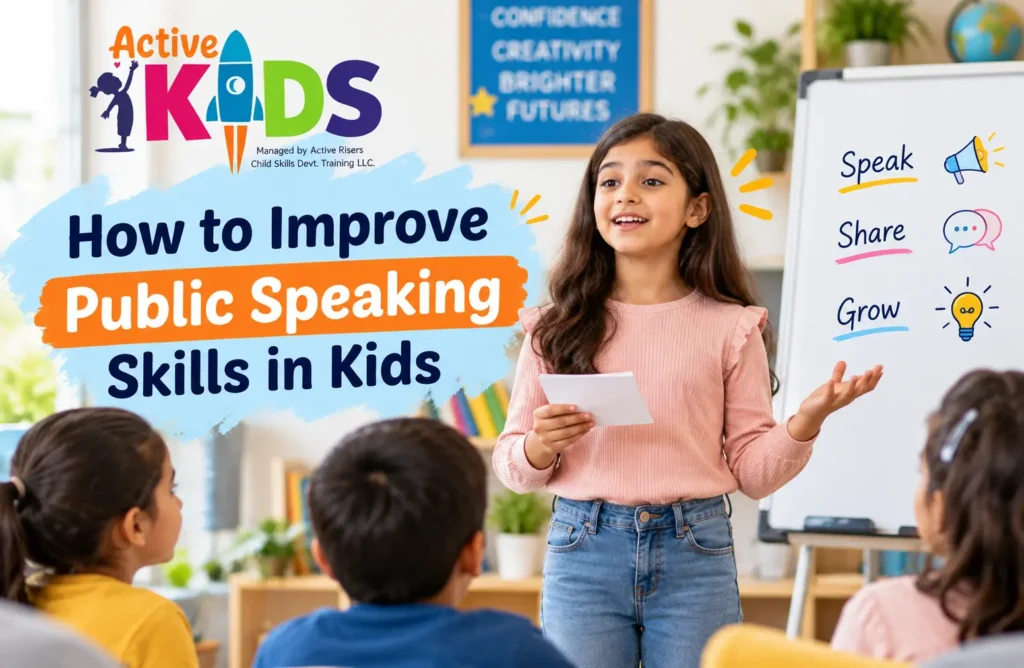
Quick Takeaway: Public speaking skills for kids are not only about standing on a stage and delivering a formal speech. They involve being able to organize thoughts, speak clearly, listen to others, explain an idea, and communicate with everyday confidence. Parents can help children develop essential speaking skills for kids through short, regular at-home practice routines, structured storytelling frameworks, and supportive, low-pressure environments.
What Are Public Speaking Skills for Kids?
Public speaking skills for kids are the practical communication skills children use when speaking to an audience, participating in school discussions, answering questions, or presenting an idea.
Developing public speaking skills for kids involves mastering several core communication habits:
- Speaking clearly: Pronouncing words distinctly so listeners understand effortlessly.
- Organising ideas: Structuring explanations logically from start to finish.
- Using an appropriate pace and volume: Avoiding rushed speech or speaking too softly.
- Listening to others: Actively processing questions and viewpoints before responding.
- Choosing suitable words: Expanding vocabulary to express thoughts accurately.
- Maintaining audience attention: Using natural eye contact and open posture.
- Using facial expressions and body language: Aligning physical cues with verbal messages.
- Presenting information in a logical order: Following a clear beginning, middle, and end.
- Answering questions calmly: Pausing to think rather than reacting impulsively.
- Practising before speaking: Building confidence through low-stakes repetition.
A child does not need to master all of these communication skills at once; they develop gradually through age-appropriate conversations and regular speaking opportunities.
Why Should Children Develop Speaking Skills?
Good speaking skills for kids help children communicate what they think, know, and feel more effectively.
For example, a child may know the answer to a question but struggle to explain it clearly. Another child may have an interesting idea but speak so quickly that teachers and peers find it difficult to follow.
Regular public speaking practice introduces children to valuable communication habits:
- Thinking before answering: Filtering thoughts before verbalizing them.
- Structuring an explanation: Sequencing information so it flows smoothly.
- Speaking at an understandable pace: Controlling tempo to maintain clarity.
- Listening before responding: Building respectful conversation habits.
- Supporting an idea with examples: Expanding beyond one-word answers.
- Presenting information in sequence: Following a logical progression of ideas.
These are essential communication habits both inside and outside the classroom.
7 Key Public Speaking Skills Children Can Develop
There is no single formula that works for every child. However, parents can focus on several core skills when helping children become confident speakers:
| # | Core Speaking Skill | Developmental Importance | Practical At-Home Exercise |
|---|---|---|---|
| 1 | Speaking Clearly | Clear speech ensures listeners understand the message without strain. | Ask your child to describe their day in 3–4 sentences, focusing on speaking slowly and clearly. |
| 2 | Organising Ideas | Structured thoughts prevent rambling and confusion. | Practice organizing answers into three parts: Beginning → Middle → End. |
| 3 | Listening Before Responding | Good speaking begins with active, attentive listening. | Ask: “Can you tell me the two things I just asked you?” to encourage thoughtful responses. |
| 4 | Using an Appropriate Pace | Balanced tempo prevents nervous rushing or trailing off. | Have your child read a paragraph too fast, too slow, and at conversational pace to notice the difference. |
| 5 | Using Body Language | Non-verbal cues reinforce spoken messages. | Practice standing comfortably, facing the audience, and using natural hand movements. |
| 6 | Expressing Ideas With Examples | Expands answers beyond simple one-word statements. | Prompt with: “Can you tell me one reason, and then give an example?” |
| 7 | Practising Regularly | Consistent, low-stakes practice builds lasting confidence. | Daily 2-minute talks on everyday topics (books, hobbies, daily learnings). |
1. Speaking Clearly
Clear speech is one of the foundations of effective communication. Encourage children to slow down when necessary and pronounce words clearly enough for the listener to understand. Instead of saying “Speak properly,” try: “Can you say that again a little more slowly?” This gives the child a practical adjustment to make.
2. Organising Ideas
A child may have plenty to say but still struggle to make the explanation easy to follow. Teach children to organise an answer into three simple parts:
- Beginning: What is the topic?
- Middle: What do you enjoy about it or find interesting?
- End: Why would you recommend it or what is your final thought?
3. Listening Before Responding
Public speaking is not only about talking; listening is an important part of communication. Practice asking questions that require careful listening rather than immediate answers, such as: “What do you think your friend meant when they said that?”
4. Using an Appropriate Speaking Pace
Some children speak very quickly when excited or nervous, while others speak too slowly. Helping them hear the contrast between rushed and conversational speaking allows them to recognize pace independently.
5. Using Body Language
Communication does not depend only on words. Posture, facial expressions, and natural gestures affect how a message is received. Focus on natural communication before polished stage techniques.
6. Expressing Ideas With Examples
Children often give short answers. When a child says “Because it’s fun,” prompt them to elaborate: “Can you give an example of why it’s fun?” This trains them to build complete explanations.
7. Practising Regularly
Public speaking practice does not always mean giving a formal speech. Explaining game rules, retelling stories, reviewing books, or sharing opinions all provide valuable practice.
How Parents Can Practise Public Speaking at Home
You do not need a stage, microphone, or large audience to create useful speaking practice:
- Daily 2-Minute Talk: Choose a simple topic (e.g., My favourite book, Something I learned today, A person I admire). Give your child a minute to think, then let them speak for two minutes uninterrupted. Afterwards, highlight one thing they did well and one thing to practice next time.
- Use “Explain It to Me”: Ask your child to explain something they already know well (e.g., “Explain how your favourite game works to someone who has never played it”). This forces them to organise information logically for another person.
- Turn Storytelling Into Speaking Practice: Ask your child to tell a story based on three simple questions:
- What happened first?
- What happened next?
- How did it end?
As confidence grows, ask: What was the problem? and How did the character solve it?
How to Help a Child Who Does Not Enjoy Speaking
Not every child will immediately enjoy public speaking. If a child is reluctant, increasing pressure will not help. Use gradual exposure:
- Step 1: Talk one-on-one to a parent in a relaxed setting.
- Step 2: Talk to a sibling or close relative.
- Step 3: Explain something to a familiar person.
- Step 4: Speak to a small group of family or friends.
- Step 5: Present to a larger group or school audience.
The pace can vary from child to child. Focus on creating opportunities for successful speaking rather than turning every conversation into a performance.
Common Mistakes Parents Should Avoid
- Avoid correcting everything at once: If working on speaking clearly, do not simultaneously correct posture, vocabulary, gestures, and grammar. Focus on one or two areas at a time.
- Avoid comparing siblings or classmates: Comparing children does not offer a constructive speaking strategy. Compare a child’s progress only to their own previous attempts.
- Avoid forcing long speeches: A structured two-minute explanation is far more useful than an exhausting five-minute speech.
- Avoid focusing only on mistakes: Always recognize what the child is already doing well before offering guidance.
A Simple Weekly Public Speaking Practice Plan
| Day | Activity | Main Skill Developed |
|---|---|---|
| Monday | Describe a picture | Vocabulary & descriptive language |
| Tuesday | Tell a short story | Narrative structure & sequencing |
| Wednesday | Explain how something works | Organization & clarity |
| Thursday | Share an opinion with examples | Expressing ideas & persuasion |
| Friday | Two-minute presentation | Presentation delivery & pace |
| Saturday | Question-and-answer game | Listening & thoughtful responding |
| Sunday | Free family conversation | Natural communication |
When Should Parents Consider Structured Public Speaking Classes?
Home practice is useful, but many children benefit from a structured environment with peers and coaches. A structured programme is worth considering when a child:
- Enjoys speaking but wants to develop presentation and debate skills.
- Needs regular opportunities to practice speaking in front of unfamiliar listeners.
- Wants to become more comfortable presenting ideas in class.
- Benefits from guided activities and constructive feedback.
- Needs opportunities to speak beyond the immediate family circle.
- Is interested in developing communication and public-speaking skills.
What Should Parents Look For in Public Speaking Classes?
If you are considering public speaking classes for kids, look beyond the course title:
- Is the programme suitable for the child’s age?
- Will the child have frequent opportunities to speak in every session?
- Are activities practical, interactive, and engaging?
- Is there a clear progression in skills?
- Will children receive positive guidance and constructive feedback?
- Does the format suit the child’s specific learning needs?
You can learn more about the options available through Active Kids Online’s public speaking classes for kids page.
Building Confidence Through Practice, Not Pressure
Confidence does not mean being the loudest child in the room. A quieter child can still become a clear, capable, and thoughtful speaker.
The focus should be on giving children manageable opportunities to:
Think → Organise → Speak → Listen → Reflect → Practise again
Over time, these experiences make speaking feel familiar and natural.
Help Your Child Become a More Confident Speaker
Developing public speaking skills for kids does not require complicated exercises. Start small. Give your child opportunities to explain, describe, tell stories, answer questions, and present ideas without expecting perfection.
And when they are ready for more structured guidance, explore Public Speaking Classes for Kids and see how Active Kids Online can support their communication journey through Speak & Shine.
The objective is simple: help children become more comfortable expressing their ideas clearly, one speaking opportunity at a time.
FAQs: How to Improve Public Speaking Skills in Kids
How can I improve my child’s public speaking skills?
Start with short, regular speaking opportunities. Ask your child to describe an object, retell a story, explain an activity, or give a two-minute presentation. Focus on one skill at a time, such as clear speech, organization, or speaking pace.
At what age should children start learning public speaking?
There is no single starting age that suits every child. Children can develop communication and speaking habits from an early age through conversations, storytelling, and age-appropriate presentation activities. More structured training can be introduced according to the child’s readiness and needs.
How can I help my child speak more clearly?
Encourage your child to slow down when necessary, pronounce words clearly, and practise explaining ideas in complete thoughts. Reading aloud and short presentation activities can also provide opportunities to practise.
What if my child is shy about speaking?
Start with low-pressure situations and familiar people. Avoid treating shyness as a defect or forcing a child into a large speaking situation immediately. Gradually introduce new speaking opportunities as the child becomes more comfortable.
Can public speaking skills be practised at home?
Yes. Parents can use storytelling, picture descriptions, two-minute talks, opinion questions, explanations, and simple presentations as regular speaking practice.