

Some children know the answer but keep their hands down when a teacher asks a question. They may worry about making a mistake, struggle to find the right words or feel uncomfortable speaking while everyone is listening.
At home, the same child might explain a school topic quite clearly. In the classroom, however, they may hesitate even when they understand the lesson.
Learning how to help kids answer questions in class starts with understanding what makes speaking difficult for them. More studying is not always the answer. Sometimes, children need time to organise their thoughts, reassurance that mistakes are part of learning and regular opportunities to express themselves.
Parents can help by making everyday conversations a little more encouraging and giving children practical ways to prepare for classroom discussions.
Why Do Some Children Hesitate to Answer Questions?
There is no single reason a child might avoid speaking in class. The difficulty could be related to confidence, language, the classroom environment or the type of question being asked.
Here are a few possibilities worth considering:
- Fear of getting the answer wrong: A child may worry about classmates laughing or the teacher correcting them in front of everyone.
- Not enough thinking time: Some children need longer to understand a question and organise a response.
- Difficulty expressing ideas: They may know what they want to say but struggle to put it into a complete sentence.
- Limited speaking practice: Children who rarely explain their thoughts aloud may find classroom discussions unfamiliar.
- Previous uncomfortable experiences: Being interrupted, criticised or teased can make a child reluctant to participate again.
These difficulties do not necessarily mean that a child lacks knowledge or confidence in every situation.
Pay attention to when the hesitation occurs. Does your child speak comfortably with family but become quiet in front of classmates? Do they struggle with questions in English but respond easily in another language? Or do they find it difficult to explain their ideas even in familiar settings?
Noticing these differences can help you decide what kind of support would be most useful.
How to help kids answer questions in class: 7 practical strategies
1. Give Your Child Time to Think
Some children need a few extra seconds to recall what they learned, decide what matters and put their thoughts into words. Asking another question immediately or supplying the answer can interrupt that process.
Try a simple example at home.
Ask, “Why do you think plants need sunlight?” Then wait quietly instead of repeating the question or answering it yourself.
If your child seems unsure, offer a smaller prompt: “What do you remember about how plants grow?”
This helps your child work towards an answer without taking away the opportunity to think independently.
Teachers can use the same approach in the classroom. In Extending the Silence: Giving Students Think Time, Edutopia educator John McCarthy explains how allowing students more time to process questions can support more considered responses.
The important point is that a quick answer is not always a better answer. Children should have a reasonable opportunity to demonstrate what they know.
2. Start With Questions Your Child Can Answer Comfortably
If your child is reluctant to speak, begin with familiar subjects rather than turning every conversation into a test.
You could ask:
- What was the most interesting thing you learned today?
- Which part of the story did you enjoy?
- How did you solve that problem?
- What would you do differently next time?
Let your child answer in their own words. Once they become comfortable, introduce questions that require a little more explanation.
For example, move from “Did you enjoy the story?” to “Which character did you like most, and why?”
This gradual approach gives children opportunities to practise explaining their thinking without feeling that every response will be judged.
There is no need to correct every sentence. Sometimes, listening to the complete answer is the most helpful thing a parent can do.
3. Teach Simple Sentence Starters
A child may have a good idea but not know how to begin explaining it. Sentence starters can provide a useful structure while they develop their own speaking style.
Practise phrases such as:
- “I think the answer is…”
- “My reason is…”
- “I agree because…”
- “One example is…”
- “I would like to add that…”
Suppose your child is asked why recycling is important. They could begin with, “I think recycling is important because it reduces waste.”
The sentence starter gives them somewhere to begin. They can then add their own explanation or example.
Use these phrases during conversations about books, school projects, current events or everyday decisions. Encourage your child to explain their reasoning rather than memorise a fixed response.
Over time, they may find it easier to begin speaking without needing a prompt.
4. Practise Speaking Before an Audience
Answering a question at home can feel very different from answering it in front of an entire class.
Give your child opportunities to rehearse aloud. Ask them to explain a science concept, describe a favourite book or tell you how they completed a school project.
Keep practice sessions short. A few questions during an ordinary conversation may be more manageable than a long session that feels like additional homework.
You can also introduce a simple routine:
- Give your child a question.
- Let them think quietly before answering.
- Ask them to explain their answer in their own words.
- Offer one suggestion if they need help making the explanation clearer.
When they become comfortable, practise with another family member or a small group. There is no need to rush them into speaking before they feel ready.
For more ideas, read our guide to public speaking skills for kids and how to improve them.
5. Help Your Child Become Comfortable With Mistakes
Some children remain silent because they believe a wrong answer will embarrass them. They may prefer not to respond at all rather than risk being corrected.
When your child makes a mistake, avoid turning the moment into a lecture. Help them understand what they can learn from it.
For example, you might say, “Let’s look at the question again. Which part gives us a clue?”
If their answer is partly correct, acknowledge what they understood before discussing what needs to change.
You can also share an example from your own experience when you misunderstood something and had to correct yourself. This shows children that learning involves revising our thinking.
The aim is not to suggest that every answer is correct. It is to help children understand that getting something wrong is not a reason to stop participating.
6. Encourage Explanations, Not Just Memorised Answers
Memorising information can be useful for certain school tasks, but children also need to explain ideas in their own words.
After your child completes a homework question, ask, “How did you work that out?” or “Can you show me another example?”
If they read a passage, ask them to explain the main idea. If they solve a maths problem, invite them to describe the steps they followed.
These conversations help children organise their thoughts and communicate their reasoning.
They also help you identify whether your child understands the subject but struggles to explain it, or needs additional help with the lesson itself.
If your child finds it difficult to explain an answer, give them time to think before offering a prompt. The aim is to help them develop their own explanation, not simply repeat yours.
7. Make Speaking Part of Everyday Life
Confidence does not usually develop through one conversation. Children benefit from regular opportunities to express themselves in different situations.
Try incorporating speaking into activities your family already enjoys:
- Ask your child to describe a meal they would like to prepare.
- Let them explain the rules of a favourite game.
- Invite them to share an opinion about a story or film.
- Encourage them to tell a short story during family time.
- Ask them to explain something new they learned at school.
Listen to the full answer before correcting grammar or pronunciation. When you offer feedback, focus on one specific improvement rather than several at once.
For example, you might say, “You explained your idea clearly. Next time, try speaking a little more slowly so everyone can follow.”
These everyday activities provide opportunities to practise speaking, listening and responding to others without making every conversation feel like a classroom exercise.
How Can Parents Encourage Classroom Participation Without Pressure?
Parents sometimes respond to a child’s hesitation by asking them to practise more questions every day. Although the intention is good, constant correction can make speaking feel like another school assignment.
A better approach is to make conversation a normal part of family life.
Give your child enough time to finish a sentence. Ask questions that genuinely interest you. Show curiosity about their ideas, even when their explanation is not perfectly organised.
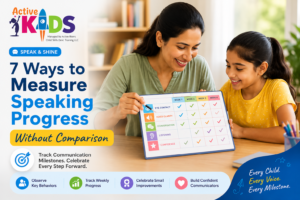
It also helps to notice small changes. Perhaps your child has started giving longer answers at dinner, asking a question during homework or explaining a school activity without being prompted.
These are useful signs of progress, even if they have not yet started volunteering answers regularly in class.
If your child consistently struggles to understand questions, find words or communicate across different settings, consider speaking with their teacher. Depending on the difficulty, guidance from an appropriate educational or speech-language professional may also help.
Can Public Speaking Classes Help Children Participate More Confidently?
Classroom participation involves more than knowing the subject. Children must also listen, organise their thoughts, choose their words and communicate while others are paying attention.
Structured speaking activities can give children opportunities to practise these skills in a supportive environment. Depending on the programme, activities may include storytelling, presentations, elocution, role-play and discussions.
Active Kids Online’s Speak & Shine public speaking programme includes elocution, speech and drama, and debate. These activities give children different ways to practise expressing ideas, speaking clearly and responding to others.
A class is not a guaranteed solution for every child, and progress will vary. The programme should suit the child’s age, needs and comfort level, with opportunities to participate rather than simply watch or memorise speeches.
Parents can explore the programme and book a free trial to understand whether its teaching approach is suitable for their child.
Help Your Child Feel More Comfortable Speaking Up
A child who stays quiet in class does not necessarily lack ideas. They may simply need more time, a little encouragement or a better way to organise their thoughts before speaking.
Start with ordinary conversations at home. Listen carefully, ask questions that invite explanation and let your child make mistakes without feeling embarrassed. As speaking becomes a more familiar part of daily life, classroom participation may begin to feel less intimidating.
If your child would benefit from guided practice, explore Active Kids Online’s Speak & Shine programme to learn about its public speaking, elocution, speech and drama, and debate activities. You can also book a free trial to see whether the programme suits your child’s needs.
The goal is not to make every child the first to raise their hand. It is to help them feel increasingly comfortable sharing what they think and know.
FAQs: How to Help Kids Answer Questions in Class
How to help kids answer questions in class when they feel nervous?
Start by practising familiar questions at home in a relaxed setting. Give your child time to think, let them finish their answers and avoid criticising mistakes harshly. As they become more comfortable, encourage them to share one idea during a small-group activity or classroom discussion.
Why does my child know the answer but refuse to speak in class?
A child may understand the subject but worry about making a mistake, being judged by classmates or struggling to find the right words. Observe when the hesitation occurs and discuss it calmly with your child and their teacher. The reason may differ from one child to another.
What questions can I ask to improve my child’s classroom communication skills?
Use open-ended questions about everyday experiences. Ask what they learned, why they liked a particular activity, how they solved a problem or what they would do differently. Follow-up questions encourage children to explain their thinking instead of giving only yes-or-no answers.
Should I correct my child’s grammar when they answer a question?
Not every time. If your child is already hesitant, correcting every grammatical error can interrupt their train of thought. Let them complete their answer first, then offer one helpful suggestion when appropriate. Focus on clear communication and gradually work on accuracy.
Can online public speaking classes help shy children participate in school?
They may help when classes provide supportive, age-appropriate speaking practice and constructive feedback. Storytelling, guided discussions, presentations and drama activities can give children opportunities to express themselves. Results vary, so choose a programme that encourages participation without putting unnecessary pressure on the child.
How long does it take for a child to become more confident when answering questions?
There is no fixed timeline. Some children begin speaking more freely after a few positive experiences, while others need continued support and practice. Look for gradual changes in how comfortably your child explains ideas, asks questions and participates, rather than expecting an immediate transformation.