
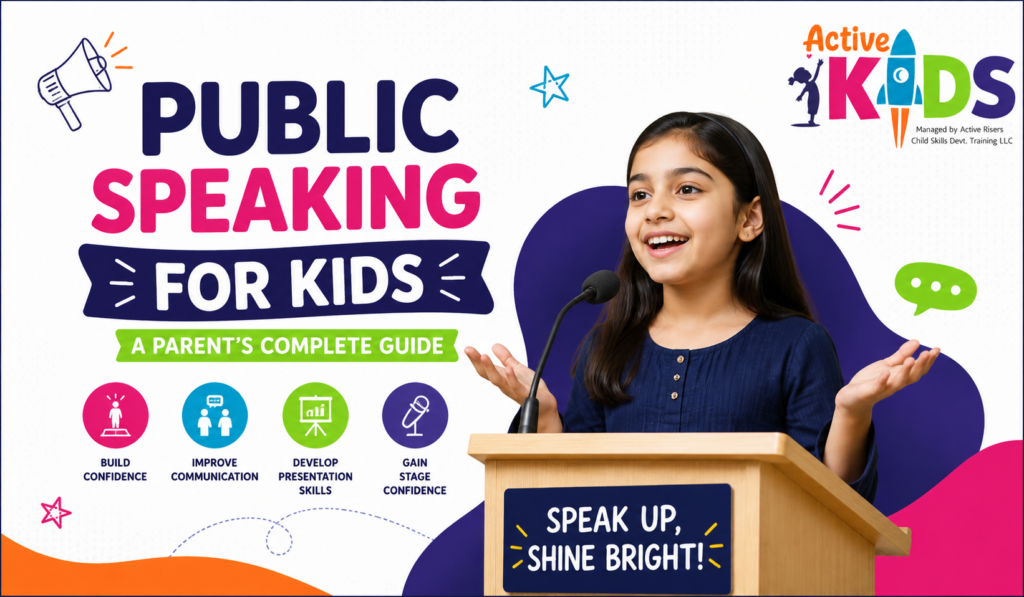
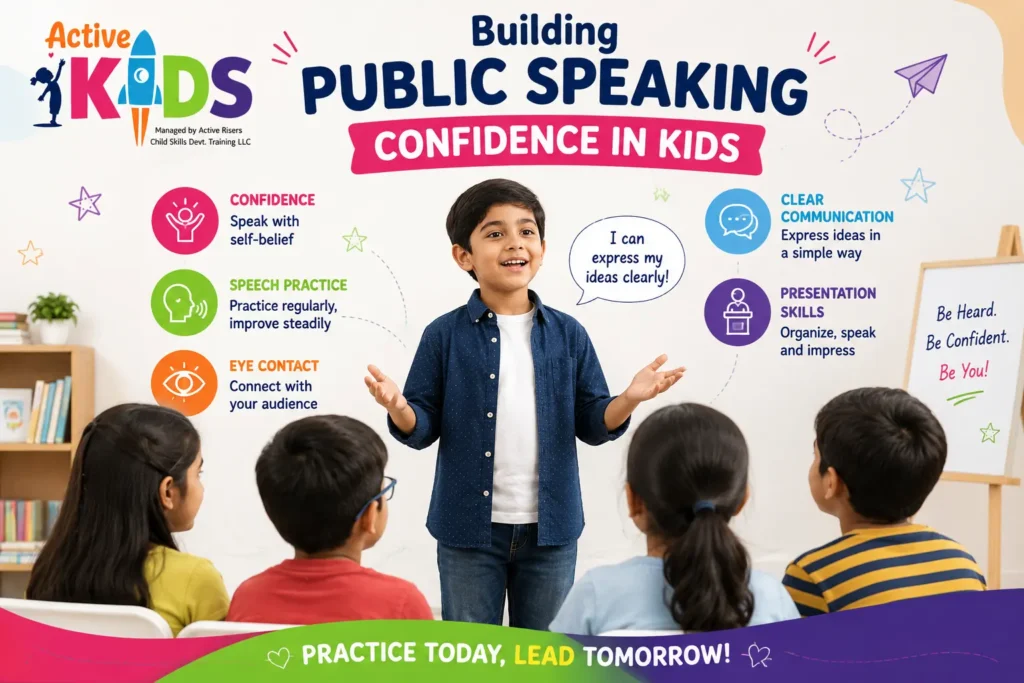
A child who can confidently express an idea, tell a story, or speak in front of others has a valuable skill that extends far beyond the classroom. Public speaking for kids helps children develop the confidence to communicate their thoughts clearly, participate more actively, and handle situations where they need to speak in front of others.
However, becoming a confident speaker does not happen overnight. Children may feel nervous about making mistakes, forgetting what they want to say, or being judged by their classmates. With regular practice and the right encouragement, these challenges can become opportunities for growth.
For parents, the goal isn’t to turn every child into a professional speaker. It is to help them develop strong speaking skills, communication skills, presentation skills, and stage confidence that can support them at school and throughout their lives.
Why Public Speaking Matters for Kids
Public speaking is more than standing on a stage and delivering a speech. For children, it is an opportunity to learn how to express ideas, interact with others, and communicate with greater confidence. Developing these abilities early can make everyday communication easier and help children feel more comfortable in academic and social situations.
Building Confidence Beyond the Classroom
One of the biggest benefits of public speaking for kids is the opportunity to build confidence through repeated practice. A child who initially feels nervous answering a question in class may gradually become more comfortable sharing an opinion, giving a presentation, or speaking to a group.
This confidence develops when children experience small successes. Completing a short speech, telling a story to their classmates, or presenting an idea to their family can show them that they are capable of communicating effectively.
Parents can support this process by focusing on effort rather than perfection. Instead of correcting every mistake, encourage children to speak clearly, finish their thoughts, and try again when something does not go as planned. Over time, regular speech practice can make speaking in front of others feel less intimidating.
Developing Communication Skills
Public speaking skills for children also contribute to stronger everyday communication. Children learn how to organise their thoughts, choose appropriate words, listen to others, and explain their ideas in a way that people can understand.
These communication skills can be useful in many situations, from classroom discussions and group projects to conversations with teachers and friends. Children also begin to understand that effective communication involves more than words. Voice, facial expressions, posture, eye contact, and body language can all influence how a message is received.
When children practise kids public speaking in a supportive environment, they can gradually become more aware of these elements. The result is not simply a child who can deliver a speech, but a young communicator who feels more prepared to express themselves.
What Are Public Speaking Skills for Children?
Public speaking skills for children involve much more than memorising a speech. They include the ability to organise thoughts, communicate ideas clearly, use appropriate body language, and adapt the way they speak depending on the audience.
These skills develop gradually. Children do not need to deliver long or complicated speeches to become better speakers. Short, regular opportunities to communicate can help them build confidence while developing practical speaking skills.
Speaking Clearly
Clear speech is one of the foundations of effective public speaking for kids. Children need to learn how to speak at an appropriate volume, pronounce words carefully, and use a pace that allows listeners to follow what they are saying.
Parents can encourage children to slow down when they become excited or nervous. Reading aloud, storytelling, and practising short speeches can also improve clarity and make speaking feel more natural.
The objective is not perfect pronunciation. It is helping children communicate their ideas so that others can understand them easily.
Organising Ideas
Even confident speakers can struggle when they do not know what they want to say. Teaching children to organise their thoughts gives their speech a simple structure.
A useful approach is to introduce three basic stages:
- Beginning: Introduce the topic or main idea.
- Middle: Explain the important points or tell the story.
- End: Summarise the message or give a clear conclusion.
This simple structure can improve presentation skills and help children avoid losing their train of thought while speaking.
Using Body Language
Effective speaking is also influenced by how a child presents themselves physically. Eye contact, facial expressions, posture, hand movements, and gestures can help reinforce the message.
Children should not be expected to control every movement while speaking. Instead, public speaking for kids should gradually introduce them to natural and purposeful body language.
Practising in front of a mirror or recording a short presentation can help children notice their posture, facial expressions, and speaking habits. With regular speech practice, these behaviours can become more comfortable and natural.
How to Build Public Speaking Confidence in Kids
Confidence is not something every child naturally has when they step in front of an audience. It develops through preparation, encouragement, and repeated opportunities to speak. The best approach to public speaking for kids is to make speaking practice feel achievable rather than intimidating.
Start with Small Speaking Opportunities
Children do not need to begin with a five-minute speech in front of a large audience. Start with situations where they already feel comfortable.
Ask your child to explain how they built something, describe their favourite book, tell a short story, or share an opinion during a family conversation. These small activities allow children to practise expressing ideas without the pressure of a formal presentation.
As their comfort grows, gradually increase the audience and complexity of the activity. This step-by-step approach can strengthen public speaking confidence without overwhelming the child.
Encourage Regular Speech Practice
Like any skill, speaking improves with practice. Occasional preparation before a school presentation may help with a specific task, but consistent speech practice can create lasting improvement.
Set aside a few minutes several times a week for simple speaking activities. Children can practise introducing themselves, describing a picture, explaining a topic, or delivering a short presentation.
Parents can also ask open-ended questions rather than questions that require only a yes-or-no answer. This encourages children to explain their thinking and develop stronger communication skills.
Make Mistakes Part of Learning
Fear of making mistakes is one of the biggest barriers to confident speaking. Children may worry about forgetting a word, stumbling over a sentence, or receiving a negative reaction from others.
Parents can help by treating mistakes as a normal part of learning. Avoid interrupting constantly to correct minor errors while a child is speaking. Instead, let them complete their thought and provide constructive feedback afterwards.
Praise specific improvements such as speaking louder, maintaining eye contact, organising ideas clearly, or showing greater stage confidence. When children understand that mistakes are not failures, they are more willing to participate, experiment, and keep improving.
The goal of kids public speaking is therefore not flawless performance. It is helping children become comfortable expressing themselves, even when they feel nervous.
Public Speaking Activities for Kids at Home
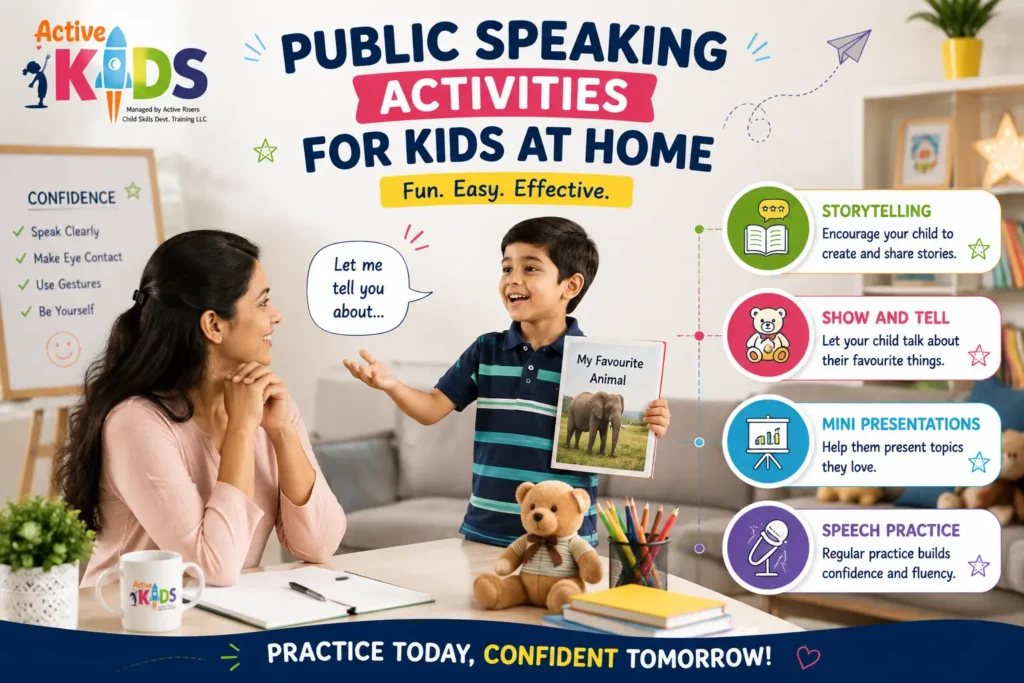
Children can develop public speaking for kids skills without needing a formal stage or classroom. Home provides a low-pressure environment where parents can introduce simple activities that make speaking enjoyable while building confidence and communication skills.
Storytelling
Storytelling is one of the easiest ways to encourage children to speak creatively. Ask your child to tell a story about a recent experience, create a fictional character, or continue a story that you start.
Encourage them to think about a beginning, middle, and ending. This helps develop speaking skills while teaching children how to organise information logically.
Parents can occasionally introduce a small challenge, such as telling the story without reading from notes. This encourages children to focus on communicating ideas rather than memorising every sentence.
Show and Tell
Show and tell can turn everyday objects into opportunities for speech practice. Ask your child to choose a favourite toy, book, drawing, or object and explain why it is important to them.
Give them three simple questions to answer:
- What is it?
- Why did you choose it?
- What would you like others to know about it?
This activity is particularly useful for younger children because they already have knowledge and enthusiasm about the subject. Familiar topics can make public speaking for kids feel much less intimidating.
Mini Presentations
Short presentations can gradually prepare children for speaking in front of larger groups. Choose an age-appropriate topic and give your child two or three minutes to explain it.
Topics could include a favourite animal, sport, hobby, book, destination, or school subject. Encourage them to use a simple structure and practise their delivery before presenting.
As children become more comfortable, introduce presentation skills such as eye contact, appropriate gestures, voice variation, and confident posture.
The key is to keep these activities supportive rather than turning them into tests. When children associate speaking with curiosity and enjoyment, they are more likely to participate willingly and develop stronger public speaking confidence over time.
When Should Children Start Learning Public Speaking?
There is no single age at which children should begin learning public speaking for kids. In fact, basic communication and speaking activities can be introduced from an early age and gradually become more structured as children grow.
Young children can start with simple activities such as storytelling, show and tell, reading aloud, and answering questions in complete sentences. These experiences help them become comfortable expressing themselves in front of others.
As children get older, activities can progress towards short presentations, debates, speeches, group discussions, and formal presentations. The level of difficulty should match the child’s age, personality, and existing speaking skills rather than focusing solely on performance.
Why Starting Early Can Help
Early exposure gives children more time to practise before they encounter situations where strong public speaking skills for children become important. School presentations, competitions, interviews, group projects, and extracurricular activities can all require children to communicate ideas confidently.
Starting early also allows children to develop public speaking confidence gradually. Instead of expecting a child to suddenly feel comfortable on stage, parents can create many small opportunities for speaking over several years.
However, starting early does not mean putting pressure on children to perform. The purpose should be to make communication familiar, enjoyable, and achievable. With consistent speech practice, children can develop confidence at their own pace.
Every Child Develops Differently
Some children naturally enjoy being the centre of attention, while others may prefer quieter forms of communication. Both are normal.
A child who is shy should not be forced into uncomfortable situations simply to make them speak. A better approach is to begin with familiar people and gradually introduce new audiences as their confidence improves.
This supportive progression can help children develop stage confidence without feeling that they are being judged. Over time, regular opportunities to practise kid’s public speaking can make speaking to groups feel like a normal part of communication rather than something to fear.
How Parents Can Support Kids Public Speaking at Home
Parents have an important role in helping children develop public speaking for kids skills. The home environment can either make speaking feel stressful or provide a safe space where children can practise, make mistakes, and improve.
The most effective support is consistent and encouraging rather than overly critical.
Create a Safe Speaking Environment
Children are more likely to speak confidently when they know they will not be laughed at or criticised for making mistakes. Give your child time to finish their thoughts without interrupting or correcting every sentence.
Ask questions that encourage explanation, such as, “What made you think that?” or “Can you tell me more about it?” This turns everyday conversations into opportunities to practise communication skills.
Give Constructive Feedback
Feedback should help children understand what they are already doing well and what they can improve.
Instead of simply saying, “Speak louder,” be specific: “Your ideas were clear, but try speaking a little louder so everyone can hear you.”
Parents can also highlight positive improvements in eye contact, posture, voice, organisation, and delivery. This helps children understand that public speaking confidence develops through small improvements rather than perfect performances.
Practise Without Over-Memorising
Memorising every word of a speech can sometimes make children more nervous if they forget a sentence. Encourage them to understand their topic and remember the key points instead.
Using short notes, keywords, pictures, or simple prompts can help children maintain their structure while still speaking naturally. This approach strengthens presentation skills and allows children to focus on communicating their ideas.
Make Speaking Part of Everyday Life
The most sustainable way to develop speaking skills is to make practice a normal part of daily life. Let children explain a game, recommend a book, describe something they learned, or share their opinion during family conversations.
These small moments provide regular speech practice without making every activity feel like a formal lesson.
With patience, encouragement, and consistent opportunities to communicate, parents can help children become more comfortable speaking to others. The goal of public speaking is not to eliminate nervousness completely, but to give children the skills and confidence to speak even when they feel nervous.
Conclusion
Strong communication skills can give children an advantage that extends well beyond a single school presentation. Public speaking for kids helps children learn to organise their thoughts, communicate ideas clearly, listen to others, and develop greater confidence when speaking in front of an audience.
The process does not have to begin with a formal speech. Storytelling, show and tell, family discussions, reading aloud, and short presentations can all provide valuable speech practice. As children become more comfortable, parents can gradually introduce larger audiences and more challenging speaking activities.
Most importantly, children need an environment where mistakes are treated as part of learning. With encouragement, regular practice, and age-appropriate guidance, they can develop public speaking confidence at their own pace.
For parents looking to take this development further, structured programmes can provide children with guided opportunities to practise speaking skills, presentation skills, stage confidence, and communication skills in a supportive learning environment. Active Kids Online can help children build these abilities through engaging learning experiences designed to make communication practice practical and enjoyable.
FAQs About Public Speaking for Kids: A Parent’s Complete Guide
How can I help my child overcome stage fear?
Start with short, low-pressure speaking activities at home. Storytelling, show and tell, and one-minute talks can gradually build public speaking confidence before children speak to larger audiences.
At what age should kids start learning public speaking?
Children can begin developing public speaking skills for children through simple storytelling, reading aloud, and family conversations from an early age. More structured presentations can be introduced as they grow.
How can I practise public speaking with my child at home?
Try storytelling, show and tell, mirror practice, and mini presentations. Keep sessions short, let your child finish speaking without interruption, and give specific feedback afterwards.
Why does my child go blank when speaking in public?
Children may go blank because of nervousness, insufficient practice, or difficulty organising their thoughts. Practising simple speech structures and speaking regularly can help them feel more prepared and confident.