
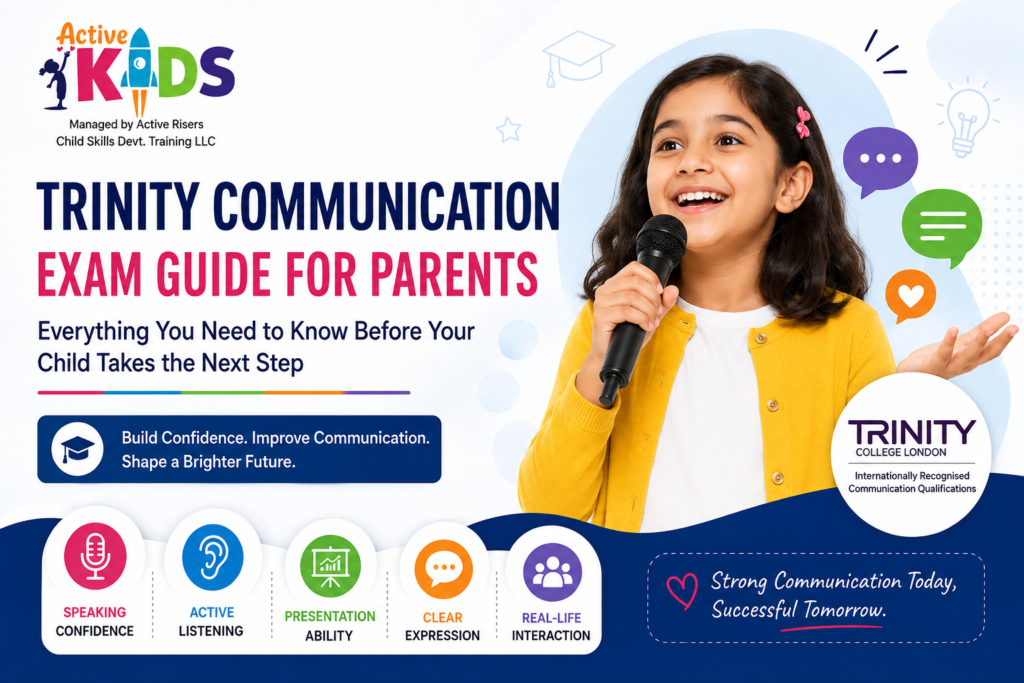
If you’ve recently heard about Trinity Communication exams through your child’s school, another parent, or an education programme, you may be wondering what they involve and whether they’re the right choice for your child. Many parents mistakenly assume these assessments are high-pressure English exams, when in reality they focus on developing practical communication skills and speaking confidence. This Trinity communication exam guide for parents explains how the qualification works, the skills children develop, what to expect during preparation, and how the assessment supports long-term communication growth. Whether your child is naturally confident or needs encouragement to express themselves, understanding the Trinity framework will help you make an informed decision about their learning journey.
What Are Trinity Communication Qualifications?
Trinity College London is an internationally recognized awarding organization known for its qualifications in English language, communication, music, and the performing arts. Its Trinity communication certification is designed to assess practical communication rather than written grammar or memorization. Through graded communication exams, children are evaluated on their ability to express ideas clearly, listen actively, engage in meaningful conversations, and communicate confidently in real-life situations.
Unlike many traditional school assessments, Trinity College London exams focus on the communication skills children use every day. This oral communication assessment measures speaking, listening, presentation, and interaction skills—abilities that support classroom participation, teamwork, leadership, and future academic success. As communication becomes increasingly important in education and professional life, these practical skills are valued by schools, universities, and employers worldwide.
The Trinity pathway is structured to support children at different stages of development, with age-appropriate progression from beginner to advanced levels. Instead of comparing children with one another, the framework encourages steady improvement in spoken English, confidence, and communication skills, making it a trusted choice for families seeking a recognized spoken English certification.
Why Communication Skills Matter Beyond Exams
While receiving a certificate is an important achievement, the greatest benefit of Trinity communication classes is the lifelong confidence children develop. Strong communication skills help children express their ideas clearly, ask thoughtful questions, solve problems, and build meaningful relationships. These abilities also support critical thinking, emotional intelligence, and self-confidence—skills that extend far beyond the classroom.
As children become more comfortable speaking in different situations, they are better prepared to participate in class discussions, present their ideas, collaborate with peers, and communicate confidently in everyday life. Rather than preparing children only for an assessment, the Trinity communication curriculum helps them develop practical skills they can use throughout their education and beyond.
What Skills Do Children Develop Through Trinity Communication?
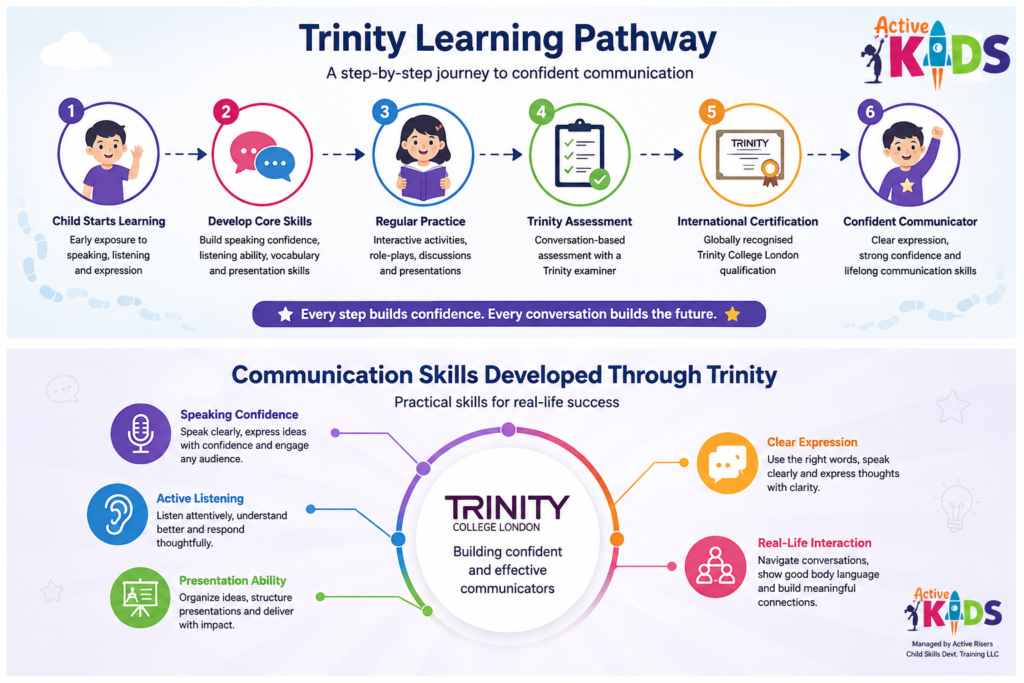
A well-designed communication curriculum helps children build practical skills they use every day, not just during an assessment. Instead of focusing only on exam preparation, Trinity preparation encourages steady growth in speaking, listening, and interpersonal communication. These skills support children throughout their school years and prepare them for future academic and social situations.
| Skill Area | Core Learning Objective | Real-World Application |
| Speaking Confidence | Express ideas clearly and speak with confidence. | Classroom participation, introductions, public speaking. |
| Active Listening | Listen carefully and respond thoughtfully. | Following instructions, group discussions, conversations. |
| Presentation Ability | Organize ideas in a clear and logical way. | School presentations, show-and-tell, project work. |
| Clear Expression | Build vocabulary, clarity, and effective speech. | Explaining ideas, sharing opinions, storytelling. |
| Real-Life Interaction | Develop natural conversation and social communication. | Interviews, teamwork, social situations, collaborative activities. |
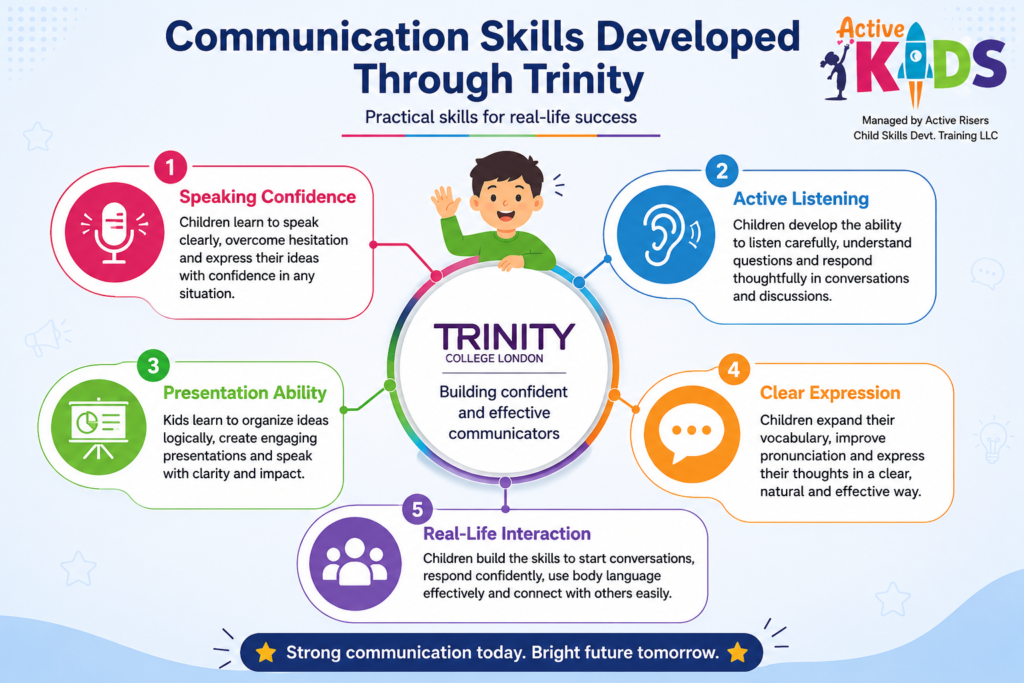
Speaking Confidence
Confidence develops through regular practice and encouragement. Children gradually learn to speak clearly, maintain eye contact, and express their thoughts with greater confidence in both classroom and everyday situations.
Listening Skills
Strong communication begins with listening. During an oral communication assessment, children demonstrate their ability to understand questions, process information, and respond thoughtfully through natural conversation rather than memorized answers.
Presentation Ability
Children learn to organize their ideas into clear, engaging presentations with a logical beginning, middle, and end. They also practice speaking confidently while keeping their audience interested.
Clear Expression
Children expand their vocabulary, improve pronunciation, and learn to communicate with greater clarity. Regular speaking activities help them organize their thoughts and express ideas in a confident, meaningful way.
Real-Life Communication
One of the strengths of Trinity speaking exams is their focus on genuine interaction. Instead of relying on scripted responses, children develop the confidence to take part in natural conversations, respond to questions, and communicate effectively in everyday situations.
What Should Parents Expect During Trinity Preparation?
Preparing for a Trinity assessment should be an enjoyable and confidence-building experience, not a stressful one. A well-structured Trinity preparation programme focuses on helping children develop communication skills gradually through consistent practice, encouragement, and interactive learning.
In a supportive classroom, children take part in activities such as storytelling, role-playing, discussions, presentations, and topic-based conversations. These age-appropriate activities encourage children to share their ideas, improve their speaking confidence, and communicate naturally. Rather than memorizing scripts, they learn to express themselves in a comfortable and engaging environment.
Constructive feedback is an important part of the learning process. Teachers recognize each child’s strengths while helping them improve pronunciation, articulation, body language, and presentation skills. This positive approach allows children to enjoy learning and build confidence step by step.
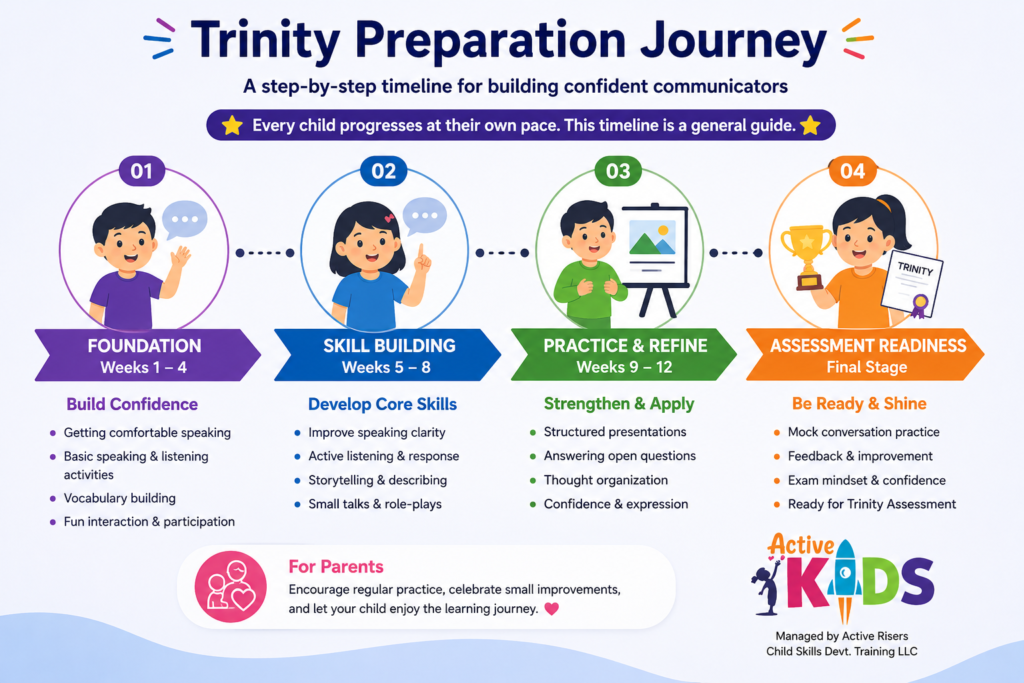
Typical Preparation Timeline
One of the most common questions parents ask is how long Trinity preparation takes. The answer depends on a child’s age, current communication skills, and previous experience with speaking activities. Some children may need several months to build a strong foundation, while others progress more quickly. The goal is steady improvement in confidence and communication rather than rushing towards an assessment.
How Do Trinity Communication Assessments Work?
One of the reasons parents appreciate Trinity College London exams is their child-friendly assessment approach. Instead of a traditional written exam, Trinity speaking exams are conducted as an interactive conversation between the child and a trained Trinity examiner.
The assessment focuses on practical communication rather than memorization. Children are encouraged to share ideas, answer questions, demonstrate active listening, and engage in natural discussions. During the oral communication assessment, examiners evaluate how confidently children communicate, organize their thoughts, and respond in real-life situations.
Because the assessment is conversation-based, children who regularly participate in Trinity communication classes develop the confidence to communicate naturally instead of relying on memorized responses.
Understanding the Exam Environment
The assessment environment is designed to help children feel relaxed and confident. Examiners create a friendly atmosphere that encourages natural conversation. For introductory levels, children may be invited to talk about a favorite object, book, or topic they enjoy, helping them feel comfortable while demonstrating their communication skills.
Common Misconceptions About Trinity Communication Exams
Many parents have questions about Trinity communication certification, and some common misconceptions can make the decision more confusing. Understanding the facts helps families choose the right communication programme for their child.
Misconception 1: Children must speak fluent English.
Fact: No. Trinity offers progressive levels suitable for both native and non-native English speakers. The focus is on continuous improvement rather than perfect English.
Misconception 2: Trinity is only for confident or high-achieving students.
Fact: Children of all confidence levels can participate. Many shy children gradually become more comfortable expressing themselves through regular speaking activities.
Misconception 3: Children need to memorize long speeches.
Fact: Trinity assessments encourage genuine communication and interaction rather than scripted or memorized answers.
Misconception 4: The assessment is stressful for young children.
Fact: The assessment is designed to be supportive and conversational, allowing children to demonstrate their abilities in a comfortable environment.
Misconception 5: Trinity only helps with school results.
Fact: While improved communication can support academic success, the biggest benefits include confidence, presentation skills, critical thinking, and effective everyday communication.
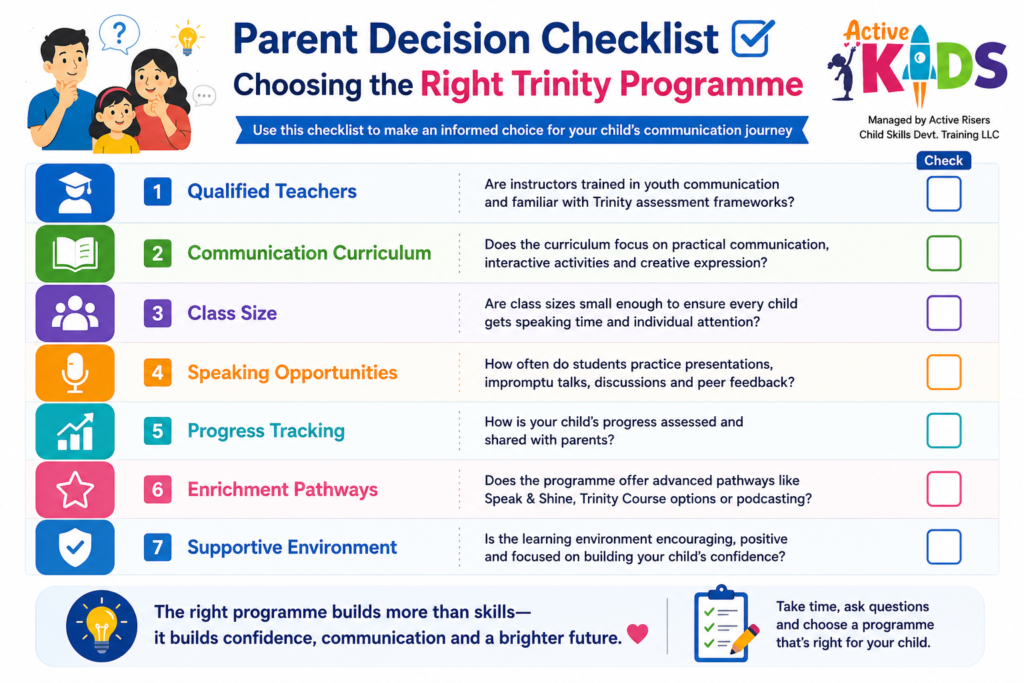
Questions Parents Should Ask Before Choosing a Trinity Programme
Choosing the right learning environment is just as important as choosing the qualification itself. Before enrolling your child in Trinity communication classes, consider asking these questions:
- Are the teachers trained in Trinity communication and child development?
- Does the communication curriculum focus on practical speaking and confidence building rather than memorization?
- Are class sizes small enough for every child to participate regularly?
- How often do children practice presentations, discussions, and interactive speaking activities?
- How is progress measured and shared with parents?
- Does the programme provide additional learning opportunities, such as Speak & Shine or other communication-focused activities?
Asking these questions will help you choose a programme that supports your child’s long-term communication development rather than simply preparing them for an assessment.
Conclusion
Communication is one of the most valuable life skills a child can develop. Trinity College London exams provide a structured and internationally recognized pathway for building speaking confidence, listening skills, and effective communication from an early age.
This Trinity communication exam guide for parents is designed to help families understand how the qualification works, what children learn throughout the journey, and what to consider before choosing a programme. By making an informed decision and selecting a supportive learning environment, parents can help their children develop confidence that extends far beyond the assessment.
Active Kids Online offers Trinity communication classes in collaboration with Trinity College London, providing children with a structured, supportive learning experience that builds confidence, communication skills, and presentation ability through age-appropriate guidance.
FAQs: Trinity Communication Exam Guide for Parents: What to Know
What is the Trinity Communication Exam?
The Trinity Communication Exam is an international oral assessment conducted by Trinity College London. It evaluates a candidate’s practical spoken English, presentation skills, listening ability, and conversational confidence through an interactive dialogue with an examiner rather than a written test.
Is Trinity recognized internationally?
Yes, Trinity College London qualifications are recognized globally by educational authorities, international schools, universities, and employers as a respected standard of oral communication competence.
What age can children start Trinity?
Children as young as 4 years old can begin introductory Trinity communication classes. The initial grades are tailored for early childhood, focusing on basic self-expression, listening, and play-based speaking activities.
How difficult are Trinity exams?
Trinity exams are designed to be accessible and progressive rather than intimidating. Because the assessment is divided into incremental grades, children are entered for levels matched to their current stage of developmental readiness.
How long does preparation take?
Preparation time varies based on the child’s age, starting confidence level, and class frequency. Typically, students spend several months engaging in regular communication practice before taking an assessment to build natural confidence.
Do children need fluent English?
No, children do not need complete fluency to start. Trinity offers entry-level grades specifically designed for early language learners and ESL students to develop spoken English skills step-by-step.
Why choose Trinity over other communication programmes?
Trinity stands out because of its focus on candidate-led interaction and authentic conversation rather than rigid testing. Its international accreditation, clear progression pathway, and emphasis on real-life speaking make it one of the most trusted communication standards worldwide.