
Have you ever listened to your child tell an incredible story, only to watch them stare at a blank piece of paper moments later?
Perhaps they can explain how dinosaurs became extinct, describe an imaginary adventure in remarkable detail, or confidently talk about what happened at school. Yet, when it’s time to write those same ideas down, they suddenly become quiet, frustrated, or insist they “don’t know what to write.”
If this sounds familiar, you’re far from alone.
Many parents worry that their child cannot express ideas in writing, even though they speak confidently in everyday conversations. It’s easy to assume they dislike writing or simply need more practice. In reality, the explanation is often far more complex—and far more reassuring.
Writing isn’t simply “talking with a pencil.” It is one of the most demanding cognitive tasks a child learns during their school years. While speaking develops naturally through everyday interaction, writing requires the brain to coordinate multiple mental processes simultaneously. A child must generate ideas, organise them logically, remember vocabulary, plan sentences, recall spelling, manage punctuation, and physically write—all while trying not to lose their original thought.
For many children, that’s an enormous mental workload.
Understanding what’s happening inside your child’s brain can completely change how you view their writing struggles. Instead of seeing laziness or a lack of effort, you’ll begin to recognise the hidden cognitive processes that make written expression challenging for many capable children.
In this article, we’ll explore why some children who love storytelling freeze when writing, how working memory and executive functioning influence written expression, what signs parents should watch for, and practical ways to support writing confidence without adding unnecessary pressure.
Speaking and Writing Are Two Very Different Skills
One of the biggest misconceptions about writing is believing that children simply need to write down what they’re already thinking.
If only it were that simple.
Although speaking and writing both involve language, they rely on different brain processes. A child who can explain an idea beautifully out loud may still find it extremely difficult to organise those same thoughts on paper.
Understanding this difference is often the first step towards helping children who struggle with writing.
Speaking Comes Naturally. Writing Does Not.
From the moment children are born, they begin learning spoken language by listening to the people around them. They hear thousands of conversations, imitate sounds, recognise patterns, and gradually build vocabulary without formal lessons.
Writing develops very differently.
No child naturally learns how to organise paragraphs, structure sentences, or record thoughts on paper. These are learned skills that require years of guided practice.
When children speak, many language processes have already become automatic. They don’t consciously think about sentence structure or verb placement. Words simply flow.
Writing demands conscious control over every stage of communication.
The child must:
- Think of an idea.
- Decide how to organise it.
- Choose appropriate vocabulary.
- Build complete sentences.
- Remember spelling.
- Apply punctuation.
- Form letters correctly.
- Maintain attention until the idea is complete.
That’s a tremendous amount for a developing brain to manage at once.
Speaking vs Writing: Why They Feel So Different
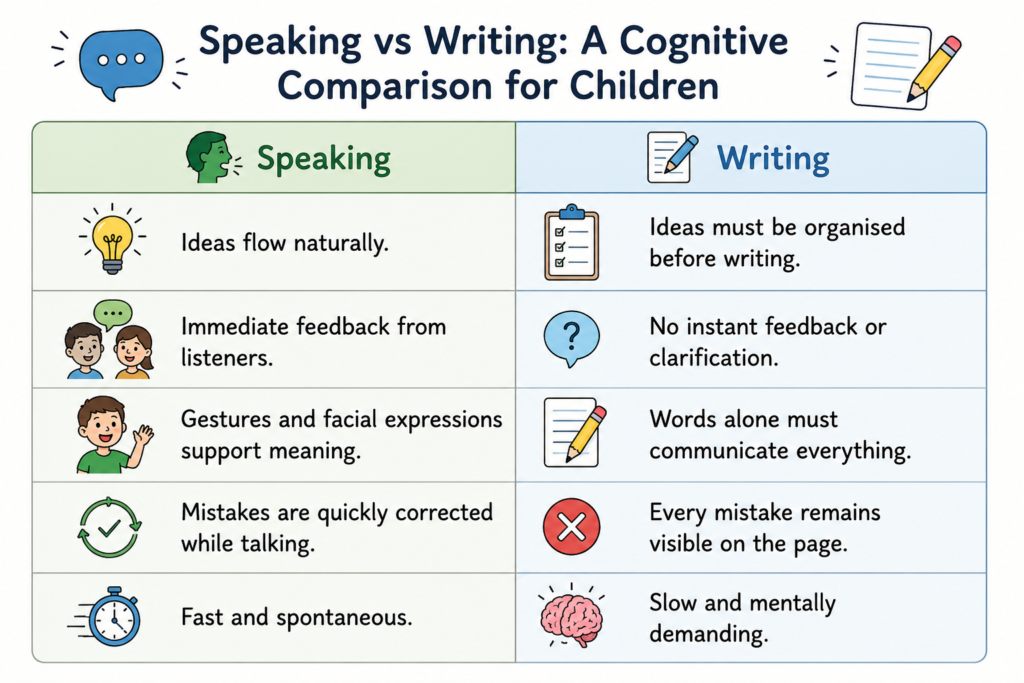
For adults, many writing processes become automatic through years of practice. For children, however, every sentence requires careful thought.
This explains why many children who enjoy storytelling become hesitant the moment they’re asked to write.
Why Your Child May Sound Brilliant but Write Very Little
Imagine asking someone to solve a maths problem while riding a bicycle, balancing a tray, and memorising a shopping list.
They might succeed—but it would require enormous concentration.
That’s surprisingly similar to what writing can feel like for many children.
When speaking, children focus almost entirely on communicating their ideas.
When writing, those same ideas compete with numerous additional demands.
Instead of simply telling the story, the brain constantly asks:
- How do I spell this word?
- Should this sentence end here?
- Is this handwriting neat enough?
- What comes next?
- Did I forget a capital letter?
- What was I trying to say?
Each question interrupts the flow of thinking.
By the time the child solves one problem, the original idea may already have disappeared.
This is why parents often hear: “I had an idea… but I forgot.”
The problem isn’t creativity.
The problem is managing too many mental tasks at once.
Why Children Freeze When It’s Time to Write
One of the most frustrating moments for parents is watching a child sit quietly in front of an empty page.
They’ve been talking excitedly for ten minutes. They clearly know the topic. Then suddenly… nothing. The pencil doesn’t move. The page stays blank. The child sighs.
Sometimes tears appear. Sometimes they insist they “can’t do it.”
This reaction isn’t usually caused by laziness or a lack of imagination. More often, it’s a sign that the brain has become overwhelmed.
The Brain Can Become Overwhelmed
Think of your child’s brain as having a small desk where important information is temporarily stored while they complete a task. Psychologists call this working memory.
Working memory has limited space.
While writing, children may need to hold all of these pieces of information at the same time:
- Their main idea
- Supporting details
- Sentence order
- Vocabulary choices
- Spelling
- Punctuation
- Handwriting
- Grammar
- Instructions from the teacher
If too many tasks compete for attention, something has to give. Usually, it’s the original idea.
That’s why children often stop halfway through a sentence or forget what they wanted to write. It’s not because they lack ideas—it’s because their working memory has become overloaded.
Why Great Ideas Often Disappear
Parents sometimes say: “He could have explained it perfectly five minutes ago.”
They’re absolutely right. The child did understand it.
However, spoken language allows ideas to flow continuously. Writing slows everything down.
Imagine your child has created an exciting story in their mind. Before they can finish writing the first sentence, they may already be thinking about the ending. Meanwhile, they’re also trying to remember how to spell a difficult word, leave spaces between words, hold the pencil correctly, and write neatly.
Eventually, the original story slips away. The child isn’t running out of imagination—they’re running out of mental capacity.
Fear of Making Mistakes Makes Everything Harder
Another reason children freeze is emotional rather than cognitive.
Many children—especially thoughtful, creative ones—already know what good writing looks like. They’ve listened to wonderful books, heard engaging stories, and recognise beautiful writing. The challenge is that their current writing skills haven’t yet caught up with the ideas in their minds.
That gap can create enormous frustration.
Children may begin worrying:
- “What if I spell it wrong?”
- “What if my handwriting looks messy?”
- “What if the teacher doesn’t like it?”
- “What if everyone else writes better than me?”
Instead of seeing mistakes as part of learning, they begin to see mistakes as proof they aren’t good writers.
When that happens, many children choose the safest option: they stop writing before they even begin. The blank page becomes less frightening than the possibility of failure.
The encouraging news is that this cycle can be broken. Once parents understand the cognitive demands behind writing—and reduce unnecessary pressure—children often begin rebuilding both their confidence and their willingness to express themselves.
Working Memory: The Hidden Challenge Behind Writing
If there is one concept every parent should understand about writing, it is working memory.
Many children who struggle with writing aren’t short of ideas—they simply run out of mental space before they can get those ideas onto paper.
Think of working memory as your child’s temporary mental workspace. It’s where the brain holds information while completing a task. Imagine asking your child to carry six shopping bags at once. If you keep adding more bags, eventually something will fall. The same thing happens inside the brain.
Every time your child writes, their working memory is juggling multiple tasks simultaneously. The more mental effort spent on spelling, handwriting, or remembering punctuation, the less capacity remains for creativity and expressing ideas clearly.
This is one of the biggest reasons why a child who can tell an amazing story aloud may produce only a few simple sentences when writing.
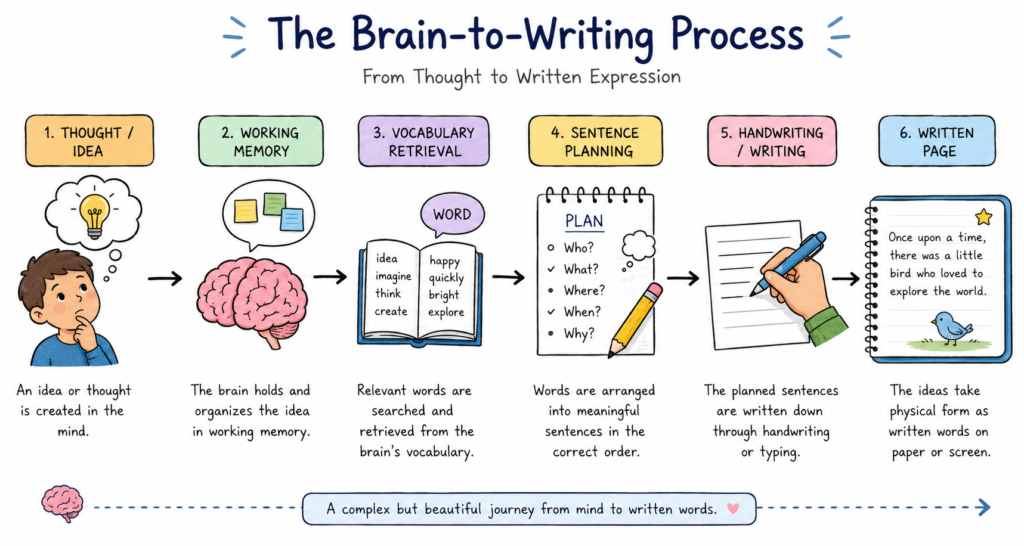
Writing Is One of the Brain’s Most Complex Tasks
Adults often underestimate how demanding writing really is because most writing skills have become automatic over time. When you write an email, you don’t consciously think about where to place every capital letter or how to spell common words. Your brain handles these processes automatically, allowing you to focus on your message.
Children haven’t reached that stage yet. Every sentence requires deliberate effort.
While writing, a child may be trying to:
- Remember the original idea.
- Choose the right vocabulary.
- Organise thoughts into a logical order.
- Plan the next sentence.
- Recall spelling patterns.
- Use punctuation correctly.
- Form letters neatly.
- Keep their place on the page.
- Follow classroom instructions.
Each of these tasks competes for the same limited mental resources. When too many demands arrive at once, the brain naturally prioritises basic mechanics over creative thinking.
That’s why a bright child may suddenly forget the wonderful idea they were excited to share only moments earlier.
Why Children Often Write Less Than They Know
Parents frequently notice a surprising gap between what their child knows and what appears on the page.
For example, a child may confidently explain how volcanoes erupt, answer every question correctly, and enthusiastically describe lava flowing down a mountain. Yet when asked to write about volcanoes, they produce only three short sentences.
This doesn’t mean they understand less. It means writing is asking their brain to perform several difficult tasks simultaneously.
Educational psychologists often describe writing as a coordination challenge rather than a knowledge challenge. Many children understand far more than they can currently express through writing. Recognising this difference helps parents respond with patience rather than frustration.
Vocabulary Retrieval Slows the Process
Another hidden challenge is vocabulary retrieval. Sometimes children know exactly what they want to say but cannot quickly find the right word.
While searching for that word, they also need to remember the original idea, the sentence structure, and what comes next. If finding the vocabulary takes too long, the entire sentence can disappear from working memory.
This explains why children sometimes pause for long periods, erase repeatedly, or begin writing a completely different idea. They’re not losing interest—they’re trying to hold several thoughts together before one slips away.
Sentence Planning Requires Executive Functioning
Writing isn’t simply placing words one after another. Before a sentence reaches the page, the brain has already made dozens of decisions.
Children need to decide:
- Which idea comes first?
- Which detail supports it?
- Does the sentence make sense?
- Should I add another sentence?
- What should I explain next?
These planning skills belong to a group of mental abilities known as executive functioning. Executive functioning helps children organise information, stay focused, switch between tasks, remember instructions, monitor their own work, and solve problems.
These abilities continue developing throughout childhood and adolescence. When executive functioning is still maturing, writing naturally feels more demanding. That doesn’t indicate a lack of intelligence; it simply reflects normal brain development.
Organising Ideas Before Writing
Many adults assume children first think clearly and then write clearly. In reality, the opposite is often true.
Children’s ideas rarely arrive in neat paragraphs. Instead, their thoughts look more like a collection of connected images, emotions, memories, conversations and exciting possibilities.
Imagine opening a toy box filled with hundreds of colourful building blocks. Everything you need is there—but nothing is organised. Writing asks children to sort those blocks into a meaningful structure before anyone else can understand them.
That organisation takes practice.
Children’s Thinking Is Naturally Non-Linear
When children tell stories aloud, they can jump from one idea to another quite naturally. They might say: “First we went to the zoo… Oh! Then I saw a huge elephant… Actually before that we bought popcorn…”
The listener usually understands because tone of voice, facial expressions and conversation help fill the gaps. Writing doesn’t offer those advantages. Every idea must appear in a logical sequence. The reader cannot interrupt to ask questions; everything must already make sense on the page.
That shift from flexible thinking to organised communication is one of the biggest challenges in written expression.
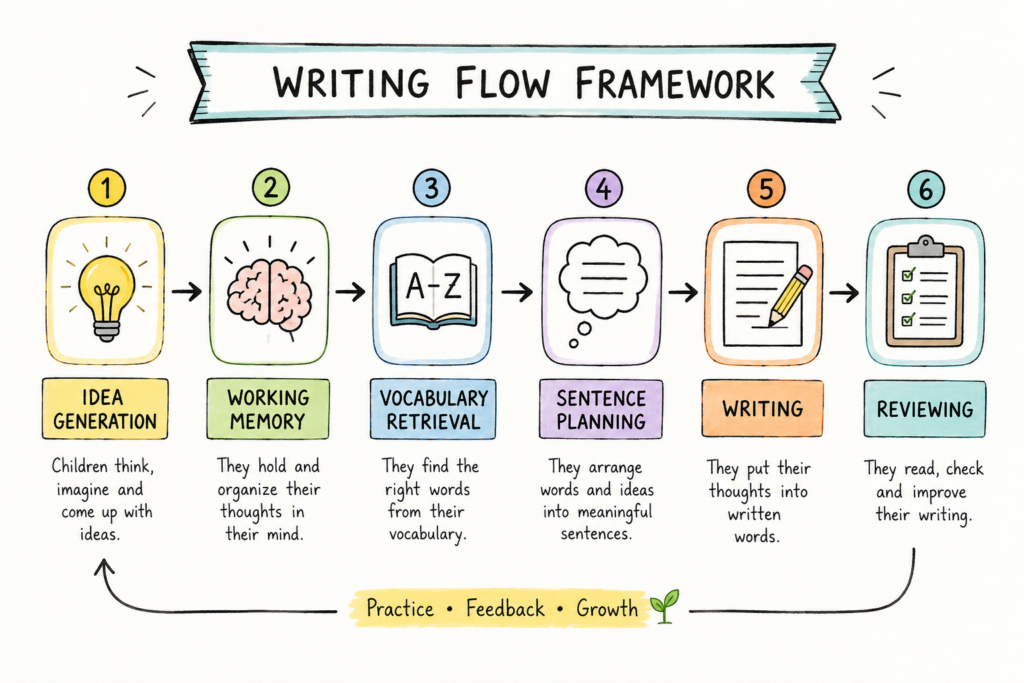
Planning Before Writing Reduces Cognitive Load
One reason structured writing programmes are so effective is that they reduce the number of decisions children have to make while writing. Instead of thinking about everything at once, children learn to separate the process into manageable stages.
For example:
- Think about the main idea.
- Organise supporting ideas.
- Decide the order.
- Build sentences.
- Review and improve.
Breaking writing into smaller thinking tasks reduces pressure on working memory and allows creativity to emerge more naturally. Children often discover they have plenty of ideas—they simply need a clearer pathway for expressing them.
Confidence Grows Through Organisation
Many reluctant writers believe they “aren’t creative.” In reality, creativity is rarely the problem. The challenge is turning thoughts into organised written language.
Once children learn simple frameworks for organising ideas, many begin writing with noticeably greater confidence. Instead of wondering, “Where do I start?” they begin asking, “What’s the best way to explain this idea?” That small shift changes everything.
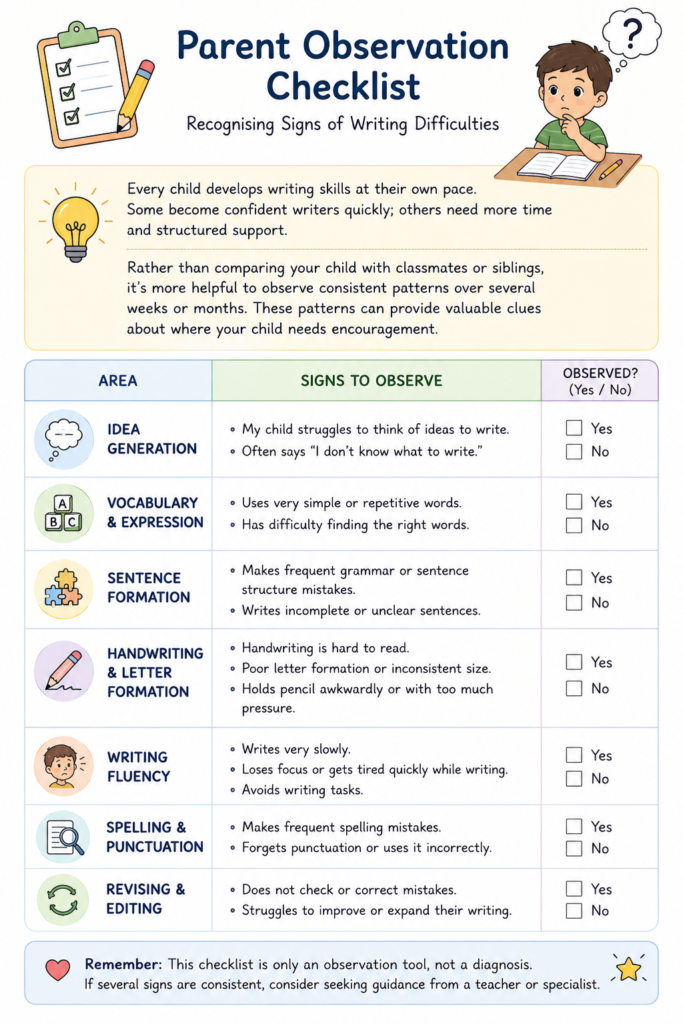
Signs Parents Should Observe
Every child develops writing skills at their own pace. Some become confident writers quickly; others need more time and structured support.
Rather than comparing your child with classmates or siblings, it’s more helpful to observe consistent patterns over several weeks or months. These patterns can provide valuable clues about where your child needs encouragement.
Your Child Talks More Than They Write
One of the clearest signs is a noticeable difference between spoken and written communication. Your child may explain ideas confidently, tell imaginative stories, answer questions thoughtfully, and enjoy discussions, yet produce very little written work.
This gap often suggests the challenge lies in written expression—not imagination.
Writing Takes Much Longer Than Expected
Children experiencing cognitive overload often need far more time than expected to complete simple writing tasks. You might notice they stare at the page, repeatedly erase words, stop after every sentence, lose their place, or ask what to write next.
These behaviours are often signs of mental overload rather than poor motivation.
Frustration Appears Quickly
Some children become upset almost immediately after beginning a writing task. You may hear statements such as “I’m terrible at writing,” “I don’t know what to say,” “This is too hard,” or “I forgot.”
These comments often reflect declining writing confidence rather than actual ability.
Avoidance Becomes a Habit
Children naturally avoid activities that repeatedly make them feel unsuccessful. Writing avoidance may appear as asking for frequent breaks, sharpening pencils several times, needing a drink, changing the subject, delaying homework, or becoming distracted.
These behaviours often indicate anxiety rather than laziness. The earlier parents recognise these patterns, the easier it becomes to rebuild confidence before negative beliefs become deeply established.
Supporting Writing Development Without Pressure
When parents discover their child is struggling, the natural instinct is often to encourage more writing practice. While practice certainly matters, pressure rarely helps.
Children develop stronger writing skills when they feel safe enough to explore ideas without worrying about getting everything perfect. The goal isn’t simply producing more writing—the goal is developing confident writers.
Focus on Ideas Before Accuracy
When children share their writing, try responding to the idea first. Instead of saying, “You forgot three full stops,” begin with, “I love the way you described the dragon.”
Positive feedback tells children their thoughts matter. Technical corrections can come later.
Separate Drafting From Editing
Even professional authors don’t write perfect first drafts. Children shouldn’t be expected to either.
Encourage them to write freely, explore ideas, ignore small mistakes initially, and then return later to improve spelling, punctuation and grammar. Separating creativity from editing dramatically reduces writing anxiety.
Encourage Talking Before Writing
If your child enjoys speaking, use that strength. Invite them to explain their ideas aloud before writing. You can ask questions such as: “What happens next?”, “Can you tell me more?”, or “How did your character feel?”
Talking helps organise thoughts before they reach the page.
Celebrate Progress, Not Perfection
Every confident writer began as a beginner. Notice improvements such as writing one extra sentence, using more descriptive vocabulary, finishing independently, showing greater confidence, or trying again after making mistakes.
These small wins build long-term resilience.
Provide Structured Guidance
Children don’t simply need more writing—they need the right kind of support. Structured guidance helps them learn how to organise ideas, plan sentences, express creativity, and develop writing confidence step by step.
Over time, these thinking processes become more automatic. As the mental effort required for writing decreases, creativity has room to flourish.
Helping Your Child Find Their Written Voice
Watching your child freeze in front of a blank page can be frustrating—for both of you. But when a child cannot express ideas in writing, it rarely means they are short of thoughts or imagination.
More often, they are struggling to manage an extraordinary number of mental tasks at the exact same time. The child who tells imaginative stories during dinner, explains science facts with excitement, or invents fascinating characters hasn’t lost their creativity when they pick up a pencil. Their brain is simply working much harder to transform those dynamic thoughts onto the page.
Understanding this changes the conversation. Instead of asking, “Why won’t my child write?” you begin asking, “What support does my child need to express these wonderful ideas more confidently?”
That shift in perspective can make an enormous difference.
Children develop writing confidence when they feel encouraged, understood, and given strategies that match the way their brains learn. With patience, consistent practice, and the right guidance, writing becomes less about avoiding mistakes and more about sharing ideas with confidence. Every sentence they write is another step towards becoming a stronger communicator—not just at school, but throughout life.
Help Your Child Turn Great Ideas into Confident Writing
At Active Kids Online, we understand that confident writers aren’t created by simply asking children to write more. They develop through structured guidance, encouragement, and learning strategies that make writing feel achievable rather than overwhelming.
Our Creative Writing Programme helps children aged 5–14:
- Organise their ideas clearly before writing.
- Build confidence in written expression.
- Strengthen sentence formation and storytelling skills.
- Reduce writing anxiety through positive, structured learning.
- Develop creativity while improving communication skills.
Whether your child has plenty of ideas but struggles to put them on paper or simply needs extra support to enjoy writing again, our experienced teachers provide step-by-step guidance in a supportive online environment. Explore our Creative Writing Programme and help your child discover that writing can become one of their greatest strengths.
FAQs : Why Some Children Have Great Ideas but Freeze When It’s Time to Write
Why does my child hate writing?
In many cases, children don’t actually dislike writing—they dislike the frustration that comes with it. Writing asks them to manage several skills at once, including generating ideas, organising thoughts, spelling words, using punctuation, and handwriting. If these tasks feel overwhelming, writing quickly becomes associated with stress rather than creativity. The good news is that with patient guidance, reduced pressure, and structured support, many children gradually begin to enjoy writing again.
Why can my child talk confidently but struggle to write?
Speaking and writing are different skills that rely on different cognitive processes. When children speak, they can use tone of voice, gestures, facial expressions, and immediate feedback to communicate their ideas. Writing removes those supports and requires careful planning, vocabulary retrieval, sentence organisation, spelling, and fine motor skills. It’s common for children to express themselves much more confidently in conversation than on paper.
Is writing more difficult than speaking?
For most children, yes. Speaking develops naturally through everyday interaction, while writing must be learned step by step. Writing requires the brain to coordinate language, memory, planning, organisation, and physical movement simultaneously. Because these skills continue developing throughout childhood, many children find writing significantly more demanding than speaking.
How can I encourage a reluctant writer?
Start by making writing feel safe rather than stressful. Encourage your child to talk through their ideas before writing, praise their creativity instead of focusing only on mistakes, and break writing tasks into smaller, manageable steps. Celebrate effort and progress rather than perfection. Building confidence often leads to greater willingness to write.
What causes writing anxiety in children?
Writing anxiety usually develops when children repeatedly feel overwhelmed or fear making mistakes. They may worry about spelling, handwriting, grammar, or producing work that doesn’t match the ideas in their minds. Over time, this fear can make them avoid writing altogether. A supportive environment that values ideas over perfection can help reduce this anxiety.
Should I correct every writing mistake?
Not immediately. During the first draft, it’s usually more beneficial to focus on your child’s ideas and effort. Constant corrections can interrupt creative thinking and reduce confidence. Once your child has finished expressing their ideas, you can gently review one or two areas for improvement together. This balanced approach helps children continue developing both creativity and writing accuracy.
How long does it take for writing skills to improve?
Writing development is a gradual process, and every child progresses at their own pace. Some children gain confidence within a few months, while others need longer depending on their age, experience, and individual learning needs. Consistent encouragement, regular opportunities to write, and structured guidance usually lead to steady improvement over time.