
Introduction
Every parent wants to know if their child is becoming a better communicator. But measuring progress isn’t always easy. One day your child chats confidently at home, and the next day they barely speak in class or during a family gathering. It’s natural to wonder if they’re falling behind their classmates.
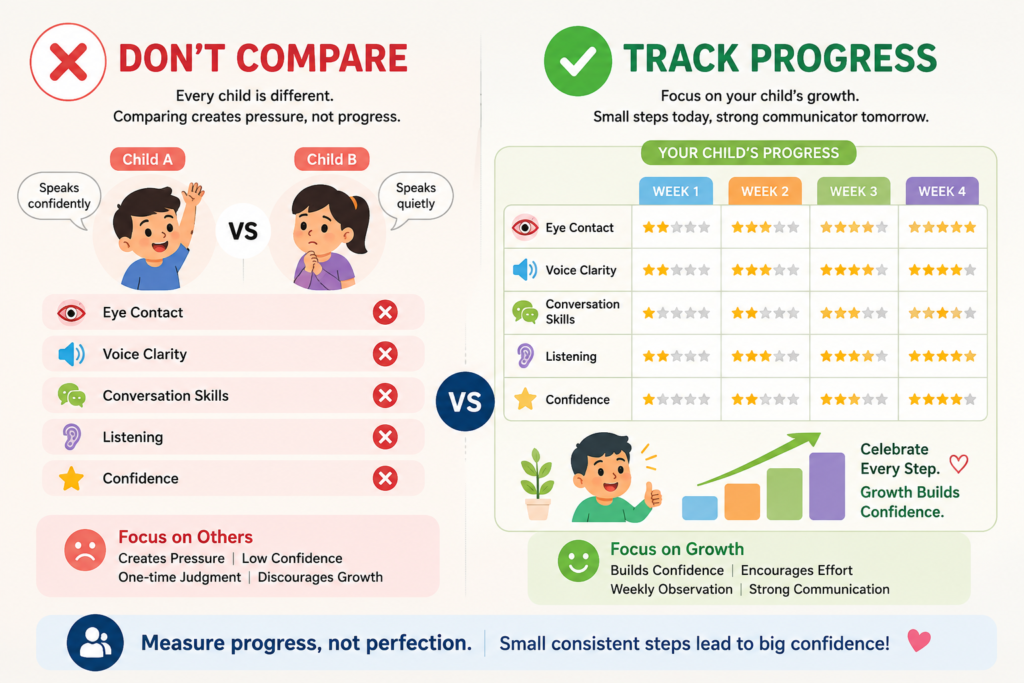
The truth is, the best way to measure speaking progress isn’t by comparing your child with others. Every child develops communication skills at their own pace, influenced by their personality, experiences, and environment. Comparing them to siblings, friends, or classmates can create unnecessary pressure and make genuine improvement harder to recognize.
Instead, focus on how your child is growing over time. By observing a few simple communication milestones each week, you can track real progress with confidence. In this guide, you’ll discover seven practical ways to measure speaking progress objectively, celebrate small wins, and support your child’s communication journey without unfair comparisons.
Why Comparing Children Is the Wrong Way to Measure Speaking Progress
It’s easy to compare your child with classmates, cousins, or siblings. You may notice another child answering confidently in class while your child stays quiet. But comparing children rarely gives an accurate picture of their communication development.
Every child develops speaking skills at their own pace. Some children are naturally talkative, while others need more time to feel comfortable expressing themselves. Factors like personality, learning style, and environment all influence how a child communicates.
A child who speaks confidently at home may become quiet in a classroom or around unfamiliar people. On the other hand, another child may enjoy speaking in groups but struggle to express emotions during one-on-one conversations. These differences are normal and don’t mean one child is “better” than another.
Instead of asking, “How is my child doing compared to others?” ask, “Is my child communicating better than they were a month ago?” That’s the comparison that truly matters.
A simple way to track progress is to compare your child’s current communication skills with their own past performance—not someone else’s.
| Comparing with Others | Tracking Your Child’s Progress |
| Focuses on other children’s abilities | Focuses on your child’s personal growth |
| Can create pressure and frustration | Encourages confidence through gradual improvement |
| Ignores personality and learning differences | Recognizes each child’s unique pace of development |
| Highlights what your child can’t do | Celebrates the skills they are steadily building |
When parents focus on steady improvement instead of competition, it’s much easier to recognize meaningful communication milestones and support long-term growth.
Communication Milestones Parents Should Track
Instead of asking whether your child is a “good speaker,” focus on small communication milestones that show steady improvement over time. These behaviors are easier to observe and give you a much clearer picture of your child’s progress than comparing them with others.
1. Eye Contact
Eye contact shows that your child is engaged and comfortable during a conversation.
Look for progress like:
- Maintaining eye contact for a few seconds while speaking
- Looking at the listener instead of the floor
- Staying engaged throughout a short conversation
Small improvements in eye contact often indicate growing confidence and better communication.
2. Voice Clarity
A clear voice helps others understand your child’s ideas.
Look for progress like:
- Speaking loudly enough to be heard
- Slowing down instead of rushing through sentences
- Pronouncing words more clearly
Remember, speaking louder isn’t the goal. Speaking clearly and comfortably is.
3. Sentence Length
As communication skills improve, children usually begin expressing their thoughts in more complete sentences.
Look for progress like:
- Moving from one-word answers to full sentences
- Explaining ideas with more detail
- Using words like because, then, or so to connect thoughts
Longer, meaningful responses often show stronger verbal expression.
4. Conversation Initiation
Confident communicators don’t always wait to be asked questions—they start conversations too.
Look for progress like:
- Greeting people first
- Sharing stories without being prompted
- Asking questions during conversations
- Starting discussions about school or daily experiences
These small moments show growing confidence in everyday communication.
5. Answering Questions
This milestone reflects how well your child listens, thinks, and responds.
Look for progress like:
- Answering questions with less hesitation
- Giving relevant and complete responses
- Explaining their opinions instead of saying only “yes” or “no”
The goal isn’t a perfect answer—it’s clearer and more confident communication.
6. Listening Behavior
Strong communication isn’t only about speaking. Good listeners often become better speakers.
Look for progress like:
- Waiting for others to finish speaking
- Paying attention during conversations
- Responding appropriately to what was said
- Asking thoughtful follow-up questions
Active listening is an important communication milestone that many parents overlook.
7. Confidence & Presentation Skills
Children don’t need to stand on a stage to show progress. Everyday situations reveal growing confidence.
Look for progress like:
- Speaking comfortably in front of family members
- Sharing ideas during class discussions
- Using natural hand gestures
- Standing calmly while speaking to a small group
Even small improvements in these situations show that your child’s communication skills are developing.
Key Takeaway
You don’t need to track every milestone every day. Choose a few behaviors to observe each week and compare them with your child’s previous progress. Over time, these small improvements will give you a much more accurate picture of their communication development.
Behavioral Indicators That Show Real Speaking Progress
Many parents expect speaking progress to happen through big moments, like giving a perfect presentation or winning a speech competition. In reality, communication development usually appears through small, everyday changes.
As your child’s speaking skills improve, you may notice they:
- Answer questions with less hesitation.
- Start conversations without being prompted.
- Use new words naturally in everyday conversations.
- Share longer and more detailed responses.
- Ask follow-up questions to keep a conversation going.
- Correct themselves calmly if they make a mistake.
- Feel more comfortable speaking with teachers, relatives, or new people.
- Participate more actively during class or group discussions.
These behaviors may seem small, but together they show meaningful communication improvement. Instead of looking for perfection, pay attention to consistent progress over several weeks. That’s a much more reliable way to measure speaking development.
Weekly Progress Tracker
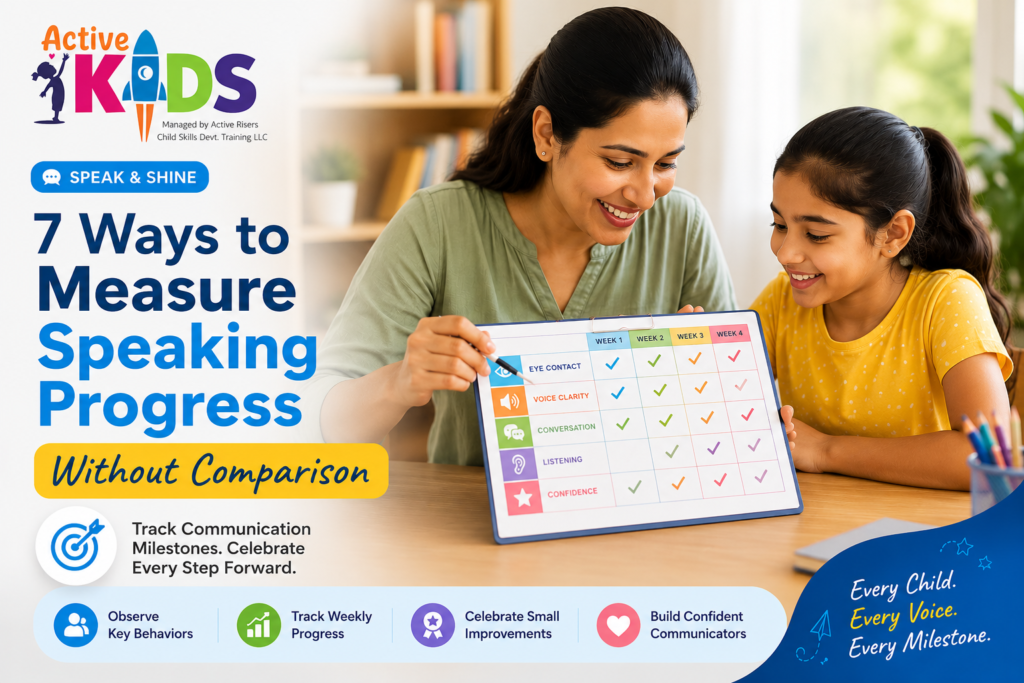
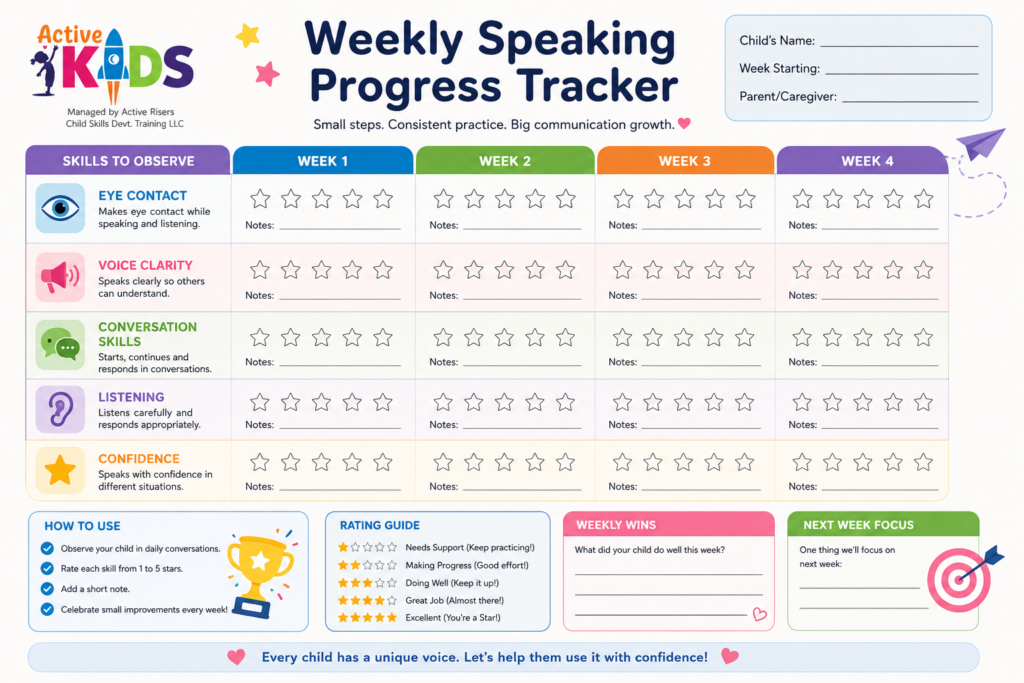
The best way to measure speaking progress is to observe the same communication skills over several weeks. Instead of giving your child scores, simply record what you notice. This helps you identify gradual improvement and makes it easier to celebrate meaningful progress.
Use a simple tracker like the one below.
| Communication Skill | Week 1 | Week 2 | Week 3 | Week 4 |
| Eye contact | Rarely makes eye contact | Looks up while answering | Maintains eye contact briefly | Comfortable during conversations |
| Voice clarity | Speaks very softly | Clear at home | Louder in familiar settings | Consistently clear voice |
| Sentence length | One-word answers | Short sentences | Explains ideas in more detail | Uses complete sentences naturally |
| Conversation initiation | Waits to be asked | Greets family members | Starts conversations occasionally | Initiates conversations confidently |
| Listening behavior | Interrupts frequently | Waits before responding | Listens attentively | Responds thoughtfully |
Tip for parents: Track progress once a week rather than every day. Weekly observations provide a more accurate picture because a child’s communication can vary depending on their mood, energy level, or environment.
Measuring Confidence Objectively
Confidence can be difficult to measure because it isn’t just about speaking loudly or standing in front of an audience. Instead, focus on behaviors you can observe consistently.
Ask yourself these questions:
- Does your child start conversations more often?
- Are they maintaining better eye contact?
- Do they answer questions with less hesitation?
- Are they willing to share their ideas in class or with family?
- Can they recover calmly after making a mistake?
If you notice gradual improvement in these behaviors over several weeks, your child’s confidence is growing. Remember, confidence develops step by step, so look for steady progress rather than dramatic changes.
Celebrate Small Improvements
Every child develops communication skills at their own pace. Some improvements may seem small, but they are important milestones worth celebrating.
For example, your child might:
- Speak a little louder than before.
- Answer a question without encouragement.
- Share a story in more detail.
- Start a conversation with a friend or teacher.
- Maintain eye contact for a little longer.
Recognizing these small wins encourages your child to keep practicing without feeling pressured. The goal isn’t to create the perfect speaker overnight—it’s to build confident communication one step at a time.
Conclusion
Every child follows a unique communication journey, and progress doesn’t happen overnight. Instead of comparing your child with classmates or siblings, focus on the small improvements they make each week. These everyday milestones provide a much clearer picture of their development.
The best way to measure speaking progress is to compare your child’s abilities with their own past performance. Whether it’s making better eye contact, answering questions more confidently, or starting conversations independently, every small step deserves recognition.
At Active Kids Online, our Speak & Shine programme helps children build strong communication skills through structured learning, regular feedback, and measurable progress. With the right guidance and consistent encouragement, parents can confidently track their child’s growth and celebrate every milestone along the way.
FAQs: 7 Ways to Measure Speaking Progress Without Comparison
How do I know if my child’s speaking skills are improving?
Look for gradual changes such as clearer speech, longer answers, better eye contact, and increased participation in conversations. Tracking these behaviors over several weeks gives a more accurate picture than judging a single day.
What are communication milestones?
Communication milestones are observable behaviours that show how a child’s speaking and listening skills are developing. They include eye contact, voice clarity, sentence length, conversation initiation, and active listening.
Should I compare my child with classmates?
No. Every child develops communication skills at their own pace. Comparing your child with others can create unnecessary pressure and overlook the progress they are making.
How often should I track speaking progress?
A weekly check is usually enough. Weekly observations help you identify consistent improvements without focusing too much on day-to-day changes.