
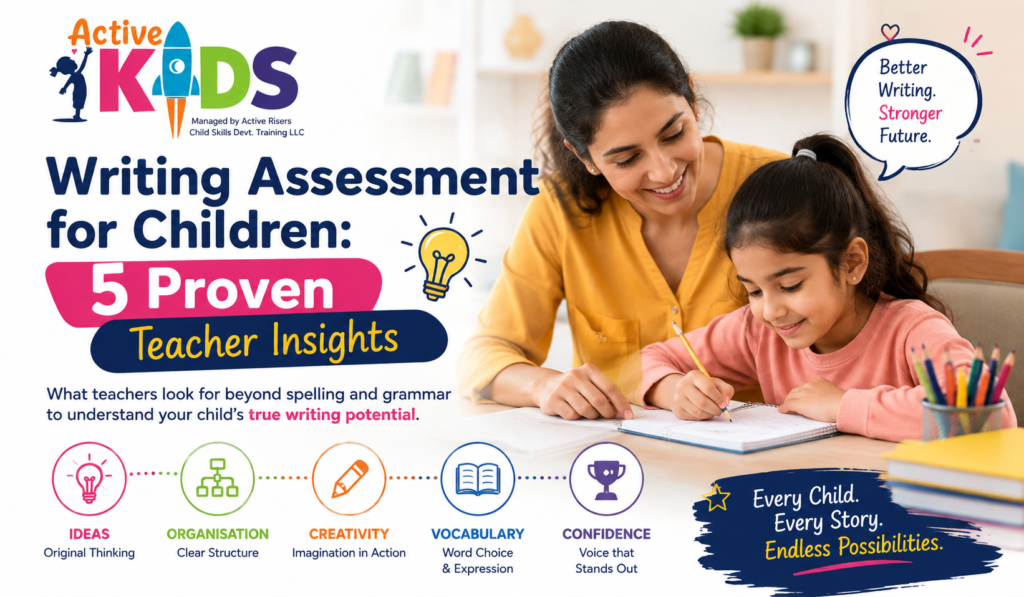
“My child gets good spelling marks, so why does the teacher say the writing still needs improvement?” This is a question I hear frequently from parents across Dubai, Sharjah, and Abu Dhabi. When a report card arrives showing neat handwriting and zero spelling errors, it feels natural to assume a young writer is thriving. Yet, during a professional writing assessment for children, experienced educators look far deeper than mechanical accuracy. Within ten minutes of reviewing a draft, a teacher can map out a student’s cognitive habits, narrative courage, and structural understanding. Understanding how teachers conduct a children’s writing skills evaluation helps parents support genuine literacy growth at home.
When an experienced writing specialist sits down with a new piece of student work, they are not simply searching for missing full stops or misspelled words. Instead, they are reading between the lines to observe how a young mind constructs ideas, manages cognitive load, and communicates meaning. The surface polish of a page rarely tells the whole story. A child who produces a flawless, five-sentence paragraph about a dog may actually be playing it safe, while another child whose page is filled with scratched-out words, ambitious punctuation, and complex plot lines might be demonstrating far higher creative capability. To understand how educators evaluate children’s writing, parents must look at the hidden layers of the assessment process.
What Teachers Notice Within the First Few Minutes
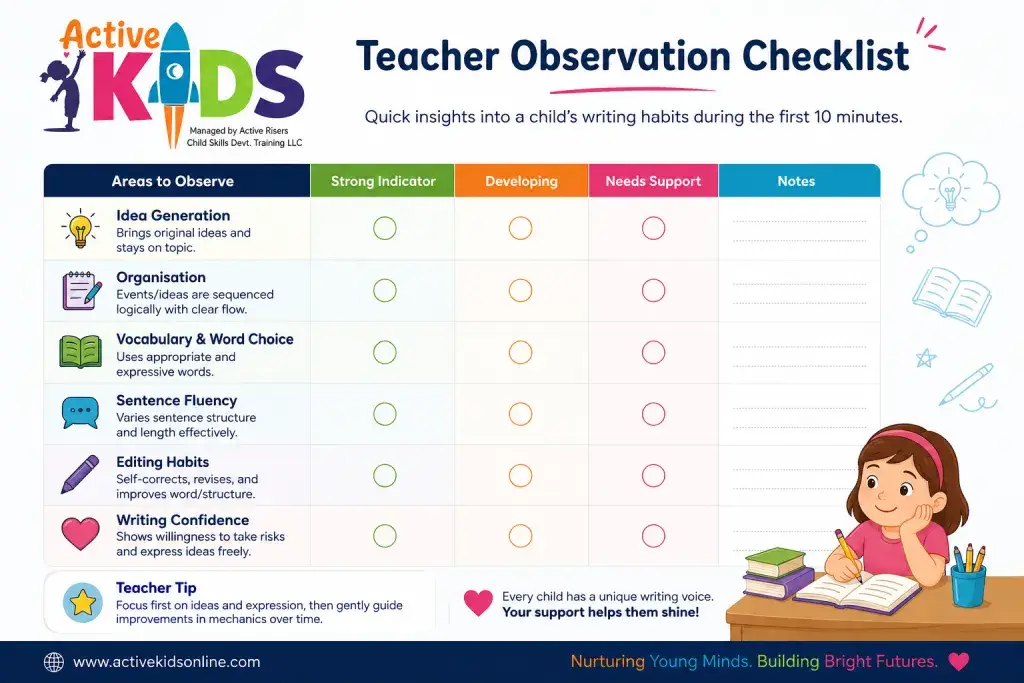
The initial ten minutes with a student’s writing sample reveal details that standardized spelling tests completely miss. Long before reading the final sentence, an educator senses the student’s relationship with the written word. This early observation sets the stage for a meaningful diagnostic assessment, guiding how teachers tailor future instruction.
The visual landscape of a piece of paper provides instant clues about a child’s mental process. Teachers immediately observe the relationship between handwriting physical mechanics and the flow of ideas. When handwriting is excessively rigid or painstaking, it often signals that a child is spending so much mental energy on letter formation that their internal narrative line is continually interrupted. Conversely, quick, loose handwriting accompanied by frequent line jumps usually indicates a mind racing faster than the hand can keep up. Neither pattern is inherently bad; rather, each reveals where cognitive energy is being directed during the task.
Writer confidence leaves unmistakable marks on the page. A teacher evaluates confidence by looking at initial momentum. Did the child begin writing with fluid purpose, or are there long, hesitant lead-ins characterized by faint pencil lines and repetitive introductory phrases? Confident young writers take risks with sentence structure and narrative direction. They do not freeze when unsure of a word; instead, they make an approximate phonetic attempt and keep moving forward to preserve their train of thought.
Organisation and spatial layout offer another window into a child’s thinking. Experienced teachers look at how a student manages the physical white space. Are margins respected naturally? Does the student instinctively chunk information, or is the piece an unbroken block of text stretching from border to border? A child who naturally spaces their writing demonstrates an early awareness of reader experience—an essential milestone in child writing development in the UAE and internationally.
Finally, subtle writing habits observed during live writing or evidenced on the draft reveal a child’s internal dialogue. Erasure marks tell a fascinating story. Heavy, aggressive erasures that tear the paper suggest high anxiety around making mistakes. Light, clean line-strikes suggest a healthy editing mindset, where the writer views initial drafts as flexible material to be refined rather than final monuments to be judged.
Table 1: What Teachers Notice First
| Observation | Why It Matters |
|---|---|
| Pencil pressure and line fluidness | Indicates physical tension, fine motor comfort, and the balance between physical mechanics and conceptual thought. |
| Handling of initial blank space | Shows executive function, task initiation ease, and whether the child has planned their ideas before writing. |
| Correction methods (erasures vs. cross-outs) | Reveals perfectionist tendencies versus an open, iterative approach to draft revision and self-correction. |
| Visual margin awareness | Reflects early awareness of page structure, document layout, and reader orientation. |
| Pacing across paragraphs | Demonstrates stamina, focus, and whether the writer can sustain creative energy through a full narrative arc. |
Organisation Matters Before Grammar
Parents often feel surprised when a teacher gives high praise to a story filled with minor grammatical mistakes while raising concerns about a grammatically perfect paragraph. The reason is simple: structure reflects thinking, whereas grammar largely reflects rule application. An educator can easily teach a child subject-verb agreement or comma placement in a few focused sessions, but building structural logic requires developing executive function and narrative reasoning.
When teachers assess a writing sample, they evaluate whether the student understands how ideas relate to one another. Before examining tense consistency or punctuation marks, an educator reads to ensure the child has created a coherent pathway for the reader to follow. Without logical sequencing, even the most sophisticated vocabulary becomes a collection of disconnected words.
Paragraph Flow
Paragraphing is far more than hitting the enter key or indenting a line; it represents the visual grouping of a distinct thought. In a robust writing assessment for children, teachers evaluate whether paragraph breaks align with shifts in time, location, speaker, or focus. Young writers frequently struggle with paragraph flow because they view writing as a linear list of events rather than a series of organized thematic clusters. Teachers look for natural bridges between paragraphs—transitional phrases or conceptual connectors that guide the reader smoothly from one scene or argument to the next.
Logical Sequencing
Logical sequence forms the backbone of both narrative and expository writing. When evaluating logical sequencing, teachers ask key questions: Does event A naturally cause event B? Does the student maintain chronological consistency, or do they jump back and forth without alerting the reader? In persuasive pieces, does the writer build a clear premise followed by supporting evidence, or do they restate the same opinion using different phrases? When a child demonstrates strong logical sequencing, it shows they can step outside their own mind and anticipate what a reader needs to understand the story.
A Teacher’s Perspective
A beautifully spelled paragraph with weak ideas often scores lower than an imaginative paragraph with a few spelling mistakes. Mechanics can be polished quickly through targeted instruction, but original thinking and structural logic reflect deep conceptual understanding that takes time to cultivate.
Vocabulary Doesn’t Matter Unless Communication Is Clear
There is a widespread misconception that good writing requires filling every page with complex, three-syllable adjectives. Many students in Dubai and Sharjah schools work hard to memorize lists of advanced vocabulary words, only to drop them awkwardly into stories where they feel out of place. Professional writing teachers look for precise, meaningful communication rather than decorative word stuffing.
A writing rubric for primary students emphasizes clarity over ornamentation. If a student uses an advanced word incorrectly or breaks the natural cadence of a sentence just to showcase a vocabulary term, overall communication suffers. Educators value authentic expression—where every chosen word earns its place by deepening meaning, setting a mood, or sharpening a character description.
Word Choice
Effective word choice is about precision. Teachers assess whether a child selects verbs that carry action without needing extra adverbs. For example, replacing “he walked very slowly and tiredly” with “he trudged” demonstrates genuine linguistic maturity. Teachers look for sensory descriptors that anchor the reader in a specific setting, as well as context-appropriate terms that demonstrate a strong command of narrative voice. When word choice is authentic, the writing feels natural, engaging, and expressive.
Sentence Variety
A monotone rhythm can flatten even the most exciting plot line. Teachers analyze sentence variety by examining sentence lengths, opening structures, and grammatical types. A sample that relies entirely on simple “Subject-Verb-Object” sentences (“The boy went to the store. He bought an apple. He walked home.”) creates a repetitive, jerky rhythm. Teachers look for a healthy blend of simple, compound, and complex sentences. Short, rapid sentences create urgency during suspenseful moments, while longer, complex sentences allow for reflection and detailed description. Observing how a student manipulates sentence length reveals their intuitive grasp of prose rhythm.
Table 2: Spelling vs Overall Writing Quality
| Parents Often Notice | Teachers Also Evaluate |
|---|---|
| Spelling accuracy and missing letters | Depth of idea development and descriptive imagery |
| Neatness of handwriting and margin lines | Logical sequencing and paragraph organization |
| Use of grand or complex vocabulary words | Contextual precision and natural sentence variety |
| Correct use of capital letters and full stops | Rhythm, expressive voice, and narrative engagement |
| Length of the composition in total pages | Conciseness, clarity, and elimination of narrative filler |
Creativity Is More Than Imagination
When parents hear the term “creative writing,” they often picture fantastical worlds filled with mythical creatures or elaborate superhero adventures. However, in an educational setting, creativity is evaluated through specific cognitive dimensions rather than genre choice alone. A story set in a everyday school cafeteria can demonstrate far more creativity than an action-packed space battle if it contains sharp observation and original perspective.
Teachers view creativity as a problem-solving skill. How does the young writer approach a prompt? Do they fall back on familiar television tropes and video game plots, or do they filter the task through their own observations and authentic voice? Identifying true creativity during a creative writing assessment tool evaluation involves looking closely at original thinking and systematic idea development.
Original Thinking
Original thinking shows up when a child steps away from predictable narrative shortcuts. Instead of starting a story with “Once upon a time, I woke up and it was all a dream,” an original thinker opens in media res or focuses on an unexpected detail. Teachers look for unique character motivations, subtle emotional nuances, and surprising plot choices. When a student takes an intellectual risk by exploring an unconventional angle, teachers celebrate that choice—even if the execution is not yet perfect.
Idea Development
An imaginative concept remains incomplete without thorough idea development. Teachers frequently encounter student samples filled with brilliant ideas that are abandoned after a sentence or two as the writer rushes to the next plot event. True development means unpacking a single moment: exploring character reactions, describing environment dynamics, and allowing scenes to play out fully before moving forward. Idea development is what transforms a simple outline into a rich narrative experience.
Writing Habits Teachers Recognise Immediately
A child’s draft acts as a record of their writing habits and thought process. When writing specialists evaluate a piece of work, they look for clues that reveal how the student manages cognitive challenges, processes mistakes, and approaches the task of communication.
Developing strong writing habits is essential for long-term academic success. Students who learn to monitor their own thinking become resilient, independent communicators who welcome constructive feedback rather than feeling discouraged by it.
Editing Habits
How does a child handle revisions on the page? Teachers pay close attention to whether editing happens spontaneously during drafting or only when prompted by an adult. Spontaneous self-correction—such as crossing out a word to replace it with a more precise synonym, or inserting a forgotten comma—shows that the student is actively reading their work as a reader while writing as an author. Teachers encourage neat strike-throughs over total erasure, as keeping early attempts visible allows both student and teacher to track intellectual progress.
Writing Confidence
Confidence in writing is not about arrogance; it is about courage. A confident young writer is willing to attempt complex sentence structures even if they risk a minor punctuation slip. They experiment with dialogue, introduce subtle emotional turns, and attempt difficult vocabulary without fear of misspelling. Conversely, a writer who lacks confidence often produces brief, overly safe sentences designed solely to avoid errors. Building writing confidence is central to child writing development in UAE learning environments, empowering students to express their true ideas.
How Teachers Use Assessment to Plan Future Learning
It is a common belief that assessments exist primarily to assign grades or percentages. In modern educational practice, however, diagnostic writing evaluation serves an entirely different purpose: it acts as a roadmap for future learning. An assessment is not a final verdict on a child’s ability; it is a point-in-time snapshot that highlights what skills are consolidated and what skills are emerging.
By analyzing a writing sample through a systematic framework, teachers can create targeted learning trajectories that cater to each child’s unique needs. This personalized approach ensures that instruction targets the precise areas where the student requires support or extension.
When an educator identifies a specific developmental need—such as difficulty transitioning between paragraphs or a tendency to rush narrative climaxes—they design focused mini-lessons around that exact skill. Rather than overwhelming the child with red ink across every line, the teacher selects one or two priority goals. This targeted approach prevents cognitive overload and allows the student to experience clear, achievable progress.
Table 3: Writing Assessment Framework
| Dimension | Key Focus Area | What Success Looks Like |
|---|---|---|
| Ideas | Clarity, originality, and depth | Focused topic, rich supporting details, original perspectives. |
| Organisation | Structure, sequencing, and pacing | Clear beginning-middle-end, logical transitions, intentional paragraphing. |
| Vocabulary | Precision, tone, and variety | Natural word choices, vivid verbs, absence of forced thesaurus words. |
| Sentence Fluency | Rhythm, length, and variety | Engaging prose rhythm, varied sentence openings and lengths. |
| Creativity | Problem-solving and voice | Authentic voice, unexpected plot or thematic twists, detailed world-building. |
| Editing | Self-correction and revision | Active self-monitoring, willingness to refine drafts, thoughtful line edits. |
| Confidence | Risk-taking and engagement | Willingness to attempt complex ideas and structures without fear of errors. |
What Parents Can Learn From a Writing Sample
Parents do not need formal teacher training to gain valuable insights from their child’s writing samples. By adjusting what you look for when your child shows you a completed story or school essay, you can offer supportive, constructive encouragement that boosts their enthusiasm for writing.
Instead of reaching immediately for a red pen to correct spelling or missing commas, try adopting a teacher’s mindset. Focus first on what your child is trying to express, celebrating their ideas and structural choices before addressing surface mechanics.
- Look for the spark of an idea: Ask your child what inspired a specific character, plot line, or word choice. Showing interest in their creative decisions builds writer confidence.
- Observe narrative structure: Ask your child to read their piece aloud to you. Children naturally hear awkward sentence structures or missing transitions when reading aloud, making self-correction easy and enjoyable.
- Praise intentional risks: If your child attempted an ambitious vocabulary word or a complex sentence structure, praise the effort—even if the punctuation or spelling needs minor refining.
- Separate drafting from proofreading: Remind your child that first drafts are for getting ideas down on paper, while proofreading is a separate stage reserved for cleaning up mechanics.
Instead of reaching immediately for a red pen to correct spelling or missing commas, try adopting a teacher’s mindset. Focus first on what your child is trying to express, celebrating their ideas and structural choices before addressing surface mechanics. If your child struggles to put thoughts into words, our guide on Child Cannot Express Ideas in Writing: Why It Happens explains the common reasons behind this challenge and how teachers support children through it.
How ActiveKidsOnline Supports Children’s Writing Development
At ActiveKidsOnline, we understand that every young writer in Dubai, Sharjah, and Abu Dhabi follows a unique learning path. Our specialized Creative Writing Programme moves beyond simple grammar drill sheets and repetitive exercises, offering a dynamic environment where young minds learn to think, structure, and express themselves with clarity and confidence.
Our approach centers on structured diagnostic assessment conducted by experienced international educators. From the moment your child joins, our writing specialists conduct an in-depth evaluation to understand their narrative strengths, cognitive habits, and areas for growth. This ensures that every student receives personalized instruction tailored to their developmental stage.
Through small, interactive online sessions, live real-time feedback, and structured skill ladders, our Creative Writing Programme helps students cultivate robust writing habits. Parents can explore the programme to learn how our experienced teachers provide personalised guidance at every stage of a child’s writing journey. We guide young authors through the complete creative writing process—from initial brainstorming and structural outline design to drafting, expressive word choice, and constructive self-correction. By creating a supportive environment where intellectual risk-taking is celebrated, we empower children to overcome blank-page anxiety and unlock their authentic narrative voice.
Conclusion
A comprehensive writing assessment for children is never about searching for flaws or counting missing commas on a page. It is an insightful process designed to understand how a young mind organizes ideas, approaches creative challenges, and communicates with the world. When educators and parents look beyond surface mechanics to evaluate structure, vocabulary precision, and narrative confidence, writing transforms from an intimidating chore into an empowering life skill.
By understanding what writing teachers notice in those initial ten minutes, parents across the UAE can offer meaningful encouragement that inspires young writers to grow. If you are ready to give your child expert guidance, structured assessment, and a nurturing community where their creative ideas can flourish, explore ActiveKidsOnline’s Creative Writing Programme today.
FAQs: Writing Assessment for Children: 5 Proven Teacher Insights
How do teachers assess writing?
Teachers evaluate writing holistically using structured frameworks that look beyond simple spelling and grammar errors. During a writing assessment for children, educators evaluate core dimensions including idea development, paragraph organization, logical sequencing, sentence variety, word choice, and overall narrative voice. They observe how effectively a student communicates meaning, structures thoughts, and engages the reader. Diagnostic assessment helps teachers identify specific cognitive habits and learning gaps, allowing them to provide targeted feedback and design personalized instruction that guides the child toward progressive improvement.
What makes a good writing sample?
A strong student writing sample demonstrates clarity of thought, authentic voice, and structural logic rather than flawless surface mechanics. It features a clear narrative or argument flow, well-developed ideas with supporting details, and natural paragraph breaks. Effective writing samples also showcase sentence variety—combining short, punchy statements with complex structures—and precise vocabulary chosen for clarity rather than showcase. Above all, a good writing sample reflects a young writer who takes intellectual risks, engages the reader’s interest, and presents original thinking clearly from beginning to end.
Do spelling mistakes affect writing scores?
While spelling is evaluated as part of language conventions, minor spelling mistakes rarely lower a student’s score if the underlying ideas, organization, and narrative expression are strong. Modern writing rubrics evaluate mechanical conventions separately from conceptual dimensions like creativity, structure, and word choice. Teachers view spelling errors as technical details that can be easily corrected during the editing stage. An ambitious draft featuring complex ideas and adventurous vocabulary with minor spelling errors often scores higher than a safe, brief paragraph with perfect spelling.
How important is creativity in writing?
Creativity is essential in writing because it reflects critical thinking, problem-solving, and original expression. However, teachers view creativity as much more than fantasy plots or wild imagination. In educational assessment, creativity refers to how a student approaches a prompt—their ability to offer fresh perspectives, develop authentic character motivations, craft realistic dialogue, and solve narrative problems. A child who writes a deeply observant, original story about an everyday event demonstrates high creative ability, showing that they can filter experiences into engaging prose.
What should parents look for in their child’s writing?
When reviewing your child’s writing at home, look for clear ideas, logical flow, and expressive language rather than focusing solely on neatness or spelling errors. Check whether the story has a distinct beginning, middle, and end, and observe if ideas are organized into logical paragraphs. Notice whether your child uses interesting verbs and descriptive details, and praise them for attempting complex sentence structures or ambitious vocabulary words. Most importantly, look for writer confidence and enthusiasm, encouraging them to share their authentic thoughts comfortably.
Can writing be assessed at home?
Yes, parents can evaluate writing at home by adopting a supportive, reader-focused mindset rather than acting as a strict grader. Instead of marking errors with red ink, ask open-ended questions about your child’s creative choices, such as why a character made a specific decision or how a scene felt. Use simple observation checklists to check for logical sequencing, sentence variety, and idea expansion. Reading the piece aloud with your child helps them spot awkward phrasing and missing punctuation naturally, turning home evaluation into a positive learning experience.
How often should writing be reviewed?
Writing should be reviewed regularly through constructive, informal check-ins rather than constant high-stakes testing. For primary and middle school students, reviewing one writing sample every two to three weeks provides a clear picture of developmental progress without causing writing fatigue. Regular reviews allow parents and teachers to track growth in idea organization, vocabulary use, and editing habits over time. Celebrating small improvements during these periodic reviews builds sustained writing momentum, self-confidence, and a lifelong appreciation for written communication.