
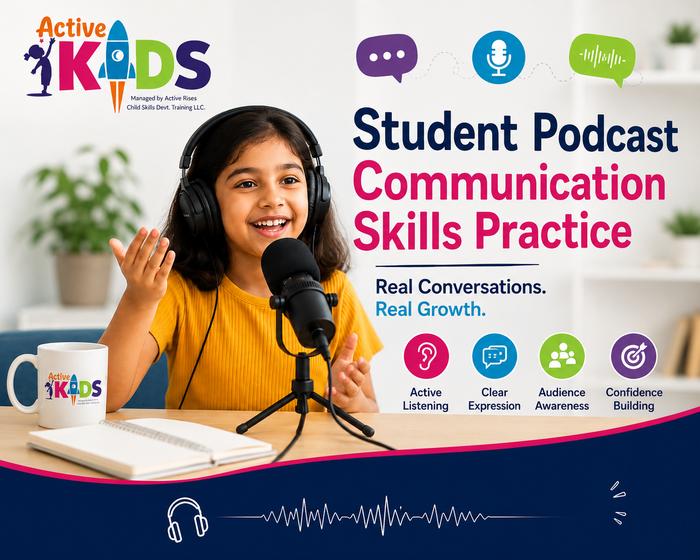
A child may explain an idea clearly at the dinner table but hesitate when asked to explain the same idea to someone outside the family. That difference is important. Student podcast communication skills develop through situations where children have to think about what they are saying, who is listening, and how clearly their ideas are being understood.
Traditional classroom activities have an important role in communication development. But children also need opportunities to use those skills in more authentic conversations. Speaking for a real listener encourages them to organize their thoughts, listen carefully, respond to questions, and become more aware of how their voice and words affect the conversation.
This is where experiential learning can become valuable. A student podcast is not simply an opportunity for a child to speak into a microphone. When designed as a learning activity, it can create a structured cycle of preparing, speaking, listening, reflecting, and improving.
For parents, the bigger question is not whether a child can record a podcast. It is what the child learns through the process of preparing for and participating in a real conversation.
This article explores seven ways authentic podcast experiences can give children meaningful communication practice and complement structured communication development.
Why Authentic Audiences Change the Way Children Communicate
There is a difference between answering a question because a teacher expects an answer and explaining an idea so another person can genuinely understand it.
In a familiar classroom setting, children often share a lot of context with the adult listening to them. A teacher may already know what the child is trying to explain, so a short or incomplete answer can still make sense.
An authentic listener changes that dynamic.
When children know that someone else will hear what they say, they have a reason to think more carefully about how they communicate. They begin to consider whether their explanation is clear, whether their words make sense to the listener, and whether they need to provide more context.
A recorded conversation can create opportunities to practice several important communication habits:
- Audience awareness: Thinking about who is listening and what that person needs to understand.
- Clear expression: Organizing ideas so they can be followed easily rather than relying on incomplete answers.
- Natural speaking: Moving beyond memorized sentences and learning to express ideas in their own words.
- Thoughtful word choice: Choosing language that communicates an idea clearly without making it unnecessarily complicated.
- Self-awareness: Becoming more conscious of speaking pace, volume, tone and clarity.
This does not mean that an authentic audience will instantly make a child a confident speaker. The value comes from repeated opportunities to communicate, receive feedback, reflect on the experience and try again.
Over time, these experiences can help children understand that effective communication is not simply about saying the correct words. It is about making sure another person can understand, respond to and connect with what they are saying.
What Children Actually Learn From Podcast Participation
A well-structured podcast conversation gives children opportunities to practice several communication skills at the same time. They are not simply speaking; they are listening, organizing ideas, responding and adapting to another person.
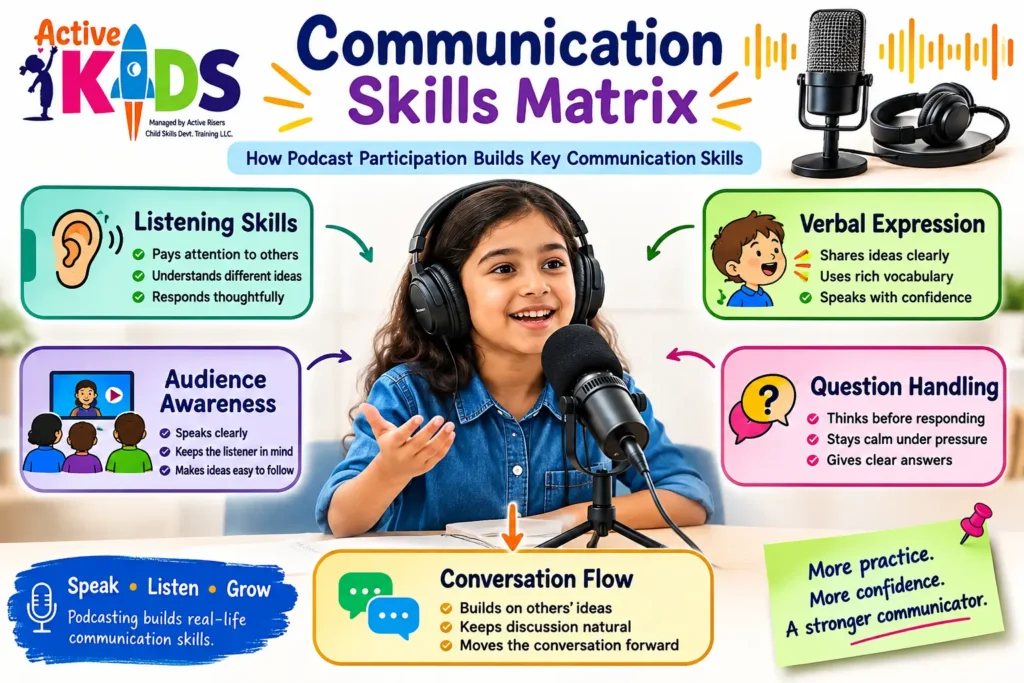
Listening Before Responding
Good communication starts with listening. During a conversation, children need to understand what another person has said before deciding how to respond. Podcast discussions provide practice in listening for meaning, waiting for an appropriate moment to speak and building on what someone else has said.
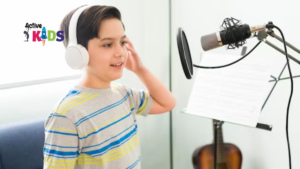
Voice Modulation and Verbal Expression
Children can also become more aware of how they sound when communicating. Recording gives them an opportunity to notice whether they speak too quickly, use an overly quiet voice, or rely on a flat tone.
Practicing pace, volume, tone and clear articulation helps children understand that effective communication depends not only on the words they choose, but also on how those words are delivered.
Conversation Flow
Natural conversations require more than answering individual questions. Children learn to stay connected to a topic, respond appropriately, ask relevant follow-up questions and introduce ideas without abruptly changing direction.
These experiences can strengthen communication practice that children may later use in classroom discussions, group activities and everyday conversations.
Question Handling
Open-ended questions also encourage children to think before responding. Instead of recalling a memorized answer, they have to organize their thoughts and communicate an appropriate response.
This gives children valuable practice in handling less predictable conversations while remaining clear and relevant.
How Children Prepare for a Recorded Conversation
Good communication practice does not mean giving children a script and asking them to memorize it. The goal is to give them enough structure to organize their thoughts while still allowing natural conversation.
Before recording, children can practice:
- Organizing ideas: Identifying the main points they want to communicate.
- Understanding the audience: Thinking about what a listener may need to know.
- Anticipating questions: Considering possible questions without memorizing exact answers.
- Practicing conversation: Getting comfortable responding, listening and continuing a discussion naturally.
This preparation helps children learn an important communication habit: think about what you want to say before deciding how to say it.
It also gives quieter or less experienced speakers a supportive starting point without removing the spontaneity that makes real conversations valuable.
How Reflection Turns Speaking Into Learning
Recording a conversation is only part of the learning process. The real value comes when children have an opportunity to listen back, notice what worked and identify one or two areas they can improve.
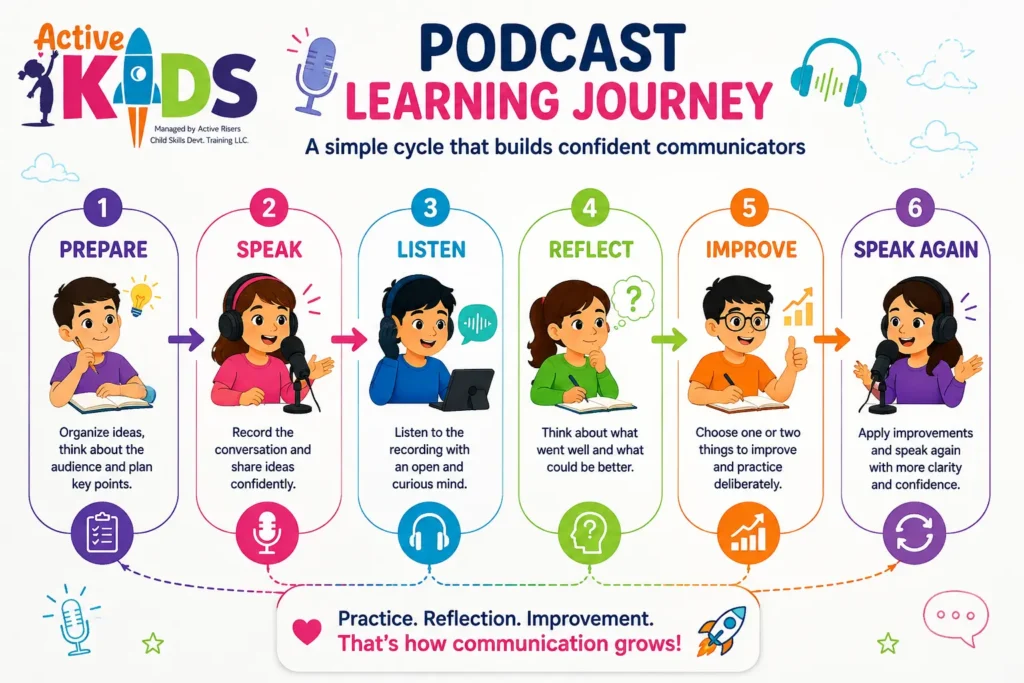
A simple learning cycle can look like this:
Prepare → Speak → Listen → Reflect → Improve → Speak Again
When children hear their own conversations, they may notice things that are difficult to recognize while speaking. For example, they might realize that they spoke too quickly, repeated certain words, gave an unclear explanation or did not fully answer a question.
With supportive guidance, children can then choose a small improvement goal for their next conversation.
This makes communication practice more deliberate. Instead of simply speaking and moving on, children learn to observe their own communication and make gradual adjustments.
The aim is not to make every conversation perfect. It is to help children become more aware of how they communicate and how they can improve with practice.
Supporting Shy or Reluctant Children Through Authentic Practice
Parents may wonder whether podcast activities are suitable for children who are shy or reluctant to speak.
They can be, provided the experience is supportive and gradual. Children do not need to be naturally outgoing to practice communication effectively.
A structured recording environment can allow children to:
- Start with shorter contributions before moving into longer conversations.
- Prepare ideas beforehand without memorizing complete answers.
- Focus on expressing their thoughts rather than performing in front of a large audience.
- Review their progress and build confidence gradually.
The goal is not to change a child’s personality. It is to give them repeated, supportive opportunities to express ideas, respond to others and become more comfortable using their voice.
How Podcasting Complements Trinity Communication Development
Structured communication training and authentic speaking experiences can serve different but complementary purposes.
A structured programme can help children develop vocabulary, organize ideas and practice communication techniques. Podcast conversations then give them an opportunity to apply those skills in a less scripted setting—listening, responding, adapting and communicating with a real audience.
Podcast participation is not a Trinity examination requirement, nor does it guarantee examination success. Its value is in giving children additional opportunities to practice the communication skills they are developing through structured learning.
Over time, this combination of guided learning and authentic practice can help children become more comfortable expressing ideas, responding to questions and adapting their communication to different situations.
Helping Children Find Their Voice
Student podcast communication skills develop through meaningful practice, not instruction alone. When children prepare, speak, listen, reflect and try again, they can become more aware of how they communicate and more comfortable expressing their ideas.
Student podcasting creates one practical way to provide these authentic speaking experiences. Combined with structured communication training, it gives children opportunities to apply what they learn in meaningful conversations.
Explore how ActiveKidsOnline combines structured communication training with authentic speaking experiences to help children grow into clear, adaptable and confident communicators.
FAQs: 7 Ways Student Podcasts Build Communication Skills
How do podcasts help children learn?
Podcasts serve as an experiential learning tool where children apply language, reasoning, and social skills in an authentic setting. By preparing content, engaging in live dialogue, and listening back to recordings, children develop audience awareness, active listening skills, and critical thinking habits that extend beyond rote classroom learning.
Can podcasting improve speaking skills?
Yes. Recording speech encourages children to pay attention to their pace, tone, volume, and articulation. Because they are communicating for a real listener, children naturally work on organizing their ideas clearly, reducing filler words, and expressing themselves with greater verbal clarity.
Why should children record conversations?
Recording conversations allows children to participate in reflective learning. Listening back to their own voice helps them identify speaking habits—such as talking too fast or using repetitive phrases—that they might not notice in the moment. This self-review cycle turns simple speaking into a deliberate learning opportunity.
What communication skills improve through podcasting?
Key skills include voice modulation, conversational flow, question handling, active listening, and audience awareness. Children also learn how to structure their thoughts before speaking and how to adapt their language dynamically when responding to unscripted questions.
How does podcasting support Trinity preparation?
While podcasting is not a formal exam requirement, it acts as a valuable complement to structured training. Dedicated communication programs use experiential activities to help students apply formal speech frameworks, broad vocabulary, and delivery techniques in spontaneous, real-world conversational settings.
Are podcasts suitable for shy children?
Yes. Podcasting offers a scaffolded, low-pressure alternative to standing in front of a large live audience. Shy children benefit from thorough preparation, small group dynamics, and a focus on vocal clarity rather than physical performance, helping them build speaking confidence step by step.
Do children need experience before joining?
No prior speaking or recording experience is necessary. Effective programs guide children through every stage of the process—from organizing initial ideas and rehearsing open questions to participating in guided discussions and reflecting on their progress afterward.