
Some children know exactly what they want to say but struggle to say it when other people are listening.
They may avoid answering questions in class, speak so quietly that others cannot hear them, or become nervous when asked to present in front of classmates. These behaviours do not necessarily mean something is wrong, but they can indicate that a child needs more opportunities to develop public speaking skills for children.
The good news is that speaking confidence can be developed gradually through practice, encouragement, and the right environment.
Here are seven signs parents should watch for.
1. Your Child Avoids Speaking in Class
One of the clearest signs is consistent avoidance during classroom discussions.
Your child may know the answer but avoid raising their hand. They might also let other students speak first, even when they have something valuable to contribute.
Occasional hesitation is normal. The concern is when avoiding participation becomes a regular pattern.
Children who rarely practise expressing their ideas in front of others may find it increasingly difficult to develop confidence.
Encouraging small contributions can help. Instead of asking your child to suddenly give a full presentation, start with simple questions at home and let them explain their answers.
This creates low-pressure speaking practice before they face larger audiences.
2. Your Child Becomes Extremely Nervous Before Presentations
School presentations can make many children nervous.
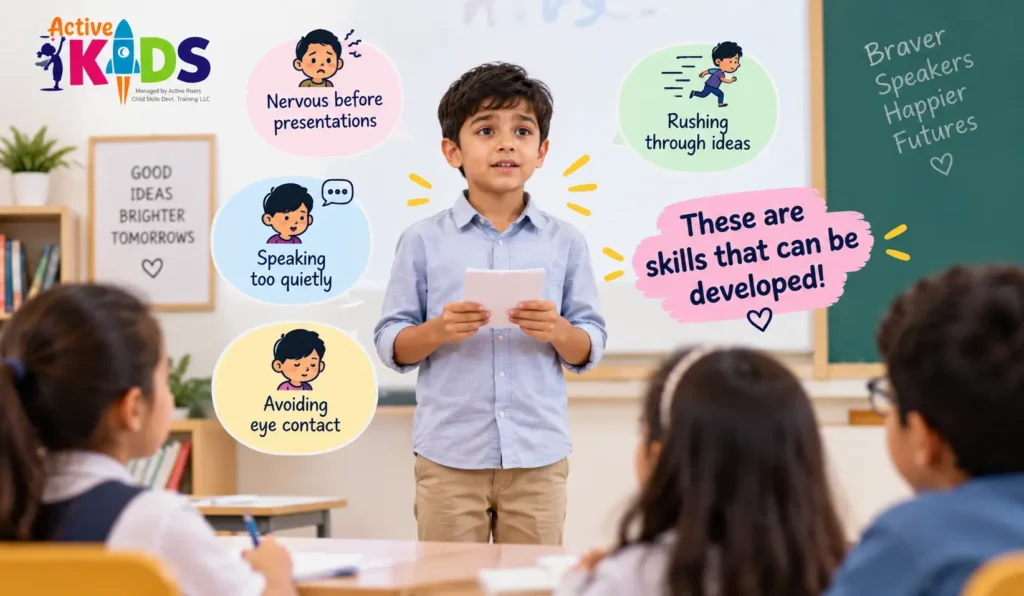
However, if your child regularly experiences intense stage fear before a presentation, refuses to participate, or spends days worrying about an upcoming speaking activity, it may be worth paying attention.
Look for behaviours such as:
- Saying they do not want to attend school on presentation days
- Repeatedly asking to avoid the presentation
- Becoming unusually quiet
- Complaining about nervousness
- Forgetting information they normally know
- Becoming distressed when practising
The objective is not to eliminate every nervous feeling.
Children need to learn that nervousness is manageable and that they can continue speaking even when they feel uncomfortable.
3. Your Child Speaks Too Quietly
A child does not need to have a loud voice to be a good speaker.
But if teachers and classmates frequently ask your child to repeat themselves, their volume may be affecting their ability to communicate effectively.
Speaking too quietly can happen because of shyness, uncertainty, nervousness, or simply a lack of experience speaking to groups.
At home, encourage your child to practise speaking to different distances. For example, ask them to explain a favourite topic while you stand several steps away. Gradually increase the distance and remind them to use a comfortable, clear voice.
This simple exercise can improve both delivery and speaking confidence.
4. Your Child Rushes Through Every Presentation
Nervous children often speak faster when they are standing in front of an audience.
They may try to finish as quickly as possible, skip important details, or run several sentences together.
This is a common form of nervous speaking.
Rather than repeatedly saying, “Slow down,” teach your child to pause between ideas.
A useful practice technique is to mark natural pauses in their presentation. They can then practise taking a short breath before moving to the next point.
Slowing down gives the speaker time to think and gives the audience time to understand.
Over time, controlled pacing can become an important part of their communication skills.
5. Your Child Struggles to Organise Ideas
A child may have plenty to say but still struggle to present those ideas in a logical order.
For example, they might start explaining an event, jump to something unrelated, return to the original topic, and then forget their conclusion.
This does not mean they lack intelligence or knowledge.
Organising thoughts is a skill that develops with practice.
Teach your child to use a simple structure:
Beginning → Main Points → Example → Conclusion
For a short school presentation, even three key points can provide enough structure to keep the child on track.
Using keywords rather than memorising every sentence can also make speaking feel more natural.
6. Your Child Avoids Eye Contact
Looking at an audience can feel uncomfortable for a nervous child.
Some children stare at the floor, look only at their notes, or turn toward the teacher instead of addressing the wider audience.
Eye contact should not become another source of pressure.
Rather than telling your child to “look everyone in the eye,” encourage them to look up periodically and connect with different people in the room.
During home practice, you can sit in different positions and have your child speak to you.
As their comfort increases, they can gradually develop better presentation skills and audience awareness.
7. Your Child Has Good Ideas but Rarely Expresses Them
This may be the most important sign.
Your child might be creative, knowledgeable, and curious but hesitate whenever they need to explain their ideas publicly.
You may notice that they talk confidently at home but become very different in school or group settings.
The difference suggests that the issue may not be a lack of ideas. It may be a lack of confidence in expressing those ideas around other people.
This is where structured public speaking for kids activities can be particularly useful.
Storytelling, role play, group discussions, and short presentations can give children repeated opportunities to communicate without making every activity feel like a formal speech.
Why These Signs Should Not Be Ignored
A child who avoids speaking today may not automatically become a confident speaker later.
Communication abilities develop through use.
If children rarely get opportunities to explain their thoughts, present ideas, or participate in discussions, they have fewer chances to practise the skills required for effective communication.
That does not mean parents should pressure children into constant performance.
The better approach is gradual exposure.
Start with familiar topics. Keep the audience small. Make the activity enjoyable. Increase the difficulty as the child’s confidence grows.
How Parents Can Help
Parents can support public speaking skills for children through everyday activities.
Make Conversation a Daily Practice
Ask your child to explain what they learned at school.
Instead of accepting a one-word answer, ask follow-up questions:
- Why do you think that?
- What happened next?
- Can you give me an example?
- What would you have done?
These questions encourage children to develop complete responses.
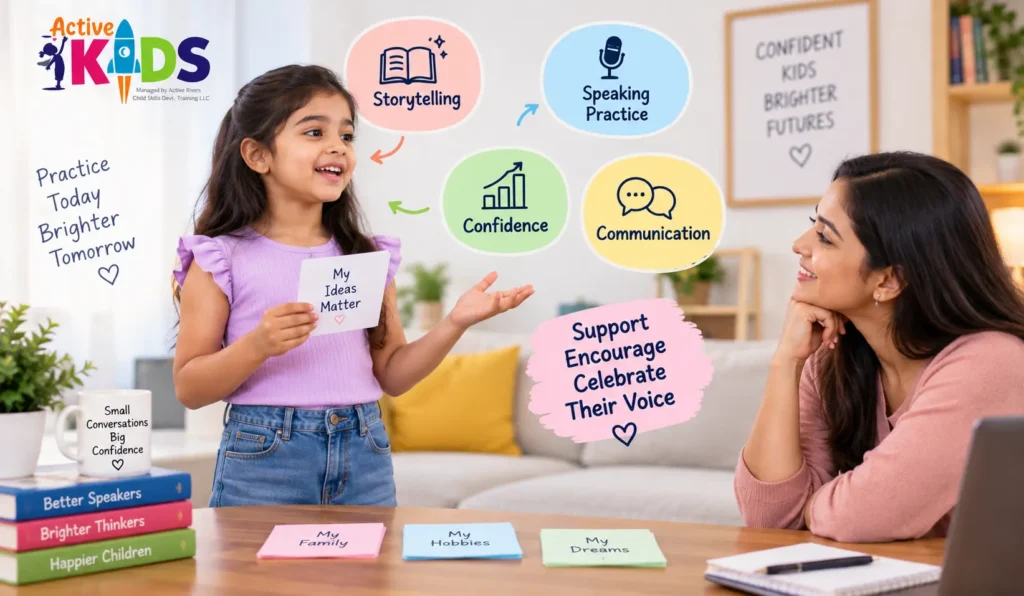
Practise Short Speeches
One-minute speaking exercises are enough to begin.
Choose simple topics such as:
- My favourite book
- A place I want to visit
- My favourite sport
- An interesting animal
- Something I learned this week
The goal is not perfect delivery.
The goal is to make speaking in front of another person feel normal.
Use Storytelling
Storytelling naturally develops vocabulary, sequencing, expression, and confidence.
Ask your child to tell you a story without interrupting them. Afterwards, identify one thing they did well and one thing they can improve.
Celebrate Effort
Instead of saying:
“You were perfect.”
Try:
“You spoke more clearly than last time.”
Specific feedback helps children understand that improvement comes from practice.
When Should Parents Seek Extra Support?
If your child consistently avoids speaking activities, experiences significant anxiety around presentations, or struggles to communicate in situations where their peers are comfortable, additional support may be useful.
A structured programme can provide something home practice cannot always replicate: regular opportunities to speak with other children.
The right environment should allow children to practise communication skills, storytelling, presentations, and group interaction without making mistakes feel embarrassing.
The focus should be on building capability and confidence step by step.
Building Confidence Takes Practice
There is no single moment when a child suddenly becomes a confident speaker.
It usually happens through many small experiences.
A child answers one question in class.
Then they participate in a group discussion.
Later, they deliver a short presentation without reading every word.
Eventually, speaking in front of an audience becomes something they can handle rather than something they automatically avoid.
That progression is why early public speaking for kids development matters.
Parents do not need to create professional speakers. They need to create opportunities for children to find their voice, practise expressing ideas, and become comfortable communicating with others.
Final Thoughts
If you recognise several of these seven signs in your child, do not treat them as weaknesses. They are simply signals that your child may benefit from more structured opportunities to practise speaking and build confidence.
Developing public speaking skills for children takes time, patience, and consistent practice. With encouragement, practical speech practice, and gradual exposure to different speaking situations, children can become more comfortable expressing their ideas and communicating with others.
The goal is not to make every child the loudest person in the room. It is to help them feel capable of speaking clearly and confidently when their ideas deserve to be heard.
FAQs: 7 Signs Your Child Needs Better Public Speaking Skills
How do I know if my child needs help with public speaking?
Your child may need more public speaking practice if they regularly avoid speaking in class, become very nervous before presentations, speak too quietly, rush through presentations, struggle to organise their ideas, or avoid expressing themselves in group settings. Occasional nervousness is normal, but consistent difficulty can indicate that they would benefit from structured speaking opportunities.
How can I improve my child’s public speaking skills?
Start with short, low-pressure speaking activities at home. Ask your child to explain something they learned, tell a story, or speak for one minute about a familiar topic. Encourage clear speaking, good pacing, and organised ideas, then gradually increase the difficulty as their confidence improves.
Why is my child confident at home but shy when speaking in public?
Some children communicate comfortably with familiar people but become nervous when they have to speak in front of teachers, classmates, or larger groups. This can happen because public speaking requires skills such as audience awareness, organisation, delivery, and confidence. Regular practice in supportive group settings can help make speaking in public feel more familiar.
What activities can help children become better public speakers?
Storytelling, role play, group discussions, show-and-tell activities, and short presentations can all help children develop public speaking skills. These activities give children opportunities to practise expressing ideas, speaking clearly, organising information, listening to others, and communicating with an audience without making every activity feel like a formal speech.