
Your child may understand English well but still hesitate when it is time to speak.
You may notice it at home.
They can follow an English cartoon. They understand what their teacher says. They can answer a worksheet. But when someone asks, “Tell me about your day,” the answer is often just a few words.
This does not always mean your child has a poor understanding of English.
Speaking requires a different kind of practice. Children have to find the right words, put them into sentences, listen to the other person, respond and keep the conversation going.
That is why the best way to improve English speaking skills for kids is not simply to give them more vocabulary lists or grammar exercises.
They need more chances to use English.
Here are seven practical ways parents can help.
Why Do Some Children Understand English but Struggle to Speak?
Understanding and speaking are closely connected, but they are not the same skill.
A child may understand the sentence:
“What did you do at school today?”
but still struggle to answer:
“We had a science activity. I made a small model with my friends.”
Speaking requires the child to recall vocabulary, form a sentence and express an idea at the same time.
Some children also worry about making mistakes.
Others simply do not get enough opportunities to have real conversations in English.
Research supports the importance of interaction. A longitudinal study followed 122 English-acquiring children from 9 to 24 months and found a two-way relationship between conversational turn-taking and vocabulary growth.
Another randomized study included 71 infants and found that an intervention designed to increase parent-child conversational turns was associated with stronger language outcomes at 18 months.
These studies focused on younger children, so they should not be treated as a direct prediction of how quickly an older child will improve. But they point to a useful principle for parents:
Children learn language by using it with people.
1. Make English Part of Everyday Conversation
You do not need to turn your home into a classroom.
Start with ordinary conversations.
At breakfast, ask:
- “What would you like to eat?”
- “Why do you like it?”
- “What are you doing after school?”
- “What was the most interesting thing you learned today?”
When you are travelling, talk about what you can see.
When you are shopping, ask your child to describe something.
When you are cooking, ask them to explain what you are making.
The conversation does not need to be complicated.
For example:
Parent: “What did you do at school?”
Child: “We played.”
Instead of ending the conversation there, ask:
Parent: “What did you play?”
Child: “Football.”
Parent: “Who played with you?”
Now the child has another reason to speak.
This is much more useful than asking your child to memorise another list of words.
A simple rule
Try to ask questions that cannot be answered with only “yes” or “no.”
Instead of:
“Did you enjoy school?”
try:
“What did you enjoy most about school today?”
The second question gives your child something to explain.
2. Teach New Words Through Real Situations
Vocabulary is easier to use when children understand where the word belongs.
Take the word “enormous.”
You could simply give your child its meaning.
Or you could say:
“That building is enormous.”
Then ask:
“Can you think of something else that is enormous?”
The child now has to understand the word and use it.
Do the same with words such as:
- curious
- disappointed
- crowded
- adventurous
- comfortable
- surprising
Ask questions around the word.
For example:
Word: curious
“What are you curious about?”
Word: disappointed
“Have you ever felt disappointed?”
Word: adventurous
“What would you do if you wanted to have an adventurous weekend?”
This approach builds vocabulary while giving children actual speaking practice.
It is also useful to work on more than vocabulary alone. Listening, speaking, reading and writing support each other.
Parents who want to understand how these four areas fit together can read what LSRW skills mean for children’s English learning.
3. Use Storytelling to Encourage Longer Answers
Some children can answer simple questions but struggle to speak for more than a sentence.
Storytelling can help.
You can use:
- a picture
- a short book
- a cartoon episode
- a family event
- an imaginary situation
Ask your child to explain what happened.
Start with simple questions:
- Who was there?
- Where were they?
- What happened first?
- What happened next?
- What was the problem?
- How did it end?
Suppose your child says:
“The boy went to the park.”
Ask:
“Who went with him?”
Then:
“What did they do?”
Then:
“Why did they go there?”
The original sentence gradually becomes a short story.
That is useful practice for vocabulary, sentence formation, memory and spoken expression.
It also prepares children for situations where they need to explain something rather than simply give an answer.
For children who also need help becoming more comfortable speaking in front of others, read how to improve public speaking skills for children.
4. Correct Pronunciation Without Stopping Every Sentence
Pronunciation matters.
But correcting every mistake can make a child afraid to speak.
Suppose your child says:
“I went to the libary.”
You do not necessarily need to stop them and say, “Wrong. Say library.”
You can simply respond:
“Oh, you went to the library? Which library did you visit?”
Your child hears the correct pronunciation while the conversation continues.
This does not mean pronunciation errors should always be ignored.
For repeated or important errors, direct practice can help. The key is choosing the right moment.
You can practise pronunciation through:
- reading aloud
- repeating difficult words
- short conversations
- listening and repeating
- recording short answers
- practising sounds through age-appropriate phonics activities
For younger children, [Phonics Club] can provide structured practice with sounds and early English skills.
5. Use Role-Play for Real-Life English
A child may know English but still not know what to say in a particular situation.
Role-play gives them a chance to practise before they face the real situation.
Try these at home.
At a shop
“Can I have a bottle of water, please?”
Asking a teacher for help
“Could you explain that again, please?”
Meeting someone new
“Hi, my name is Ahmed. What is your name?”
Asking for directions
“Excuse me. Could you tell me where the library is?”
Giving an opinion
“I think this story is interesting because…”
You can even switch roles.
Let your child become the shopkeeper while you become the customer.
Then change the situation.
This makes speaking practice less repetitive.
It also teaches children that communication is more than vocabulary. They need to know how to ask, answer, explain, disagree politely and continue a conversation.
If your child often stays quiet even when they know the answer, read why a child may struggle to speak up.
6. Read Aloud — Then Ask Questions
Reading aloud is useful.
But do not stop when your child reaches the end of the page.
Talk about what they have read.
Ask:
- “What happened?”
- “Which character did you like?”
- “Why did the character do that?”
- “What would you have done?”
- “What do you think will happen next?”
- “Can you explain the story in your own words?”
That last question is particularly useful.
Your child is no longer repeating the author’s words. They have to organise the information and explain it themselves.
That is speaking practice.
Research also shows why different English skills should not simply be treated as interchangeable. English learning research has examined spoken production, listening and reading as separate areas of ability.
So if your child reads English comfortably but rarely speaks it, give speaking its own practice time.
7. Give Your Child a Safe Place to Speak
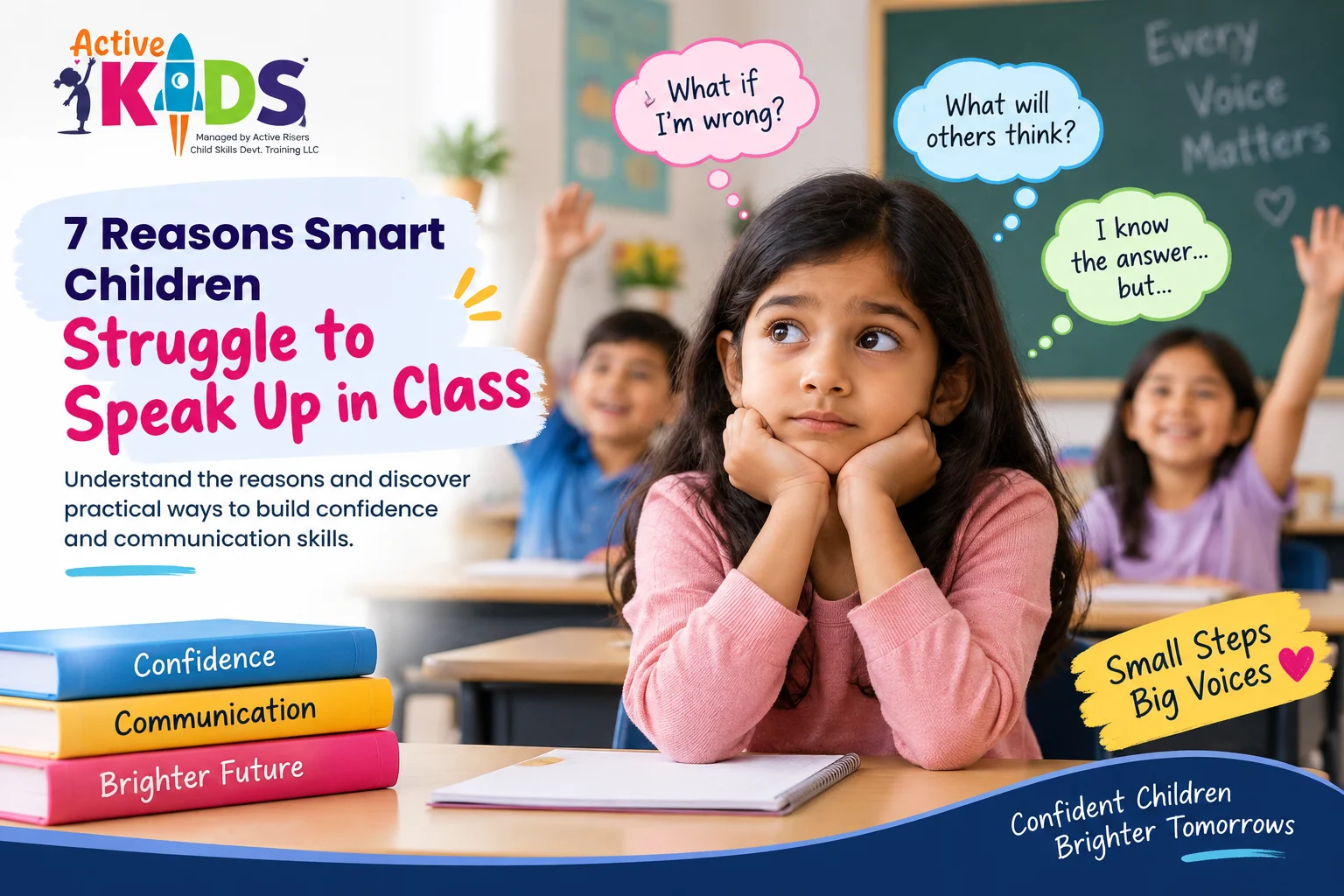
A child who is afraid of making mistakes may speak less, even when they know the answer.
That is why the atmosphere matters.
Avoid:
- laughing at mistakes
- comparing your child with another child
- interrupting every sentence
- demanding perfect grammar
- forcing a shy child to perform without preparation
Instead, notice the effort.
Your child asked a question?
Good.
They explained an idea in English?
Good.
They tried again after making a mistake?
That matters too.
Confidence usually grows through repeated experiences where the child feels that speaking is manageable.
If your child is shy about presentations, conversations or speaking in groups, you can also read from shy to confident: helping your child master public speaking.
How Can I Improve My Child’s English Speaking at Home?
Keep it simple.
You do not need a one-hour lesson every day.
Try a 15-minute speaking routine.
5 minutes: Conversation
Talk about school, friends, food, hobbies or something interesting that happened during the day.
5 minutes: Reading or listening
Read a short story together or listen to a short English story.
5 minutes: Speaking
Ask your child to retell the story, explain an idea or give an opinion.
For example:
Topic: Favourite food
New words: delicious, spicy, healthy
Question: “What is your favourite food?”
Follow-up: “Why do you like it?”
Challenge: “Would you recommend it to your friend?”
You have now created a short English speaking lesson without a worksheet.
How Can I Improve My Child’s English Vocabulary?
Do not focus only on the number of words your child knows.
Focus on whether they can use the words.
For example, if your child learns:
“humid”
ask:
“Is it humid today?”
If they learn:
“disappointed”
ask:
“When was the last time you felt disappointed?”
If they learn:
“enormous”
ask:
“What is the biggest or most enormous thing you have seen?”
The word becomes connected to an idea.
That makes it easier to bring the word into future conversations.
Does Reading Aloud Improve English Speaking?
Yes, reading aloud can give children useful practice with pronunciation, sentence rhythm and spoken English.
But reading aloud by itself does not create a complete speaking routine.
Add conversation after reading.
Ask the child to explain the story, describe a character or give an opinion.
That extra step makes the child produce their own language rather than simply read someone else’s words.
How Can I Help a Shy Child Speak English?
Start with situations where the child already feels comfortable.
Do not begin with a large audience.
Try this progression:
Parent → sibling → close friend → small group → larger group
Give the child time to prepare.
For example, before asking them to speak about their favourite animal, help them prepare three points:
- What is the animal?
- Where does it live?
- Why do you like it?
Preparation can reduce the pressure of having to think about everything while speaking.
For more practical ideas, see [helping a child overcome hesitation and speak up].
Are Online English Classes Effective for Kids?
They can be useful when children actively participate.
The important question is not simply whether the class is online.
Ask what happens during the class.
Does your child:
- answer questions?
- speak with the teacher?
- interact with other children?
- practise pronunciation?
- tell stories?
- take part in role-play?
- receive feedback?
- explain ideas?
A class where children spend most of the lesson listening gives them less speaking practice than an interactive class.
Parents looking for broader English development can also explore English language classes for children in the UAE.
What Should Parents Look for in English Classes for Kids in Dubai?
Look beyond the course title.
Ask the provider:
- How much of the lesson involves speaking?
- Are classes interactive?
- How many children are in each group?
- Does the teacher give individual feedback?
- Is the programme suitable for my child’s age?
- Does it include pronunciation?
- Does it include vocabulary and sentence formation?
- Are storytelling and role-play used?
- How is progress monitored?
A good programme should give children opportunities to use English, not simply learn about English.
How Long Does It Take to Improve English Speaking Skills?
There is no reliable number of weeks that applies to every child.
Progress depends on:
- age
- starting English level
- exposure to English
- frequency of practice
- vocabulary
- listening ability
- confidence
- opportunities to speak
- learning environment
Look for small changes rather than expecting overnight fluency.
For example:
Earlier:
“I like football.”
Later:
“I like football because I play with my friends after school.”
The second answer shows more vocabulary, sentence structure and willingness to explain an idea.
Those small changes matter.
Should Children Practise English at Home or Join a Class?
It does not have to be one or the other.
Home practice gives children frequent opportunities to use English in familiar situations.
A structured programme can provide:
- planned lessons
- teacher feedback
- group interaction
- speaking activities
- regular practice
- situations that may not happen naturally at home
For children who want more practice with communication and confidence, [Speak & Shine] is one of the relevant Active Kids Online programmes.
For broader language development, parents can explore the [Language Enrichment Club].
What About Public Speaking?
English speaking and public speaking overlap, but they are not exactly the same.
A child may speak English comfortably with parents but become nervous when asked to speak in front of a group.
Public speaking adds another layer:
- organising ideas
- speaking clearly
- maintaining attention
- using appropriate voice and pace
- presenting information
- managing nervousness
Parents looking specifically at this area can explore public speaking and debate courses for kids in the UAE.
What About Speech Therapy?
English learning and speech therapy are different.
A child learning English as an additional language may simply need more exposure and practice.
Speech therapy is a different matter and may be appropriate when a child has persistent difficulties with speech sounds, language, fluency or communication.
Parents should not assume that every English-speaking difficulty is a speech disorder.
If you are comparing these options, read speech therapy and public speaking classes for more context.
A Simple Weekly Speaking Plan
You can use this routine at home:
| Day | Activity |
| Monday | 10-minute family conversation |
| Tuesday | Read a short story and retell it |
| Wednesday | Role-play a real-life situation |
| Thursday | Learn 3 useful words and use them in conversation |
| Friday | Talk about the week’s favourite activity |
| Saturday | Picture description or storytelling |
| Sunday | Free conversation about anything your child chooses |
The goal is not to make every session perfect.
The goal is to make speaking normal.
Final Thoughts
If you want to improve English speaking skills for kids, start with conversation.
Ask your child questions.
Let them explain things.
Read together.
Tell stories.
Play pretend.
Talk about their interests.
And give them enough time to finish what they are trying to say.
You do not need to correct every sentence.
You do not need to make every activity feel like a lesson.
Children become more comfortable with English when they have regular reasons to use it.
If you are looking for structured support, explore Speak & Shine, and Phonics Club to see which type of programme fits your child’s current needs.
You can also follow Active Kids Online on Instagram for learning ideas and updates, or check the Active Kids Online Google profile for current information and reviews.
FAQs: 7 Powerful Ways to Improve English Speaking Skills for Kids
How can I improve my child’s English speaking skills?
Give your child regular opportunities to speak English in everyday situations. Use conversation, storytelling, role-play, reading aloud and questions that encourage longer answers.
How can I improve my child’s English speaking at home?
Start with 10–15 minutes of daily conversation. Talk about school, hobbies, food, books or family activities. Ask follow-up questions instead of accepting only one-word answers.
How can a child speak English fluently?
Fluency develops through repeated exposure and regular use. Children need opportunities to listen, speak, learn vocabulary and communicate with other people.
What activities improve English speaking skills in children?
Storytelling, role-play, picture description, reading aloud, show-and-tell, family discussions and simple question-and-answer games are useful speaking activities.
Does reading aloud improve English speaking?
Reading aloud can help children practise pronunciation and spoken expression. Combining it with questions and discussion gives them additional opportunities to use English independently.
How can I improve my child’s English vocabulary?
Teach useful words in context and encourage your child to use them in sentences. Repeated use in conversation is more practical than memorising isolated word lists.
How can I help my child overcome hesitation when speaking English?
Reduce pressure, give the child preparation time and start with familiar speaking situations. Avoid correcting every mistake while the child is trying to express an idea.