
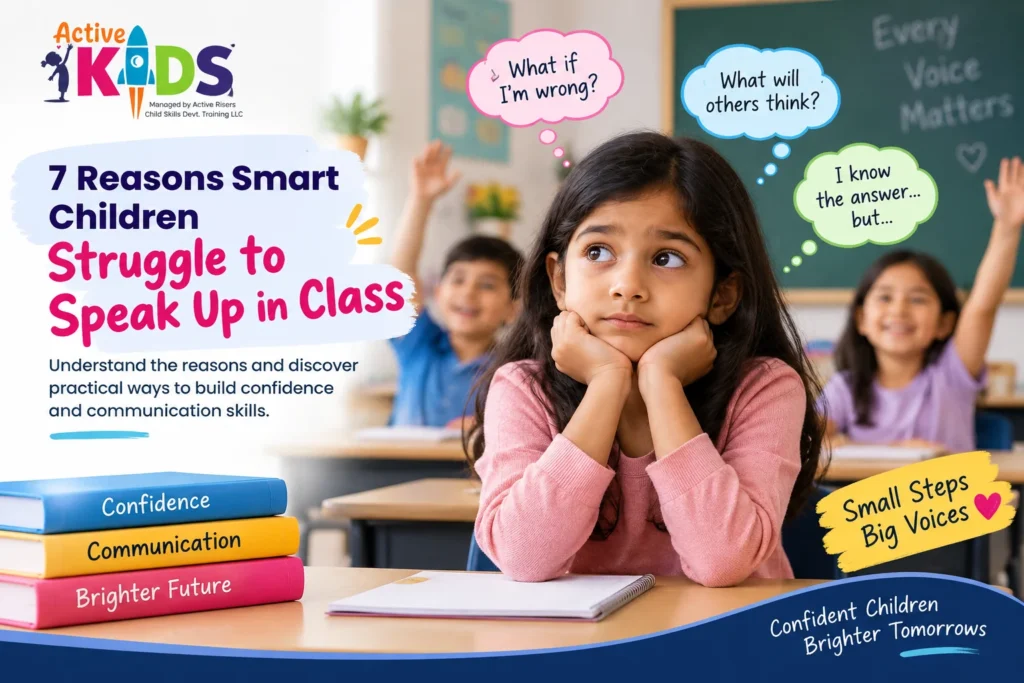
A child can understand the lesson, know the answer, and still remain silent when the teacher asks a question.
When a child struggles to speak up, parents may wonder whether the problem is shyness, lack of confidence, communication difficulty, or simply a preference for staying quiet. In many cases, the reason is more specific than that.
Speaking in a classroom requires children to think, organise their ideas, manage nervousness, and communicate those ideas while other people are listening.
These abilities develop with practice.
If your child rarely participates in discussions, avoids presentations, or becomes hesitant when asked to explain an answer, understanding the possible reasons is the first step toward helping.
1. They Are Afraid of Giving the Wrong Answer
One of the most common reasons children stay silent is fear of being wrong.
A child may know the answer but still think:
- “What if everyone laughs?”
- “What if my teacher says I’m wrong?”
- “What if another student gives a better answer?”
- “What if I forget what I want to say?”
This creates hesitation before the child even begins speaking.
The problem is not necessarily a lack of knowledge. It can be the fear of what might happen after expressing that knowledge.
Parents can help by changing the way mistakes are discussed at home.
Instead of focusing only on whether an answer is correct, ask your child to explain how they reached it.
This teaches children that expressing ideas is part of learning, even when the final answer needs correction.
For more on recognising this pattern, see our guide to 7 signs your child needs better public speaking skills.
2. They Have Classroom Confidence but Not Speaking Confidence
Some children are comfortable completing worksheets, reading independently, or working on projects but become uncomfortable when they have to speak.
That difference matters.
Classroom confidence is not exactly the same as confidence when communicating in front of others.
A child may understand the subject but struggle to organise a spoken response quickly.
This is why regular opportunities for class participation matter.
Short discussions, storytelling, question-and-answer activities, and presentations can give children repeated opportunities to practise communicating their thoughts.
The goal is not to make children speak constantly.
It is to make speaking a familiar part of learning.
Parents looking for practical activities can also explore these public speaking activities for kids and use similar exercises at home.
3. They Need More Time to Organise Their Thoughts
Some children process information carefully before answering.
When a teacher asks a question and expects an immediate response, the child may still be deciding what they want to say.
If another student answers first, the opportunity disappears.
This can make the child appear less confident than they actually are.
Give children time to formulate an answer.
At home, avoid immediately completing their sentences. Give them a few seconds to think before prompting them.
You can also practise using a simple structure:
Think → Organise → Speak
With regular speaking practice, children can become quicker at turning their thoughts into clear spoken responses.
4. They Are Worried About Being Judged by Classmates
Peer judgment can become particularly important as children get older.
A child may be comfortable talking to parents but become much quieter around classmates.
They may worry about their accent, vocabulary, voice, appearance, pronunciation, or whether their answer sounds “smart enough.”
This can contribute to speaking anxiety and cause children to avoid opportunities to participate.
The solution is not to tell them to “just ignore everyone.”
Instead, help them practise speaking in gradually more challenging environments.
Start with a parent.
Then a sibling.
Then a small group.
Eventually, the child can practise speaking to a larger audience.
This gradual approach gives children opportunities to experience successful communication before they face more demanding situations.
5. They Have Good Ideas but Struggle to Express Them Clearly
Some children have plenty of ideas but cannot easily organise those ideas into a spoken answer.
They might begin explaining something, lose their train of thought, add unrelated details, and then stop.
This can be frustrating for both the child and the teacher.
The answer is not necessarily more memorisation.
Children need opportunities to practise child communication through structured conversation.
Try asking your child to explain something using three steps:
What is it? → Why is it important? → Give me an example.
For example, if the topic is their favourite sport:
- What is the sport?
- Why do you enjoy it?
- Can you give me an example of a memorable match or moment?
This simple framework helps children organise information before speaking.
It also connects speaking with broader skills such as listening, reasoning, vocabulary, and expressing ideas.
The Speak & Shine online course is another resource parents can explore when they want structured opportunities for children to develop these abilities.
6. They Have Had Too Little Opportunity to Practise Speaking
Communication is a skill that develops through use.
A child who rarely speaks in groups has fewer opportunities to practise the behaviours involved in group communication.
That includes:
- Speaking clearly
- Listening to others
- Waiting for a turn
- Organising an answer
- Using an appropriate voice
- Responding to questions
- Explaining an opinion
- Presenting information
The Education Endowment Foundation describes oral-language approaches as activities that emphasise speaking and listening and reports positive effects from structured verbal interaction in educational settings. Its evidence review also highlights questioning, dialogue, vocabulary development, and purposeful interaction as useful components.
This does not mean every child needs formal public speaking training.
It means children benefit from environments where communication is actively practised.
For parents considering a structured environment, explore Active Kids school programmes, where communication and related skills can be developed through school-based programmes.
7. They May Be Naturally Quiet — and Adults Misread That as a Problem
Not every quiet child needs to become highly outgoing.
Some children naturally prefer observing before participating. They may listen carefully, think deeply, and contribute only when they feel they have something meaningful to add.
The important distinction is between being quiet by choice and being unable to speak because of fear or lack of confidence.
Ask yourself:
- Does your child communicate comfortably at home?
- Can they explain their interests to people they trust?
- Do they avoid speaking only in certain environments?
- Do they want to participate but hesitate?
- Do they become noticeably nervous during presentations?
- Do they struggle to explain ideas even when they understand them?
The answers can help you understand whether your child simply has a quieter personality or needs additional support with communication.
Why Speaking Skills Matter Beyond the Classroom
Speaking is not only a presentation skill.
It affects how children participate in learning, collaborate with classmates, explain their thinking, ask for help, and communicate with adults.
The UAE’s National Education Charter identifies effective communication as one of the skills to be embedded across the education system, alongside critical thinking, creativity, reading and writing, and other future-oriented skills.
The UAE Ministry of Education has also identified listening and speaking as communication skills in its EmSAT-related assessment framework.
That makes communication development relevant well beyond a single school presentation.
How Parents Can Help a Child Speak Up More
The first step is to remove unnecessary pressure.
You do not need to turn every dinner conversation into a speaking lesson.
Instead, create small opportunities throughout the week.
Ask for Explanations
Instead of asking:
“Did you understand?”
Ask:
“Can you explain what you learned today?”
This encourages the child to retrieve information and communicate it.
Practise One-Minute Speaking
Choose a familiar topic and give your child one minute to explain it.
Good topics include:
- Favourite sport
- Favourite book
- A school project
- A recent family activity
- An interesting animal
- Something they learned
The purpose is class participation practice without classroom pressure.
Use Storytelling
Storytelling gives children a natural reason to speak.
Ask them to describe:
Beginning → Problem → Events → Ending
This develops sequencing, vocabulary, expression, and confidence.
If your child is particularly hesitant, our article on building shy child confidence provides additional guidance.
Practise Presentations Gradually
Do not begin with a large audience.
Start with one parent.
Then add another family member.
Then perhaps a sibling or friend.
As the child becomes more comfortable, the audience increases.
Parents can also read our guide on how to choose a public speaking course for kids if they are considering structured support.
When Should Parents Consider a Structured Programme?
If your child repeatedly avoids speaking activities despite encouragement and practice, structured support may be worth considering.
A useful programme should provide opportunities for children to practise:
- Public speaking
- Storytelling
- Presentations
- Group discussions
- Listening
- Vocabulary
- Self-expression
- Team communication
The environment matters as much as the activity.
Children need enough challenge to grow, but enough support to feel comfortable making mistakes.
For parents looking specifically for a school-based option, Active Kids School Programmes can be explored as the primary next step.
You can also visit the public speaking classes for kids page to understand the broader programme options.
Public Speaking Is Not About Making Every Child Extroverted
A common misconception is that confident speaking means becoming loud, highly social, or constantly eager to perform.
That is not the objective.
A quiet child can become an excellent communicator.
The goal is to help children communicate when communication is required.
They should be able to:
- Ask a question
- Explain an idea
- Present their work
- Share an opinion
- Participate in a discussion
- Speak to a teacher
- Work with classmates
- Express what they need
That is practical confidence.
The Connection Between Writing and Speaking
Parents sometimes treat writing and speaking as completely separate abilities.
They are closely connected.
A child who struggles to organise ideas in writing may also struggle to structure those ideas when speaking.
Likewise, regular conversation can help children develop vocabulary and organise their thoughts.
If your child has difficulty expressing ideas in written work, these resources may also be useful:
Developing language across speaking, listening, reading, and writing gives children more ways to communicate their thinking.
Communication Skills Develop Across Different Activities
Public speaking does not have to exist in isolation.
Children can develop communication through storytelling, elocution, podcasts, group activities, presentations, reading, and structured discussions.
For example, parents can explore 7 powerful skills kids build through elocution lessons to see how speaking activities can support broader development.
Older children may also benefit from age-specific learning. The public speaking course for kids aged 9–14 provides another relevant resource for families considering structured training.
Children can also learn communication through real-world formats. The student podcast on communication skills is an example of how speaking can be connected to authentic communication rather than only formal speeches.
A Simple 4-Week Plan for Parents
If your child currently avoids speaking, start small.
Week 1: Speak at Home
Ask one open-ended question each day and give your child time to answer.
Week 2: One-Minute Talks
Ask your child to speak for one minute about something they enjoy.
Week 3: Family Presentation
Let your child prepare a short presentation and deliver it to the family.
Week 4: Real-World Practice
Encourage a small speaking opportunity outside the home—such as asking a question, explaining something to a teacher, or participating in a group activity.
The purpose is gradual progress.
You are not trying to transform the child in four weeks.
You are building a habit of communication.
Final Thoughts
When a child struggles to speak up, the silence does not necessarily mean they lack knowledge or ability.
They may be afraid of making mistakes, worried about judgment, unsure how to organise their thoughts, or simply lacking enough opportunities to practise.
The right response is usually not more pressure.
It is a more structured opportunity.
Give children time to think. Encourage them to explain their ideas. Practise short conversations and presentations. Build classroom confidence gradually. Most importantly, create environments where speaking is treated as a skill that can improve rather than a personality trait a child either has or does not have.
For families who want to take that development into a structured school environment, Active Kids School Programmes is the recommended next resource to explore.
You can also visit Active Kids to see the wider range of learning programmes and resources available for children.
The objective is simple: not to make every child the loudest voice in the classroom, but to help every child feel capable of using their voice when they have something to say.
FAQs: 7 Reasons Smart Children Struggle to Speak Up in Class
Why does my child struggle to speak up in class?
A child may struggle to speak up in class because they are afraid of giving the wrong answer, worried about being judged by classmates, unsure how to organise their thoughts, or uncomfortable speaking in front of others. Some children also need more time to process a question before responding. A quiet personality does not necessarily mean a child lacks confidence or communication skills.
How can I encourage my child to speak more confidently?
Start with low-pressure speaking opportunities at home. Ask your child to explain something they learned, talk about a favourite topic, tell a short story, or give a one-minute presentation. Gradually move from speaking with a parent to a sibling, small group, and larger audience. Avoid forcing a child to speak before they feel ready.
Why does my child talk at home but not at school?
Some children communicate comfortably at home but become very quiet at school because they feel nervous, fear being judged, or find the classroom environment overwhelming. If a child consistently cannot speak in particular settings despite being able to speak comfortably elsewhere, parents should consider discussing the pattern with a paediatrician, speech-language pathologist, or child psychologist.
How do I help my child who is afraid of speaking in front of others?
Build speaking confidence gradually rather than starting with a large audience. Begin with short conversations at home, followed by one-minute talks, family presentations, and small-group activities. Practising familiar topics can help children focus on expressing their ideas instead of worrying about making mistakes.
Is it normal for a child to be quiet in class but talkative at home?
Yes. Some children are naturally quieter and prefer observing before participating. The important question is whether the child can communicate comfortably in familiar situations and whether their quietness prevents them from participating in activities they want or need to join. Persistent distress or an inability to speak in particular environments may require professional guidance.
How can I help my child speak up at school?
Give your child regular opportunities to practise communication outside school. Try open-ended questions, storytelling, one-minute talks, role-playing everyday situations, and short family presentations. You can also encourage small real-world speaking opportunities, such as asking a teacher a question or sharing an idea during a group activity.
Does speech delay cause a child to struggle with classroom participation?
Speech or language difficulties can affect how easily a child expresses ideas, answers questions, or participates in classroom discussions. However, difficulty speaking up is not always caused by speech delay. Fear of mistakes, speaking anxiety, limited practice, difficulty organising thoughts, and a naturally quiet temperament can also contribute.
When should I worry about my child’s difficulty speaking up?
Consider seeking professional advice if your child’s difficulty speaking is persistent, causes significant distress, prevents participation in everyday activities, or occurs alongside broader communication difficulties. A paediatrician, speech-language pathologist, or child psychologist can help identify whether the issue relates to communication development, anxiety, selective mutism, or another factor.