


Introduction
Parents across the UAE often wonder about the real messy handwriting causes when they see their child struggling to write neatly. A page filled with uneven letters, inconsistent spacing or difficult-to-read words can be frustrating, but messy handwriting doesn’t always mean a child is careless or not trying hard enough. In many cases, it can be a sign that their handwriting habits need guidance—or that their fine motor skills are still developing.
Whether your child attends a British, CBSE, IB or American curriculum school, neat handwriting remains an important part of everyday learning. It helps children organise their thoughts, complete classroom tasks with confidence and communicate their ideas more effectively. However, before looking for solutions, it’s important to understand why your child’s handwriting looks untidy in the first place.
Many parents assume that more handwriting practice is the answer. While that may help some children, it isn’t the right solution for everyone. If the underlying challenge is related to hand strength, motor coordination or developmental readiness, practising the same writing patterns repeatedly may only lead to frustration and reduced confidence.
This guide will help you understand the most common messy handwriting causes, recognise the difference between handwriting habits and fine motor development, and learn when a simple change in technique is enough—and when your child may benefit from a structured handwriting assessment.
What Messy Handwriting Actually Indicates
Messy handwriting is not a diagnosis. It is a sign that something in your child’s writing process needs attention. While some children develop untidy handwriting because of inconsistent writing habits, others struggle because their fine motor skills are still developing.
Understanding the messy handwriting causes is more important than focusing on how the handwriting looks. Two children may have equally untidy handwriting, but the reason behind it can be completely different. One may improve with better handwriting instruction, while the other may need support to strengthen hand muscles and motor coordination.
It is also important to remember that handwriting develops at different rates. Factors such as age, hand strength, pencil grip, posture and motor development all influence how neatly a child writes. Comparing your child’s handwriting with others may lead to the wrong conclusion.
Before looking for solutions, parents should first identify the root cause. Once you understand whether the challenge is related to handwriting habits or fine motor development, choosing the right support becomes much easier.
Understanding Fine Motor Development
Fine motor development refers to the ability to control the small muscles in the hands and fingers. These muscles play an essential role in everyday tasks such as holding a pencil, fastening buttons, using scissors and writing clearly. Without well-developed fine motor skills, handwriting can become slow, tiring and difficult to control.
Several skills work together to support neat handwriting. Hand strength helps children hold and move a pencil comfortably, while motor coordination allows their fingers to make smooth, controlled movements. Pencil grip, writing posture and letter formation also influence how easily children can write and how long they can write without discomfort.
As these skills develop, handwriting usually becomes more consistent and effortless. However, if a child has weak hand muscles or immature motor control, they may press too hard, grip the pencil tightly or experience writing fatigue after only a short period. These signs often indicate that the challenge goes beyond handwriting habits alone.
Understanding how fine motor development supports handwriting helps parents identify whether their child needs guidance with writing techniques or additional support to build the physical skills required for confident writing.
Handwriting Habits vs Weak Fine Motor Skills: How to Tell the Difference
Poor handwriting in children is not always caused by the same issue. Some children know how to control a pencil but develop habits that affect the appearance of their writing. Others struggle because their hands have not yet developed the strength and coordination needed for comfortable writing.
The table below highlights the key differences. It is not a diagnostic tool, but it can help parents identify which signs they are seeing most often at home.
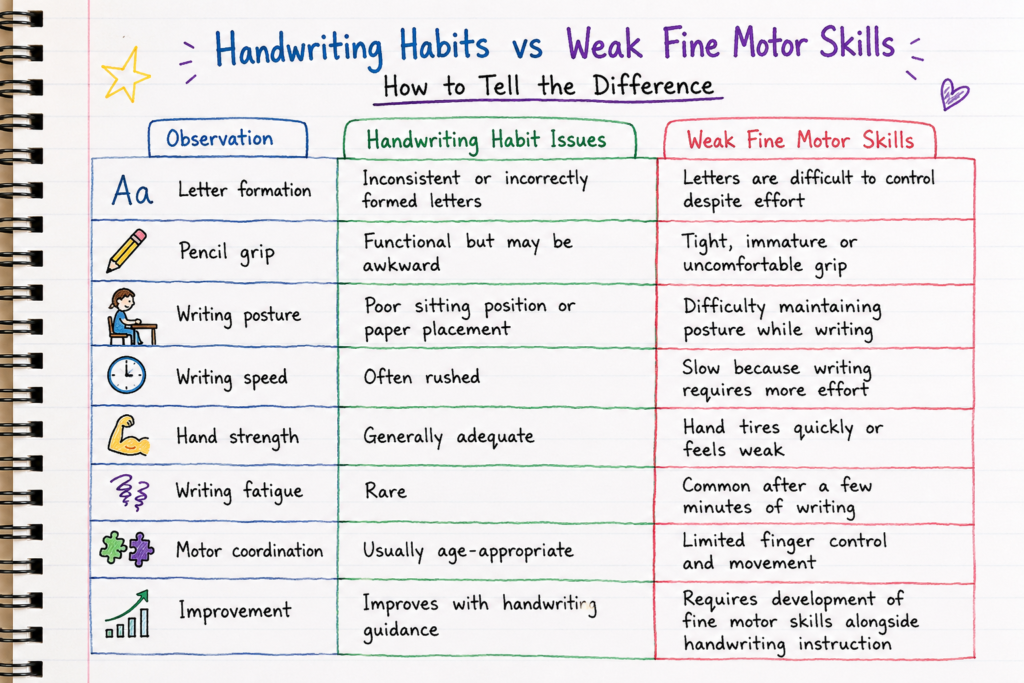
If your child’s handwriting improves when they slow down or pay closer attention, the challenge is often related to handwriting habits. However, if writing remains difficult even when they try their best, it may be time to consider a child handwriting assessment to understand whether fine motor development is affecting their progress.
Home Observation Checklist for Parents
Before looking for a solution, spend a few days observing your child’s writing habits. This simple checklist can help you identify patterns that may point to the messy handwriting causes affecting their progress.
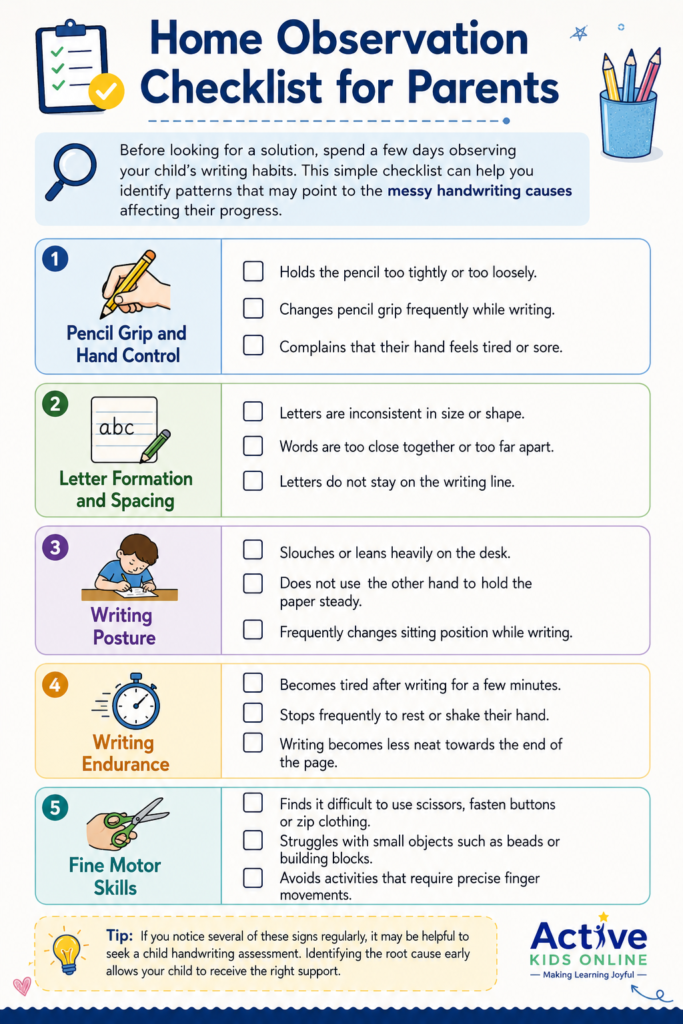
If you notice several of these signs regularly, it may be helpful to seek a child handwriting assessment. Identifying the root cause early allows your child to receive the right support before handwriting difficulties begin to affect their confidence and classroom performance.
When Handwriting Practice Helps and When It Doesn’t
Handwriting practice can be effective, but only when it addresses the right problem. If your child has good hand strength and motor coordination, but struggles with letter formation, spacing or writing posture, focused handwriting instruction can help improve neatness and consistency over time.
However, handwriting practice alone is unlikely to solve the problem if the underlying issue is weak fine motor development. A child who finds it difficult to control a pencil, experiences frequent writing fatigue or has poor hand strength may continue to struggle, no matter how much they practise.
The first step is understanding why your child is finding handwriting difficult. Once the root cause is identified, parents can choose the right support, whether that means improving handwriting habits, developing fine motor skills or combining both approaches.
Starting with the right strategy not only improves handwriting but also helps children feel more confident and enjoy writing instead of becoming frustrated by it.
When Parents Should Seek Structured Support
Every child develops handwriting skills at their own pace, so occasional untidy writing is usually nothing to worry about. However, if handwriting difficulties continue for several months despite regular practice and classroom support, it may be time to look a little deeper.
Consider seeking a child handwriting assessment if your child:
- Finds writing physically tiring or uncomfortable.
- Avoids homework or written activities whenever possible.
- Has handwriting that remains difficult to read for their age.
- Shows little improvement over time.
- Struggles with everyday fine motor tasks, such as fastening buttons or using scissors.
A structured assessment helps identify whether the challenge is related to handwriting habits, fine motor development or a combination of both. Once the root cause is understood, children can receive support that matches their individual learning needs instead of relying on trial and error.
Early support can make a significant difference. By addressing handwriting difficulties at the right time, parents can help their child build confidence, improve classroom performance and develop writing skills that support long-term academic success.
Conclusion
Understanding the messy handwriting causes is the first step towards helping your child become a more confident writer. While some children simply need guidance with handwriting habits, others require additional support to develop the fine motor skills that make writing easier and more comfortable.
Rather than assuming that more practice will solve every handwriting problem, take time to observe how your child writes, how they hold a pencil and whether writing causes discomfort or frustration. Identifying the root cause early allows you to choose the right support and helps prevent small handwriting difficulties from becoming bigger learning challenges.
At Active Kids Online, our Handwriting Improvement Programme begins with understanding each child’s individual needs. Instead of following a one-size-fits-all approach, we assess the underlying cause and provide structured guidance to help children build stronger writing skills with confidence.
If you’re looking for the right support for your child, explore our Handwriting Improvement Programme and discover how a personalised approach can make handwriting a more positive and enjoyable learning experience.
FAQs : Messy Handwriting Causes: Fine Motor Skills or Bad Habits?
Why is my child’s handwriting messy?
There are many possible messy handwriting causes, including inconsistent handwriting habits, weak fine motor development, poor pencil grip or immature motor coordination. The best way to find the right solution is to identify the root cause rather than focusing only on how the handwriting looks.
Can weak fine motor skills affect handwriting?
Yes. Fine motor skills help children control small hand and finger movements needed for writing. If these skills are still developing, children may struggle with pencil control, letter formation, hand strength and writing endurance, making handwriting appear untidy even when they are trying their best.
At what age should handwriting improve?
Handwriting develops gradually throughout the primary school years. While many children show noticeable improvement between the ages of 6 and 8, every child develops at their own pace. Progress depends on handwriting instruction, fine motor development and regular opportunities to write.
Does pencil grip matter?
Yes, but only if it affects comfort or control. An efficient pencil grip allows children to write with less effort and better control. If a child experiences pain, grips the pencil too tightly or struggles to form letters consistently, their pencil grip may need further assessment.
Should I worry about messy handwriting?
Occasional untidy handwriting is a normal part of learning. However, if handwriting difficulties continue for several months, affect schoolwork or cause frustration, it is worth exploring whether handwriting habits or fine motor development may be contributing to the problem.
Can handwriting improve naturally?
Yes. As children grow, their hand strength, coordination and motor control usually improve, which can lead to neater handwriting. However, some children benefit from structured support to develop the skills needed for confident and consistent writing.
How do I know if my child needs handwriting classes?
If your child continues to struggle despite regular classroom practice, experiences writing fatigue or avoids writing tasks, a child handwriting assessment can help identify the underlying cause. Understanding whether the difficulty is related to handwriting habits or fine motor development makes it easier to choose the right support.