
A child may know exactly what they want to say but still struggle to express it clearly.
They may speak too quickly, pronounce certain words incorrectly, use the same tone throughout a presentation, or become quiet when everyone is looking at them.
This is where elocution lessons can make a practical difference.
Elocution is not simply about speaking with a particular accent. It helps children understand how to use pronunciation, articulation, voice, pace, pauses and expression while speaking.
With regular practice, children can learn to communicate their ideas with greater clarity and control.
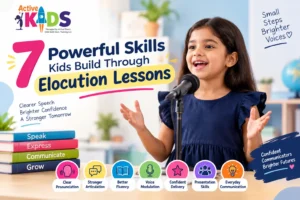
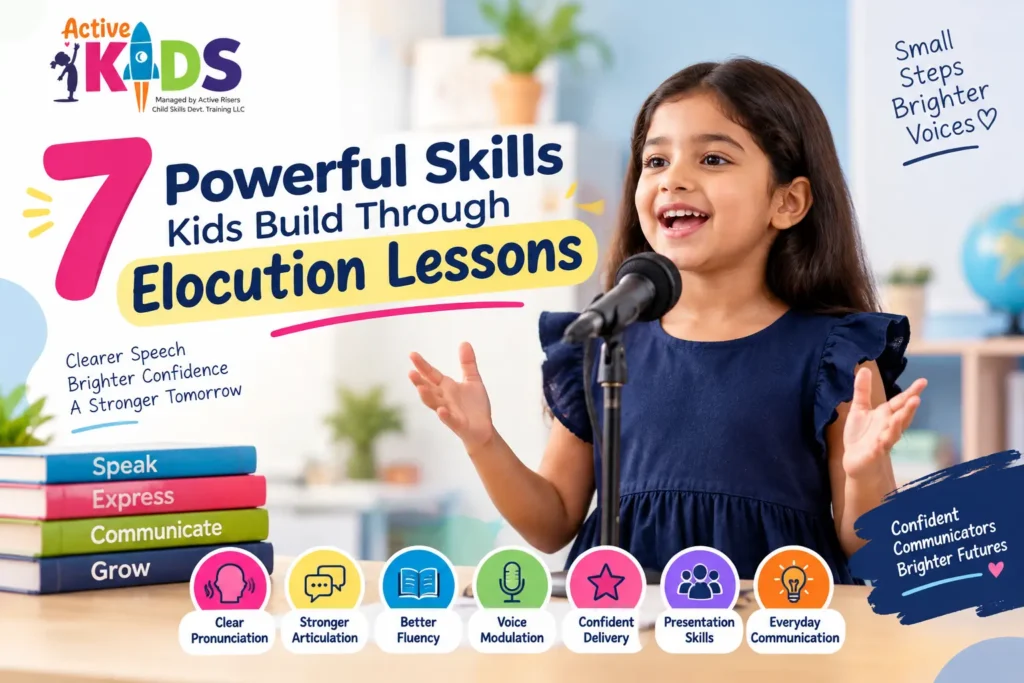
Here are seven important skills children can develop through well structured elocution lessons.
1. Clearer Pronunciation
Clear pronunciation is one of the first skills children practise in elocution.
A child may understand a word perfectly but still pronounce it unclearly. This can make their speech difficult to follow, especially when they are speaking in front of a group.
Elocution practice gives children opportunities to listen carefully to sounds and practise saying words correctly.
They may work on individual sounds, difficult words, sentence reading and short speaking exercises.
The goal is not to make every child sound the same.
The goal is to help children pronounce words clearly enough for listeners to understand them comfortably.
This skill can become particularly useful during:
- Classroom reading
- School presentations
- Poetry recitation
- Speeches
- Storytelling
- Elocution competitions
Parents looking for structured support can explore the Active Kids Elocution programme for more information about how communication and expressive speaking are developed.
2. Stronger Articulation
Pronunciation and articulation are closely connected, but they are not exactly the same.
Pronunciation focuses on producing words and sounds correctly.
Articulation focuses on how clearly those sounds are formed and connected when a child speaks.
For example, a child may know the correct pronunciation of a sentence but rush through it so quickly that several words become unclear.
Elocution exercises can encourage children to slow down and pay attention to how they form sounds.
They may practise words, phrases, sentences and short passages.
Repeated practice helps children become more aware of their speech.
This awareness is useful when they need to speak clearly in front of classmates, teachers or an audience.
It also supports everyday communication.
A child who learns to articulate ideas clearly has a better chance of being understood the first time they speak.
3. Better Speaking Fluency
Fluent speaking is more than speaking quickly.
Good fluency means being able to express an idea smoothly without unnecessary hesitation or rushing.
Children can develop this skill through activities such as reading aloud, storytelling, poetry recitation and prepared speaking.
They learn how to connect one thought to the next.
They also learn that a short pause can sometimes make speech clearer.
For example, compare these two approaches.
“Today I want to tell you about my favourite book because it has an interesting story and the main character…”
The child may rush through the entire sentence.
A more controlled delivery could sound like this.
“Today, I want to tell you about my favourite book. It has an interesting story, and the main character…”
The second version gives the listener time to follow the idea.
This is one reason speech elocution lessons often include repeated reading and speaking practice.
Children are not only learning what to say.
They are learning how to deliver it.
4. Voice Modulation and Expression
Imagine listening to a child read an exciting story.
Every sentence is spoken at exactly the same volume, speed and tone. The words may be correct, but the story can still feel flat.
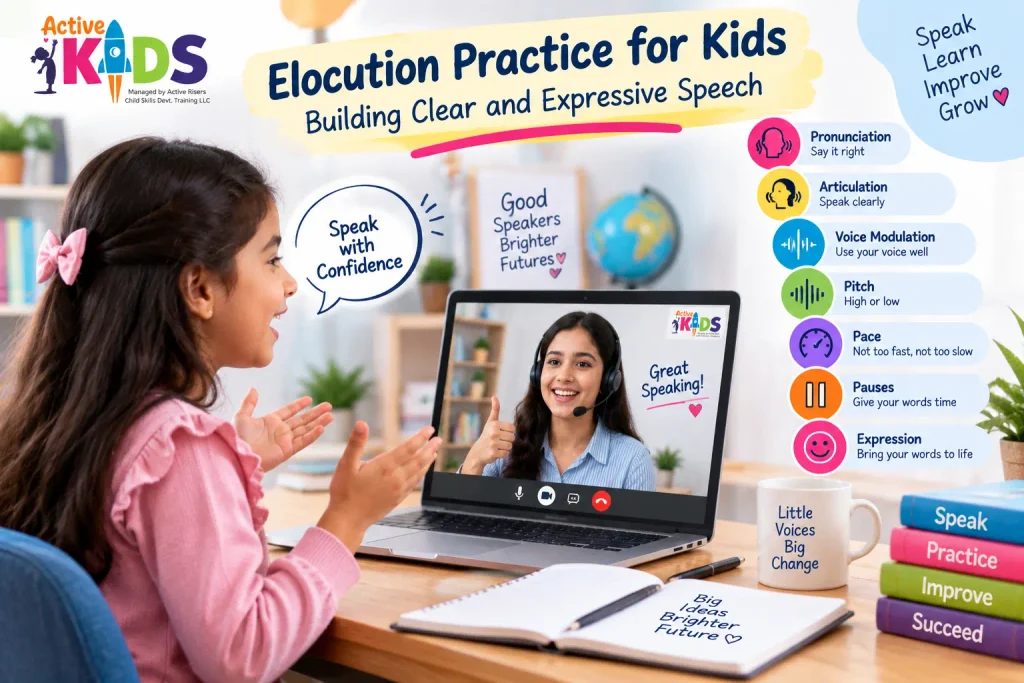
Voice modulation helps change that.
Children can learn to vary aspects of their voice depending on what they are communicating.
These can include:
- Pitch
- Pace
- Volume
- Pauses
- Stress
- Intonation
- Expression
For example, a question may require a different tone from a statement.
An exciting moment in a story may need more energy.
A serious sentence may require a slower and more controlled delivery.
This is where speech and elocution can overlap with performance skills.
Trinity College London’s Speech and Drama framework also places emphasis on presentation, communication, public speaking and bringing written material to life through performance.
You can explore Trinity College London’s Speech and Drama information to understand how these skills can be developed through structured performance work.
5. Confident Speech Delivery
Knowing what to say is only part of effective communication.
Children also need opportunities to practise saying it in front of other people.
This is where confidence can develop through repeated speaking practice.
A child who initially avoids reading aloud may gradually become more comfortable after practising in a supportive environment.
The process can be simple.
First, the child speaks to a teacher.
Then they may speak to a small group.
Later, they may deliver a prepared speech or presentation.
This gradual exposure gives children opportunities to practise without making every speaking situation feel overwhelming.
Confidence does not mean that a child will never feel nervous.
A confident speaker can still feel nervous.
The difference is that they have learned how to continue speaking despite those feelings.
Active Kids incorporates speaking practice, showcases and guided activities into its Speak & Shine programme, where children work on elocution, speech and drama, and debate skills.
6. Better Presentation and Public Speaking Skills
Elocution does not have to stay inside an elocution class. Children can use these skills in many school situations.
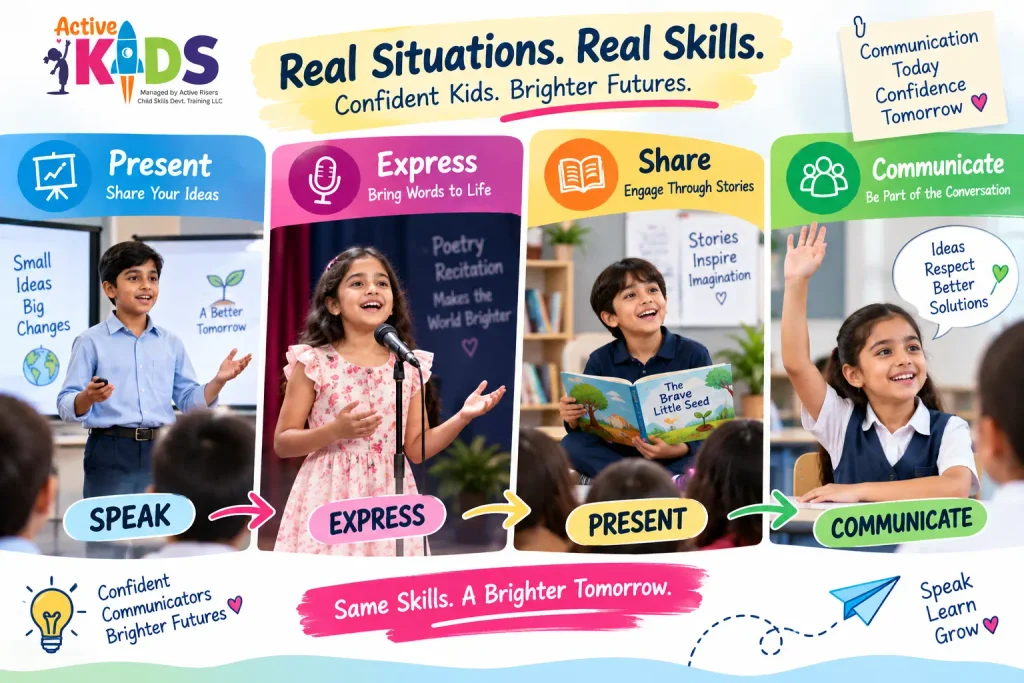
They may need to present a science project.
They may participate in a group discussion.
They may read a poem during an assembly.
They may take part in an elocution competition.
They may also need to explain an idea to their classmates.
These situations require more than memorising words. Children need to think about their speech delivery, voice, expression and audience.
That is why elocution can become a useful foundation for youth public speaking.
Trinity College London’s Speech and Drama syllabus includes presentation, communication and public speaking skills alongside practical performance work.
Parents can also explore Public Speaking Classes for Kids from Active Kids if they want to understand how these broader speaking skills connect with children’s communication development.
7. Stronger Everyday Communication
The final skill is perhaps the most practical.
Children do not communicate only during competitions or school presentations.
They communicate when asking questions.
They explain their opinions.
They speak with teachers.
They interact with friends.
They tell stories.
They participate in classroom discussions.
They communicate with family members.
Elocution practice can help children become more conscious of how they speak in these situations. They may begin to notice when they are speaking too quickly. They may learn to pause before answering.
They may become more comfortable expressing an opinion. They may also become more willing to participate in conversations. These skills connect naturally with broader communication development.
Active Kids combines elocution with speech and drama and debate through Speak & Shine, giving children opportunities to practise clear speech, expression, discussion and presentation.
What Are Elocution Lessons Actually Like for Kids?
Parents often search for what are elocution lessons because they want to know what their child will actually do during a class.
A good lesson should involve more than asking children to memorise a speech.
Depending on the child’s age and level, activities can include:
- Reading aloud
- Pronunciation practice
- Articulation exercises
- Poetry recitation
- Storytelling
- Speech delivery
- Voice exercises
- Expression practice
- Presentation activities
- Group speaking
- Performance practice
The exact activities can change according to the child’s needs.
You can also read our Mastering Elocution guide for kids for a broader explanation of speaking techniques and practical exercises.
What Should Parents Look For in Elocution Lessons?
Not every class will have the same approach.
Before choosing a programme, parents can look at several practical factors.
Age appropriate activities
Children should practise skills that match their age and communication level.
A five year old does not need the same activities as a fourteen year old.
Regular speaking practice
Children need opportunities to speak.
A class that focuses only on explanation gives limited opportunities for practical development.
Constructive feedback
Children need to know what they are doing well and what they can improve.
Feedback should be specific and encouraging.
A combination of skills
Strong elocution practice can include pronunciation, articulation, fluency, voice control and expression.
These skills work together.
Opportunities to perform
Children benefit from using their skills in practical situations.
Presentations, recitation, storytelling and showcases can provide useful speaking experience.
Active Kids describes its Speak & Shine curriculum as combining small group and individual lessons with practice, activities, feedback and showcases.
Can Elocution Lessons Online Work for Children?
Yes, online learning can provide a practical environment for speaking practice when sessions are interactive.
The important factor is not simply whether the class happens online. It is what the child actually does during the session.
Children should have opportunities to speak, receive feedback, practise again and participate with their teacher or classmates.
For families in the UAE, online elocution lessons can also make regular practice easier to fit around school and other activities.
Active Kids offers live online programmes for children and includes elocution within its Speak & Shine curriculum. The programme currently lists children from ages 5 to 14, with group and individual learning options.
Elocution and Speech Therapy Are Not the Same
This distinction is important for parents.
Elocution generally focuses on speaking skills such as pronunciation, articulation, expression, voice control and delivery.
Speech therapy addresses communication or speech related difficulties that may require assessment and intervention from a qualified speech language professional.
If a parent has concerns about a child’s speech development, persistent difficulty producing sounds, stammering or another communication concern, professional assessment may be appropriate.
Elocution should not be treated as a replacement for speech therapy.
For children who are developing normally but want to improve speaking clarity, expression and presentation skills, elocution can provide structured speaking practice.
How Elocution Skills Can Grow Over Time
The development of speaking skills is usually gradual. A child may begin by working on individual sounds. Then they may practise words and sentences. Later, they can work on reading fluency and expression.
With more practice, they can move into speeches, storytelling, presentations and public speaking.
The progression can look like this:
Pronunciation → Articulation → Fluency → Voice Control → Expression → Speech Delivery → Confidence
The important part is consistent practice.
Children do not need to become perfect speakers immediately.
They need opportunities to speak, listen, receive feedback and try again.
Final Thoughts
The value of elocution lessons goes beyond learning how to deliver a speech.
Children can develop clearer pronunciation. They can become more aware of how they form sounds. They can practise fluent and expressive speaking. They can learn how to use their voice more effectively.
Most importantly, they get regular opportunities to communicate their ideas. These skills can become useful during school presentations, storytelling, classroom discussions, poetry recitation and public speaking.
For parents, the goal should not be to make a child sound like someone else. The goal is to help the child communicate clearly, expressively and confidently in their own voice.
If you are looking for a structured programme that combines elocution with broader communication and public speaking practice, explore Active Kids Speak & Shine and book a free demo to understand whether the programme is suitable for your child.
FAQs: 7 Powerful Skills Kids Build Through Elocution Lessons
What are elocution lessons for children?
Elocution lessons help children practise clear pronunciation, articulation, fluent speaking, voice control, expression and speech delivery. Activities may include reading aloud, poetry, storytelling and prepared speeches.
At what age can children start elocution lessons?
The appropriate starting age depends on the child’s communication level and learning needs. Activities should be adapted to the child’s age. Active Kids offers communication and elocution related programmes for children across different age groups.
Can elocution lessons help with public speaking?
Elocution can provide useful foundations for public speaking by helping children practise pronunciation, articulation, fluency, expression and voice control. These skills can then be applied to presentations, speeches and other speaking situations.
Are elocution lessons online suitable for children?
Live online lessons can work well when children actively participate, practise speaking and receive regular feedback. The quality of interaction and teaching approach is more important than the delivery format alone.
What is the difference between elocution and public speaking?
Elocution focuses strongly on how a person speaks, including pronunciation, articulation, voice, pace and expression. Public speaking involves using these skills to communicate ideas to an audience through speeches, presentations, discussions and other formats.