
Introduction
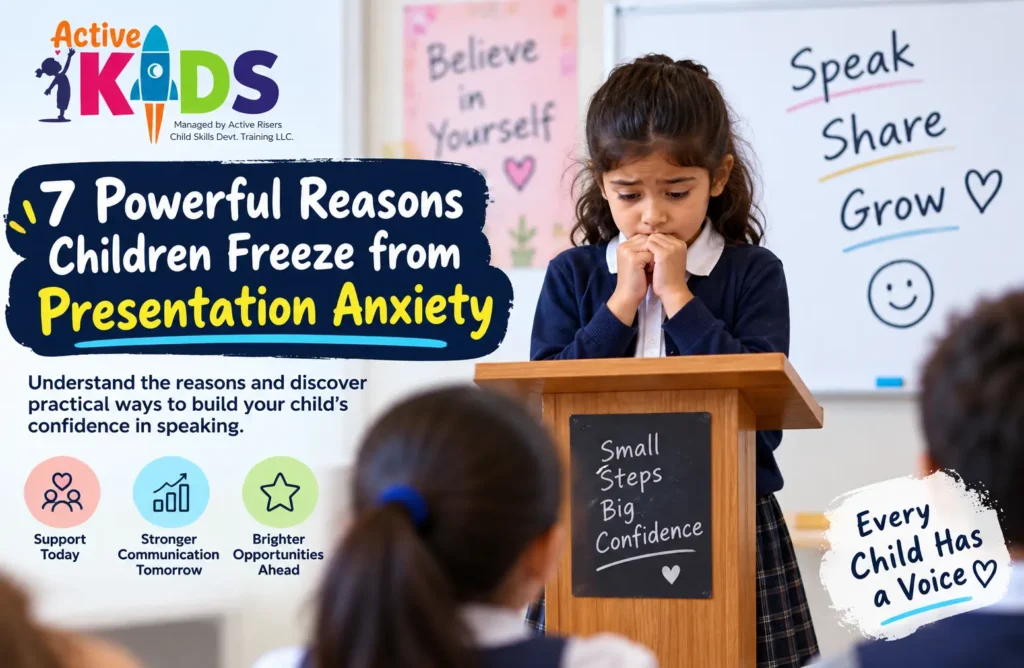
Your child may know the topic, practise at home, and still suddenly go blank when it is time to speak in front of the class. A child may forget the next sentence, stare at the floor, speak too quietly, rush through the presentation, or stop completely. This does not automatically mean the child lacks knowledge or preparation. Presentation anxiety can make it harder to retrieve and organise what a child already knows when attention shifts to being watched and evaluated.
School presentations combine several demands at once: remembering ideas, choosing words, using an appropriate voice, looking at an audience, managing nervousness, and responding to the teacher or classmates. For some children, that combination is enough to interrupt otherwise familiar speaking skills.
In this guide, we look at seven practical reasons children freeze during school presentations and what parents and teachers can do to make speaking practice more manageable. The focus is not on forcing a child to “perform”; it is on building reliable communication skills through repeated, low-pressure opportunities to speak.
Quick answer: Why does a child freeze during a school presentation?
A child can freeze when the demands of remembering, speaking, being watched, and managing nervousness become difficult to handle at the same moment. The child may still understand the subject but struggle to retrieve the next idea or put it into words. Shorter practice rounds, keyword prompts, realistic rehearsal, supportive feedback, and gradual exposure can make school presentations feel more predictable.
1. The child memorised every sentence
Full-script memorisation can feel safe because the child knows exactly what comes next. The problem is that one forgotten sentence can make the entire speech feel lost. If the child has memorised wording rather than the structure of the ideas, a small interruption can lead to a complete pause.
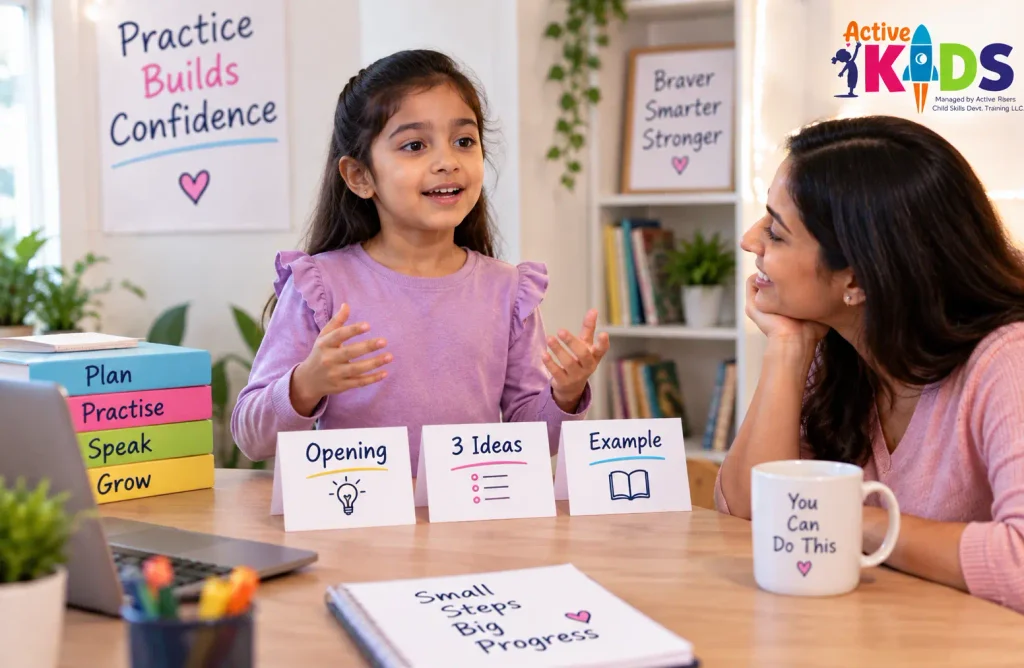
A better approach is to practise a simple sequence: opening idea, three key points, example, and conclusion. Use cue cards with keywords rather than paragraphs. This gives the child a recovery path if one sentence disappears.
This is also where communication practice connects with writing development. A child who struggles to organise ideas on paper may benefit from working on idea structure before being asked to deliver a long presentation. See our guide on helping a child who cannot express ideas in writing for a related perspective.
2. Being watched changes the task
Speaking alone in a bedroom is different from standing in front of twenty classmates. During a school presentation, the child has to think about the content while also noticing faces, eye contact, teacher reactions, posture, voice, and possible mistakes.
That extra attention can make a familiar task feel much harder. Children who are comfortable talking at home may therefore look very different in a classroom. If this pattern sounds familiar, our article on why a child talks at home but not at school can help parents examine the difference between comfortable conversation and classroom communication.
Parents should avoid turning every practice session into a test. A short explanation followed by a calm speaking attempt is usually more useful than repeated correction after every sentence.
3. The child has not practised retrieval
Reading the same speech five times is not the same as practising how to retrieve the next idea without the page. A child may recognise every sentence while reading but still struggle when the paper is removed.
Retrieval practice can be simple. Ask the child to look at three keywords and explain the idea in their own words. Then change the order of the prompts. Ask one short follow-up question. Finally, practise beginning again from the middle rather than always starting from the first sentence.
This approach also develops speaking confidence because the child learns that forgetting one phrase does not mean the whole presentation has failed.
4. The presentation is too demanding for the child’s current speaking skills
Sometimes the issue is not fear alone. The child may be trying to manage vocabulary, sentence formation, pronunciation, ideas, timing, and audience interaction all at once. If the task is above the child’s current communication level, a freeze can be the visible result.
Parents can reduce the load without reducing the learning goal. Shorten the speech, simplify the structure, introduce useful vocabulary earlier, or allow a visual prompt. Regular language and communication activities can also strengthen the foundation underneath school presentations.
Research from the Education Endowment Foundation reports that oral language approaches have an average impact equivalent to six months of additional progress, with spoken interaction, vocabulary, developing ideas, and speaking and listening among the areas addressed. The evidence is about oral-language approaches broadly, not a guarantee that any single speaking course will produce the same result. EEF oral language evidence
5. The child has had a difficult speaking experience before
A child who once forgot an answer, heard laughter, received harsh correction, or felt embarrassed during a presentation may start anticipating the same outcome. That expectation can increase nervousness before the next presentation even begins.
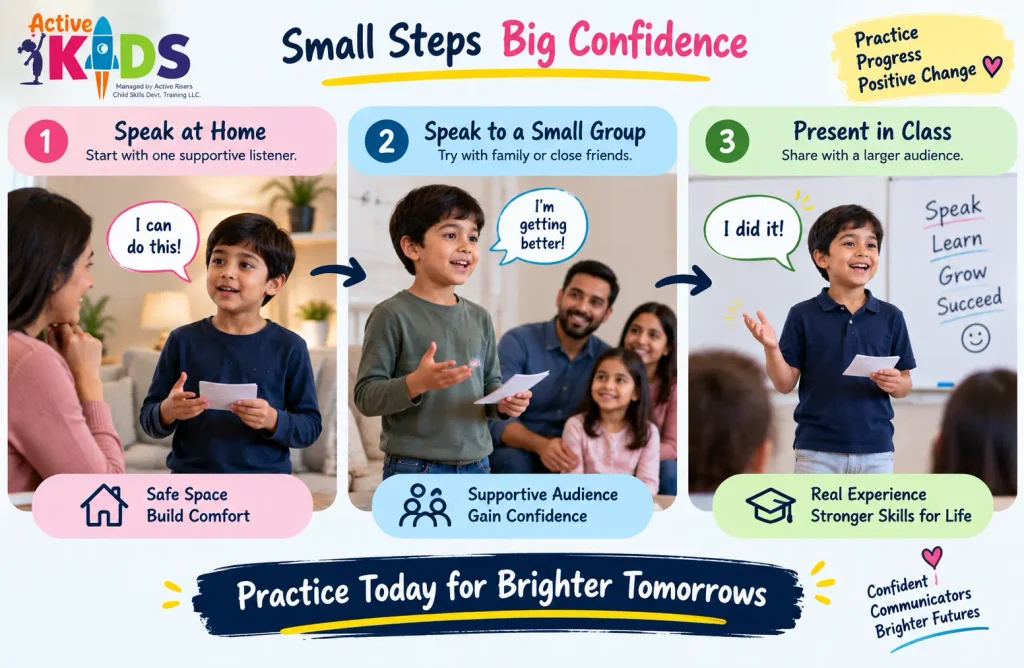
The useful response is not to repeatedly discuss the previous mistake. Instead, create smaller successful speaking experiences. Start with one-minute explanations, then a short presentation to a parent, then two family members, then a familiar peer group, and eventually a classroom-style rehearsal.
For parents looking specifically at shyness and confidence, our guide to building confidence in a shy child covers gradual encouragement and low-pressure speaking opportunities.
6. The child is expected to speak without enough structure
“Go and present” is a large instruction for a child who is still learning how to organise a talk. A clear framework reduces the number of decisions the child has to make while speaking.
A useful school-presentation structure is: introduce the topic, explain three ideas, give one example, and finish with one takeaway. Put one or two keywords under each part. This creates a visible map for the child.
Teachers can also agree on a discreet recovery cue. If the child pauses, the teacher can point to the next keyword or ask a neutral prompt such as, “What was your next point?” A calm recovery is more useful than drawing attention to the pause.
7. Speaking practice has been too rare or too high-pressure
Confidence usually grows from repeated experience, not from one large rehearsal the night before a presentation. If most speaking practice happens only when marks are involved, the child may associate speaking with evaluation rather than communication.
Regular low-stakes activities can change that pattern. Children can explain a favourite book, describe how something works, record a short podcast, retell a story, give a two-minute opinion, or explain a project to a family member.
Our student podcast communication skills resource is relevant here because podcast-style practice gives children a reason to organise ideas, speak clearly, and listen back to their own communication. For broader practice, see our guide to public speaking for kids and our article on 7 powerful skills kids build through elocution lessons.
What should parents do when a child freezes?
First, give the child a moment. Avoid filling every second of silence with corrections. A calm pause can allow the child to find the next idea.
Second, use a prompt rather than supplying the whole answer. Ask, “What was your first point?” or let the child look at a keyword card.
Third, discuss the experience after the presentation rather than immediately criticising performance. Ask what part felt easy, where the child got stuck, and what support would make the next attempt easier.
Fourth, separate the child’s knowledge from the speaking performance. A child can understand a subject and still need more practice with public speaking skills, presentation structure, or classroom confidence.
If your child repeatedly struggles to speak up in class, our article on why a child struggles to speak up can help you look at the broader pattern rather than focusing only on one presentation.
What can teachers do when a child freezes?
Teachers can make presentation routines predictable. Give clear instructions, allow keyword cards where appropriate, provide practice opportunities before assessment, and avoid making an unexpected freeze into a public discussion.
Where possible, allow the child to rehearse in stages. The first attempt might be with a partner, followed by a small group, then the full class. The goal is not to remove every nervous feeling; it is to help the child learn that speaking can continue even when some nervousness is present.
Communication skills also improve when speaking is integrated into ordinary learning. The EEF notes that oral-language approaches are strongest when integrated with the existing curriculum and purposeful classroom interaction. EEF communication and language evidence
When should parents consider structured support?
If a child occasionally freezes during a presentation but speaks comfortably in other situations, ordinary practice and supportive preparation may be enough. If the difficulty is frequent, affects classroom participation across subjects, or appears alongside broader communication difficulties, it is reasonable to discuss the pattern with the child’s teacher and consider appropriate professional guidance.
Structured communication programmes can provide regular opportunities for children to practise speaking, listening, presentation skills, vocabulary, and confidence in a supported setting. For families exploring options, Active Kids Online offers public speaking courses for children aged 9–14, ways to improve public speaking skills for children, and ways to improve English speaking skills for kids.
For school-wide development, our School Programmes provide a route for communication and speaking activities to be integrated into a school environment rather than relying only on home practice.
How to measure progress without comparing children
Progress should not be measured only by whether a child delivers a perfect presentation. Look for smaller indicators: starting without a long delay, using a keyword card independently, speaking at an audible volume, completing a three-point structure, recovering after forgetting a sentence, answering one follow-up question, or speaking to a slightly larger audience.
Our guide on measuring speaking progress without comparison explains why individual progress markers are more useful than comparing one child with another.
Assessment can also reveal whether the challenge is mainly presentation confidence or whether language, writing, pronunciation, or another communication skill needs attention. Our writing assessment insights for teachers and phonics assessment at home resources can support parents who want to understand different parts of a child’s language development.
A simple practice plan before the next school presentation
A useful routine is to practise for 10–15 minutes rather than repeating a full speech for an hour. Start with speech preparation: choose three ideas, write one keyword for each, and explain each idea aloud in the child’s own words. This builds speaking practice without making the rehearsal feel like another test.
Next, create a small audience. Move from one parent to two family members, then to a familiar friend or small group. This gradual exposure can support presentation confidence and classroom confidence because the child experiences the same communication task at increasing levels of visibility. If presentation anxiety appears, pause, use a keyword prompt, and restart from the next idea rather than returning to the beginning.
During the final rehearsal, practise public speaking skills rather than perfect wording. Check voice, pace, eye contact, posture, audience awareness, and the ability to answer one simple question. The aim is flexible communication, not flawless memorisation.
After the rehearsal, record one improvement: clearer voice, stronger structure, better retrieval, calmer speaking, or faster recovery after a pause. This gives the child a concrete measure of progress and keeps speaking confidence connected to practice rather than comparison.
For children who experience presentation anxiety, the most useful routine is usually predictable, short, and repeatable. Consistent speaking practice gives the child more opportunities to use communication skills in a realistic setting and reduces the feeling that every school presentation is a completely new event.
A strong routine can combine classroom communication, public speaking, speech preparation, retrieval practice, presentation confidence, speaking confidence, and language skills in one short session. This helps children practise the complete communication process instead of treating each school presentation as an isolated event.
Keep the final rehearsal focused on audience awareness and speaking skills: one clear opening, three organised ideas, a confident voice, and a simple recovery strategy if the child loses the next point.
Short, repeated speaking practice also reinforces classroom communication and spoken language. These routines can include speech preparation, public speaking skills, and audience awareness without turning every activity into a graded performance.
Conclusion
A child who freezes during a school presentation does not necessarily lack knowledge, intelligence, or preparation. The presentation may simply demand more retrieval, organisation, speaking, audience awareness, and emotional control than the child can comfortably manage at that moment.
The most useful response is usually practical: simplify the structure, practise retrieval instead of only repetition, use keyword prompts, rehearse in realistic but low-pressure stages, and measure progress against the child’s own previous performance.
Over time, these small speaking experiences can help children become more comfortable expressing ideas in class and in front of an audience. If your school is looking for a structured way to develop communication and public speaking skills, explore the Active Kids School Programmes.
With the right preparation, presentation anxiety can become a manageable part of learning to speak in front of others.
FAQ: Children freezing during school presentations
Why does my child freeze during a school presentation?
A child may freeze when remembering information, speaking, managing nervousness, and being watched all happen at once. The child may know the subject but struggle to retrieve the next idea. Shorter rehearsals, keyword prompts, and gradual classroom-style practice can help.
Why does my child forget what to say during a presentation?
Full-script memorisation can make one forgotten sentence feel like the whole speech has disappeared. Practising ideas with keywords and changing the order of practice questions can help children retrieve information more flexibly.
Why does my child know the answer but freeze when speaking?
Knowing an answer privately and explaining it aloud are different communication tasks. A child may need more practice turning ideas into spoken language while managing an audience and classroom expectations.
How can I help my child recover after freezing?
Stay calm, give a short pause, and use a keyword or gentle prompt. Practise recovery phrases such as “My next point is…” so the child has a simple way to restart without beginning the entire presentation again.
Should children memorise their entire presentation?
Not necessarily. Memorising key ideas and practising the structure can be more flexible than memorising every sentence. Cue cards with short keywords can provide a useful reminder while still requiring the child to speak in their own words.
How can teachers support a child who freezes?
Teachers can make the routine predictable, permit appropriate cue cards, provide low-stakes rehearsal, use discreet prompts, and avoid turning a pause into a public correction. Gradual practice with partners, small groups, and the full class can make the task more manageable.
Can speaking practice improve presentation confidence?
Regular, purposeful speaking practice can build familiarity with organising ideas, using voice, answering questions, and speaking to different audiences. The EEF evidence on oral-language approaches supports structured spoken interaction as part of learning, although it does not prove that every individual child will respond in the same way.
When should parents seek additional support?
Consider discussing the issue with a teacher or appropriate professional if freezing is frequent, affects participation across settings, or occurs alongside wider communication difficulties. The goal is to understand the child’s needs rather than label a single presentation reaction.