
A child can have excellent ideas but still struggle to explain them clearly in front of a class.
Developing public speaking skills for children takes more than asking them to “speak louder” or memorise a speech. Children need regular opportunities to organise their thoughts, practise delivery, handle nervousness, and communicate with an audience.
The good news is that these abilities can be developed gradually.
With the right activities and consistent speech practice, parents and educators can help children become more comfortable expressing themselves in classrooms, presentations, group discussions, and everyday conversations.
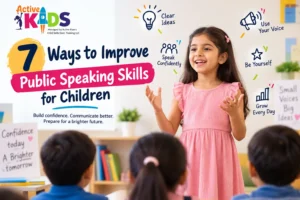
Here are seven practical ways to improve speaking skills in children.
1. Start With Short Speaking Exercises
Long presentations can feel overwhelming when a child is still developing confidence.
Start with short speaking exercises instead.
Ask your child to speak for 30 seconds about a familiar topic:
- Their favourite book
- A favourite sport
- A family trip
- A pet
- A hobby
- Something they learned at school
Once 30 seconds feels comfortable, increase the time to one minute and eventually two or three minutes.
The purpose is not to create a perfect speech.
It is to make speaking in front of another person feel normal.
Short, repeated speech practice can gradually improve both fluency and speaking confidence.
For parents who want to understand why children sometimes avoid speaking, our guide on public speaking skills for children: 7 signs provides a useful starting point.
2. Teach Children to Organise Their Ideas
A child may know what they want to say but still struggle to put their thoughts in the right order.
This can make presentations sound confusing even when the child understands the subject.
Teach a simple structure:
Introduction → Main points → Example → Conclusion
For younger children, an even simpler framework can work:
What? → Why? → Example?
For example, if the child is talking about their favourite animal:
What?
“My favourite animal is a dolphin.”
Why?
“I like dolphins because they are intelligent and playful.”
Example?
“I learned that dolphins communicate using different sounds.”
This type of structure gives children a mental roadmap.
It also helps them develop presentation skills that can transfer to school projects and classroom discussions.
If your child also struggles to organise ideas in writing, our article on when a child cannot express ideas in writing explores a related communication challenge.
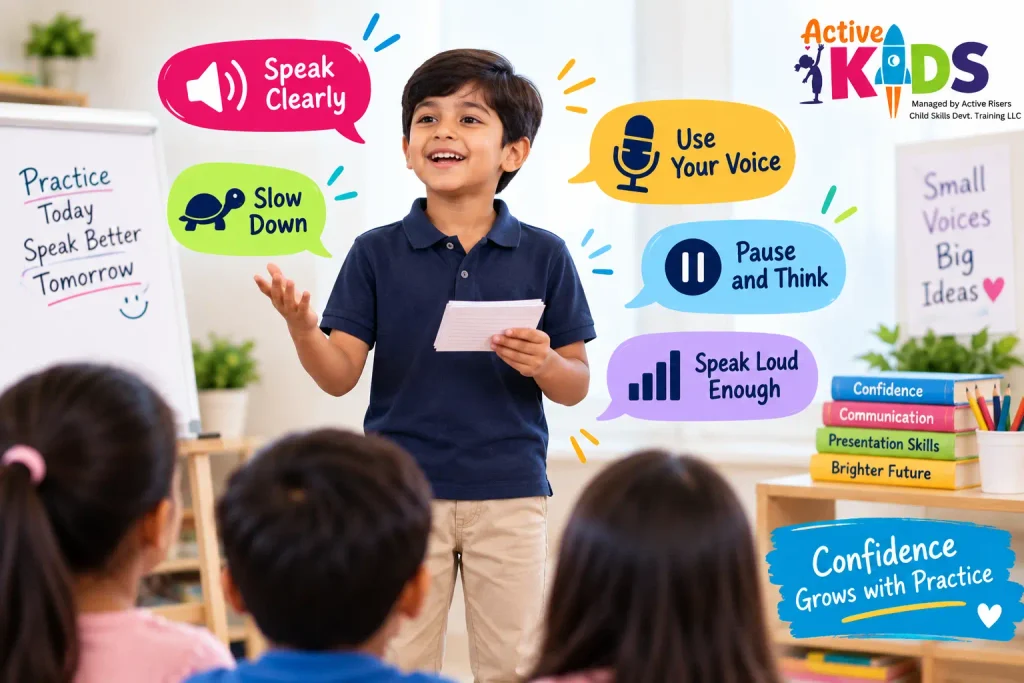
3. Practise Voice and Pace
Good speaking is not only about choosing the right words.
How children use their voice matters too.
Children who feel nervous may:
- Speak too quietly
- Speak too quickly
- Speak in a monotone
- Stop frequently
- Repeat words
- Lose their breath while talking
Give your child simple voice exercises.
Ask them to say the same sentence at different volumes and speeds.
For example:
“Today I am going to tell you about my favourite animal.”
Have them practise saying it:
- Too quietly
- Too loudly
- Too quickly
- Then at a comfortable volume and pace
The objective is not dramatic performance.
It is learning how to adjust the voice so an audience can comfortably hear and understand the message.
The UAE Ministry of Education’s EmSAT speaking-skills specification includes the ability to speak audibly and clearly express ideas, feelings, and opinions among its communication-skill indicators.
4. Use Storytelling to Build Natural Speaking Skills
Storytelling is one of the most useful ways to develop public speaking for kids because it gives children something meaningful to communicate.
Instead of asking them to memorise a speech, ask them to tell a story.
Use a simple structure:
Beginning → Problem → Events → Ending
You can begin with familiar experiences:
- “Tell me about your best school day.”
- “What happened on your last family trip?”
- “Tell me a story about your favourite character.”
- “What would happen if you could fly?”
Storytelling encourages children to think about sequence, vocabulary, expression, and audience understanding.
It also gives them repeated opportunities to practise without every activity feeling like a formal presentation.
For another perspective on how structured speaking activities can support children, see 7 powerful skills kids build through elocution lessons.
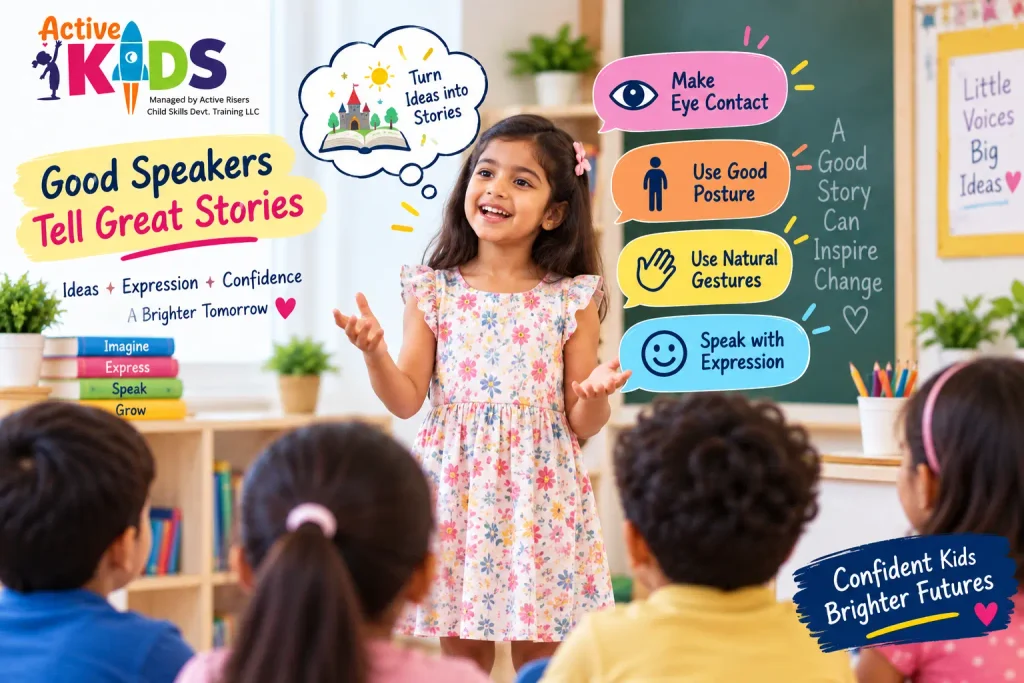
5. Teach Body Language Gradually
Children do not need to become professional performers.
But basic body language can make communication clearer.
Teach a few simple habits:
Face the Audience
Encourage your child to face the people they are speaking to rather than turning toward the floor or their notes.
Stand Comfortably
A relaxed posture is easier to maintain than a rigid one.
Use Natural Gestures
Hands can help emphasise important points, but children do not need to choreograph every movement.
Look Up Regularly
Instead of demanding constant eye contact, encourage children to look toward different parts of the audience naturally.
These small behaviours can make presentations feel more confident without forcing a child to act like someone else.
Parents can also read our guide on building shy child confidence for strategies specifically focused on hesitant speakers.
6. Increase the Audience Gradually
One of the biggest mistakes parents can make is jumping from home practice straight to a large audience.
A child who is comfortable speaking to one parent may not immediately feel comfortable speaking to twenty classmates.
Build the experience gradually.
Stage 1: One Parent
The child gives a short presentation to one parent.
Stage 2: Two Family Members
Add another listener.
Stage 3: Small Group
Invite a sibling or friend.
Stage 4: Larger Group
Increase the audience when the child is ready.
This approach allows children to experience small successes before facing more challenging situations.
It can also help reduce speaking anxiety because the child becomes familiar with the experience of being listened to.
If you’re exploring structured options, public speaking classes for kids can provide a more consistent environment for practising these skills.
7. Give Children Real Opportunities to Speak
Practice is useful, but children also need authentic opportunities to communicate.
Ask your child to:
- Explain a game to another child
- Tell a family member about a school project
- Ask a teacher a question
- Introduce themselves to someone new
- Explain how to complete a simple task
- Share an opinion during a family discussion
- Present something they have created
These situations help children understand that speaking is not only something they do during a school presentation.
It is a practical everyday skill.
The Education Endowment Foundation’s review of oral language interventions highlights the importance of spoken language and verbal interaction in learning. Its evidence base includes approaches such as structured questioning, purposeful dialogue, vocabulary development, and opportunities for pupils to develop ideas through interaction.
Why Public Speaking Should Be Practised at School Too
Parents can do a great deal at home, but schools provide something different: a real group environment.
Children need opportunities to communicate with teachers and peers, respond to questions, participate in discussions, and present ideas to an audience beyond their immediate family.
The UAE’s current National Education Charter identifies effective communication as one of the future skills to be embedded across the education system, alongside critical thinking, creativity, reading and writing, and other skills.
This makes communication development relevant not only to public speaking competitions but to broader learning and participation.
For schools looking to provide structured development opportunities, Active Kids School Programmes is the primary page to explore.
How Parents Can Make Speech Practice Enjoyable
Children are more likely to practise consistently when the activity feels achievable.
Instead of announcing:
“We are going to practise public speaking.”
Try turning the activity into a challenge.
The One-Minute Challenge
Give your child one minute to explain a topic without stopping.
The News Presenter Game
Ask your child to present a fictional news story.
The Teacher Game
Let your child teach you something they know.
The Story Challenge
Give them three random words and ask them to create a story using all three.
The Product Pitch
Ask them to convince you to buy a toy, book, game, or imaginary invention.
These activities make speaking practice less formal while still developing communication abilities.
What If Your Child Is Very Shy?
A shy child may need more gradual exposure.
Do not interpret quietness as a lack of ability.
Some children simply need more time before speaking in unfamiliar situations.
Start with subjects they enjoy and audiences they trust.
If your child consistently avoids speaking, becomes extremely nervous before presentations, or wants to participate but cannot overcome the hesitation, additional structured support may be useful.
Our article on public speaking for kids provides a broader parent-focused guide to developing these abilities.
You can also read how to choose a public speaking course for kids before selecting a programme.
How to Know If Your Child Is Improving
Improvement does not always mean your child suddenly becomes highly confident.
Look for smaller changes.
Your child may:
- Speak more audibly
- Take fewer long pauses
- Volunteer answers more often
- Explain ideas more clearly
- Make better eye contact
- Organise presentations more effectively
- Recover more easily after forgetting something
- Become more willing to practise
These are meaningful indicators of developing speaking confidence.
The goal is progress, not perfection.
Public Speaking and Communication Go Beyond Speeches
The benefits of stronger speaking skills can extend beyond formal presentations.
Children use communication when they:
- Work in groups
- Explain their thinking
- Ask for help
- Participate in class
- Tell stories
- Give opinions
- Solve problems collaboratively
- Talk to teachers
- Introduce themselves
For this reason, public speaking should be viewed as part of broader communication skills, rather than an isolated performance activity.
The student podcast on communication skills is one example of how children can use authentic formats to develop communication and speaking experience.
Speaking and Writing Skills Are Connected
Children communicate through more than one medium.
A child who struggles to organise an explanation verbally may also need support organising ideas in writing. Likewise, developing vocabulary and the ability to structure thoughts can support both forms of communication.
Parents can explore writing assessment for children: 5 teacher insights to understand how educators can identify areas where a child may need additional support.
Developing speaking, listening, reading, and writing together gives children a stronger overall communication foundation.
What About Older Children?
The type of speaking practice should evolve as children grow.
Older children may be ready for:
- Formal presentations
- Debates
- Persuasive speaking
- Group discussions
- Structured speeches
- Interviews
- Leadership activities
For children aged 9–14, parents can explore the public speaking course for kids aged 9–14 for an age-specific learning option.
For children who prefer online learning, the Speak & Shine online course is another option to consider.
A Simple Weekly Speaking Routine
Parents can introduce a short routine without turning it into another school assignment.
Monday — Conversation
Ask your child to explain something they learned.
Wednesday — One-Minute Talk
Give them a familiar topic and one minute to speak.
Friday — Storytelling
Ask them to create or retell a short story.
Weekend — Family Presentation
Let them present something they enjoy to the family.
This requires only a few minutes at a time but creates consistent opportunities for speech practice.
Over several weeks, children can become more familiar with organising thoughts, using their voice, and speaking to an audience.
When a School Programme Can Help
Home practice is valuable, but a structured school programme can provide a different learning environment.
Children can practise with peers, receive guided feedback, participate in group activities, and apply speaking skills in situations that resemble real classroom communication.
For schools and parents looking for a structured environment where these skills can be developed, Active Kids School Programmes should be the primary next step.
The Active Kids provides an overview of the wider programmes and learning resources.
Final Thoughts
Improving public speaking skills for children is not about turning every child into a performer.
It is about giving children the ability to communicate their ideas clearly and comfortably.
Start with short conversations. Use storytelling and role play. Teach children how to organise their ideas. Practise voice, pace, and simple body language. Gradually increase the audience and create opportunities for real-world communication.
Most importantly, keep the experience supportive.
A child who once hesitated to answer a question may eventually volunteer an idea, present a project, lead a discussion, or speak confidently in front of classmates.
Those changes happen through repeated opportunities to practise.
For schools interested in making communication development part of the learning environment, Active Kids School Programmes is the recommended place to explore the available school-based options.
FAQs:7 Ways to Improve Public Speaking Skills for Children
How can I help my child develop public speaking skills?
You can help your child develop public speaking skills through short speaking exercises, storytelling, voice practice, and gradual exposure to different audiences. Start with familiar topics for about 30 seconds, then gradually increase the speaking time and audience size. Regular practice helps children become more comfortable organising ideas and communicating clearly.
What are the most important public speaking skills for children?
The most important public speaking skills for children include clear speech, organised ideas, voice control, storytelling, body language, audience awareness, and speaking confidence. Children can develop these skills through repeated speaking practice, presentations, conversations, and interactive activities.
How can kids practise public speaking at home?
Kids can practise public speaking at home through one-minute talks, storytelling, role-play, family presentations, and activities such as pretending to be a teacher or news presenter. Parents can also ask children to explain something they learned, describe a favourite topic, or present something they have created.
What activities improve public speaking for kids?
Storytelling, short speaking exercises, role-playing, picture descriptions, one-minute challenges, product pitches, and family presentations can improve public speaking for kids. These activities give children opportunities to practise organising ideas, using their voice, expressing themselves, and speaking to an audience. The supplied UAE research also identifies storytelling, role-playing, and picture descriptions as common interactive activities in children’s communication programmes.
How can I help my child overcome fear of public speaking?
Help your child overcome fear of public speaking by increasing the audience gradually. Start with one trusted parent, then add another family member, a sibling or friend, and eventually a larger group. This gradual approach gives children opportunities to experience small successes before facing more challenging speaking situations.
What is the best age for children to learn public speaking?
There is no single age at which children must start learning public speaking. Younger children can begin with simple conversations, storytelling, and short speaking exercises, while older children can progress to formal presentations, debates, persuasive speaking, interviews, and structured speeches.
How does storytelling improve public speaking skills in children?
Storytelling helps children practise sequencing, vocabulary, expression, idea organisation, and audience awareness. Using a simple structure such as beginning → problem → events → ending gives children a mental framework for communicating ideas without relying entirely on memorised speeches.